Latest News
Winter 2026 | Updates and resources to support inclusive education and post-school success for students with disabilities.
Winter Newsletter
January 28, 2026
As we move through the winter months, the team at the Center for Change in Transition Services is grateful for the ongoing work you do to support students with disabilities as they prepare for life after high school. This season offers an important opportunity to pause, examine data, and refocus our efforts on practices that lead to meaningful and equitable post-school outcomes.
A key feature of this Winter 2026 issue is the release of the latest Post-School Outcome (PSO) data, which provide critical insight into how students with disabilities are engaging in education and employment one year after exiting high school. These data allow districts and schools to identify progress, examine disparities, and reflect on how inclusive transition planning practices are influencing post-school outcomes across the state.
In this edition of CCTS News and Updates, you’ll find highlights from the 2025 Post-School Survey (2023–24 leaver year), along with updated guidance and training resources that support inclusive transition planning and data-informed practice.
Thank you for your continued partnership in advancing equitable post-school outcomes for students with disabilities across Washington state.
Warmly,
The CCTS Team
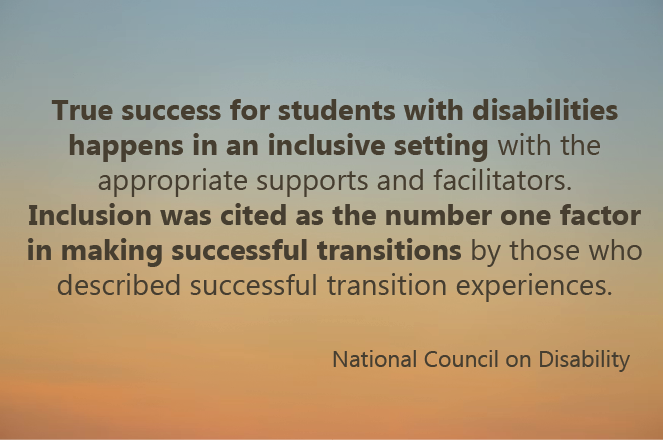
“True success for students with disabilities happens in an inclusive setting with the appropriate supports and facilitators. Inclusion was cited as the number one factor in making successful transitions by those who described successful transition experiences.” - National Council on Disability, 1995
New Post-School Outcome (PSO) Data
Data from the 2025 Post-School Survey (2023-24 leaver year) are now available
Post-School Outcome (PSO) data provide insights into education and employment activities for students who received special education services while in high school.
To gather PSO data from all former students who were receiving special education services at the time they exited high school, school districts conduct the annual Post-School Survey. Based on their survey responses, former students are categorized as Engaged or Not Engaged in Higher Education, Competitive Employment, Other Education, or Other Employment.
The 2025 Post-School Survey was conducted with former students one year after they permanently exited high school and who were receiving special education services at the time of exit. From June 1–November 1, 2025, survey responses were recorded for 75.93% of the 8,585 eligible former students from the 2023–24 academic year.
How to access PSO data reports and presentations
- For Washington state, ESD, and county-level data, visit the Post-School Outcome Data page on the CCTS website.
- For district-level data:
- You must be a school or district representative with an active user account in the TSF2, CCTS’s secure online data collection and reporting platform.
- If you do not have an account, contact your district’s data manager or email CCTS@seattleu.edu.
Explore Post-School Outcome (PSO) Data
To learn more about post-school outcomes by county, ESD, or demographic categories (exit status, gender, disability, race/ethnicity, language proficiency), visit the Post-School Outcome Data page on the CCTS website.
Big Picture Takeaways: 2025 Post-School Outcome Data
Comparing Post-School Outcomes for all Special Education Leavers, 2022–23 to 2023–24
Results from the 2025 census survey (2023-24 academic year) show the following changes from youth who left in the 2022–23 academic year:
| Post-School Outcomes | 2022–23 | 2023–24 | Percentage Point Change | Percent Change |
|---|---|---|---|---|
| Overall Engagement | 69.00% | 71.30% | 2.30 | 3.33% |
| Higher Education | 18.11% | 20.86% | 2.75 | 15.18% |
| Competitive Employment | 31.82% | 26.29% | -5.53 | -17.38% |
| Other Education | 4.25% | 5.51% | 1.26 | 29.65% |
| Other Employment | 14.81% |
18.64% |
3.83 | 25.86% |
| No Engagement | 31.00% | 28.70% | -2.30 | -7.72% |
Comparing Overall Engagement for IPTN Aim Populations, 2022–23 to 2023–24
The goals of the Inclusionary Practices Technical Assistance Network include improving outcomes for Black students with disabilities and students with intellectual disabilities. CCTS recommends that districts review their data by race/ethnicity and disability categories to examine outcomes for these populations. Results from the 2025 Post-School Survey show the following changes for Black/African American leavers and leavers with Intellectual Disabilities in Washington state over the last two years:
| Overall Engagement | 2022–23 | 2023–24 | Percentage Point Change | Percent Change |
|---|---|---|---|---|
| Black/African American Leavers | 69.43% | 68.31% | -1.12 | -1.61% |
| Leavers with Intellectual Disabilities | 43.90% | 40.39% | -3.51 | -8.00% |
CCTS. (2026, January). Indicator B14 Post-School Outcome Report, Washington state, 2023-24.
Summary
For all Washington state special education leavers:
- Overall Engagement increased by 2.30 percentage points, or 3.33%.
- Higher Education increased by 2.75 percentage points, or 15.18%.
- Competitive Employment decreased by 5.53 percentage points, or 17.38%.
- Other Education increased by 1.26 percentage points, or 29.65%.
- Other Employment increased by 3.83 percentage points, or 25.86%.
- Non-Engagement decreased by 2.30 percentage points, or 7.42%.
For IPTN aim populations in Washington state:
- Overall Engagement for Black/African American leavers decreased by 1.12 percentage points, or 1.61%.
- Overall Engagement for leavers with Intellectual Disabilities decreased by 3.51 percentage points, or 8.00%.
To learn more about post-school outcomes by county, ESD, or demographic categories (exit status, gender, disability, race/ethnicity, language proficiency), visit the Post-School Outcome Data page on the CCTS website.
Updated Resource: Effective Transition Plans and Services
CCTS recorded presentation (45 minutes)
Developed for Washington state educators, this presentation addresses connections between post-school outcomes and IEP transition planning, components of IEP transition planning, aligning High School and Beyond Plans with IEP transition plans, and additional resources for transition planning.
- Introduction (00:00–03:37)
- IEP Transition Planning and Post-School Outcomes (03:37–07:18)
- PSO Data for Black/African American Leavers (07:18–12:39)
- PSO Data for Leavers with Intellectual Disabilities (12:39–18:12)
- Interrelationship of IDEA Indicators (18:12–19:56)
- Components of Inclusive IEP Transition Planning (19:56–21:37)
- Age-Appropriate Transition Assessments (21:37–24:58)
- Measurable Postsecondary Goals (24:58–30:10)
- Transition Services (30:10–33:59)
- Course of Study (33:59–35:18)
- Annual Goals (35:18–35:56)
- Agency Connections (35:56–38:03)
- Student-Centered Transition Team (38:03–39:19)
- High School and Beyond Plan (39:19–42:04)
- Resources from CCTS and OSPI (42:04-44:21)
- Wrap up (44:21-45:07)
View CCTS Presentation Library
Recordings and slide decks from CCTS presentations centering on secondary transition planning strategies and tools for students with Individual Education Programs (IEPs).
CCTS Self-Paced Online Training
Free Transition Training Materials
Each of CCTS’s self-paced training courses can be accessed free of charge from the CCTS website. Courses include modules and activity workbooks that can be completed individually or with a group.
- Writing Effective Transition Plans (10 modules)
- Student-Led IEPs (7 modules)
- Developing Job Shadow Experiences (4 modules)
- Partnerships for Inclusion: Special Education and Career Technical Education (6 modules)
Visit CCTS’s Secondary Transition Training page for details.
View CCTS's self-paced training courses
Courses designed for educators, adult service agencies, and families/caregivers.
Subscribe to CCTS Newsletters
Stay connected with CCTS by subscribing to our quarterly newsletters.