Latest News
Summer 2026 | Empowering Student Voice
Summer Newsletter
August 25, 2026
First and foremost, we are thinking of the educators, students, and families in the Spokane area affected by this summer’s wildfires. The Spokane Complex Wildfire Response Resources website is an up-to-date compilation of resources available to support staff and families, gathered by Spokane Public Schools, Innovia Foundation, the City of Spokane, Spokane County, and the American Red Cross. For those in need or have resources to offer, this accessible site is a hub of valuable information.
Our summer newsletter centers on a core idea: the best transition planning starts with listening to students themselves. We are spotlighting updates to our self-paced Student-Led IEP training course, with new guidance for ensuring every student has a real seat at the table, including Black students with disabilities and students with intellectual disabilities.
You will also hear directly from Sammamish High School graduate Kylee Seibel, whose Seattle Times essay on the leap from IEP to adult life included an interview with a CCTS team members and a hard look at how few students connect with adult service agencies after exiting school.
Rounding things out, we're sharing a new student-led transition toolkit from the RAISE Center, updated interagency collaboration modules from the IRIS Center, and reminders about accessing post-school outcome data for your district.
As we head into a new school year, we hope this inspires you to think about how you can empower students to take a central role in their transition planning.
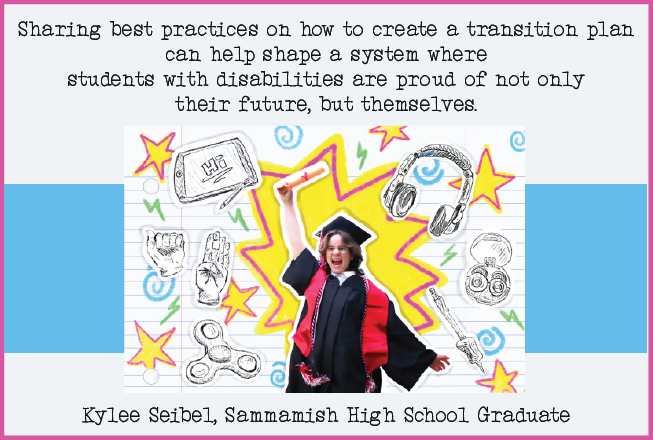
“Sharing best practices on how to create a transition plan can help shape a system where students with disabilities are proud of not only their future, but themselves." Kylee Seibel, Sammamish High School Graduate
Empowering Voices through Student-Led IEPs
Updates to CCTS’s self-paced Student-Led IEPs Canvas course
In alignment with the goals of the Inclusionary Practices Technical Assistance Network (IPTN), CCTS’s updated Student-Led IEP training course incudes new recommendations that support inclusion for all students, including Black students with disabilities and students with intellectual or developmental disabilities (IDD).
Course content is currently available on the CCTS website. The option to earn clock hours for a fee will be available starting in October.
The following excerpt from the course highlights the importance of amplifying student voice, especially for groups who have historically been underserved, as we work to disrupt segregated systems of disproportionality and reduce exclusionary practices in schools across the state.
Equity and Student Voice
Students in LRE 3 settings spend less than 39% of the school day in general education classroom settings. These students are particularly at risk of being excluded from their IEP meetings. With the right preparation and accommodations, students in LRE 3 can and do participate meaningfully in their IEPs. Their participation is also a bridge to inclusion: students who understand their own IEP goals and rights are better positioned to advocate for more inclusive placements.
Black students with disabilities face compounding barriers. Nationally, Black students are significantly more likely to be identified with certain disability categories and placed in more restrictive settings. At the same time, there is a well-documented demographic mismatch between students and educators—while nearly half of students are students of color, the teaching workforce remains predominantly White (Egalite, A. J., 2024).
This mismatch can lead to differences in communication, expectations, and interpretations of behavior, making IEP meetings feel unwelcoming or even adversarial for some families. Research also shows that when students have access to educators who share or understand their cultural backgrounds, outcomes related to discipline, engagement, and academic success improve (deCourcy, K., et al, 2024; Egalite, A. J., 2024).
Student voice, particularly when families and communities are engaged as true partners, is a powerful way to shift the dynamic toward genuine collaboration.
––
References
Student-LED IEP Training
This free, self-paced training is designed to inform educators and families/caregivers about best practices in developing Individualized Educational Programs (IEPs) that are student-centered and student-directed.
Student-Led Transition IEP Toolkit
Resource from the RAISE Center, funded by OSERS
This toolkit provides educators, parent centers, and youth-serving organizations with ready-to-use videos and accessible worksheets designed to build student voice, self-advocacy, and leadership within the IEP and transition planning process.
All videos reference and align with the screen reader–friendly versions of the accompanying documents to ensure accessible use for all learners. Together, these tools promote self-determination, collaboration, and meaningful student participation in transition planning.
Ready or not: The largest leap for special education students
Education Lab article from the Seattle Times
Big congrats to Sammamish High School graduate Kylee Seibel, whose work was published last month in the Seattle Times as part of their Student Voices project.
In her article, Kylee shares a compelling, first-hand account of why transition services matter, and where systems can still fall short. Drawing on her own experiences of navigating accommodations, she speaks to the anxiety she faces as she leaves behind the structured support of her IEP and heads to college this fall. She highlights how the transition planning process often starts too late and leaves students to face a puzzle of adult services largely on their own.
Kylee cites Washington state post-school outcome data showing only 19% of students with IEPs connected with an adult agency after exiting school in 2024. CCTS team members Meg Iyer and Jay Shepherd were among several transition professionals Kylee interviewed on the importance of earlier transition planning and stronger agency handoffs.
Person-Centered Transition Planning and Interagency Collaboration
Free, updated course modules from the IRIS Center
The IRIS Center is a national center dedicated to improving education outcomes for all children, especially those with disabilities, through effective evidence-based practices and interventions. Modules are available for free, with the option of earning a PD certificate for completion.
Secondary Transition: Person-Centered Transition Planning
This module underscores the benefits of person-centered transition planning for students with disabilities. It addresses strategies for engaging students throughout the transition planning process and highlights considerations for shifting to a more person-centered approach. Updates include:
- Revised content and updated research findings
- Expanded content on self-determination
- New expert audio interviews on the benefits of person-centered planning for students and educators, fostering self-determination skills, using transition assessments to develop postsecondary goals, engaging families throughout the process, and more
- New practitioner audio clips with a transition coordinator who discusses how students can use self-determination to pursue careers aligned with their interests and how to meaningfully involve families in the transition process
- New audio interview with a high school student who shares how he takes a leadership role in his IEP meetings
Secondary Transition: Interagency Collaboration
This module defines interagency collaboration and explains its role in transition planning for students with disabilities. It addresses the importance of partnerships among school personnel and various agencies, in addition to providing strategies for this collaboration. Updates include:
- Revised content and updated research findings
- New expert audio interviews on the individuals and groups involved in interagency collaboration, the importance of building community partnerships, tips for promoting seamless transitions, and more
- New practitioner audio clips with a transition coordinator and transition consultant who offer practical insights on supports, collaboration, and transition planning for students with disabilities
Learn more about the IRIS Center at Vanderbilt Peabody College
Post-School Outcome (PSO) Data
2023-24 Special Education Leavers
Are you curious to know about your former students’ education and employment activities after they leave high school? PSO data reports are available on the CCTS website by county and ESD. If you work for a school district, you can access district-level reports from our secure data collection platform, the TSF2.
- Outcome categories include Higher Education, Competitive Employment, Other Education, Other Employment, and No Engagement.
- Outcomes are disaggregated by exit category, gender, race/ethnicity, disability, and language proficiency. Data on connections with adult service agencies are also included.
School districts can use these reports to evaluate the effectiveness of their special education programs. If you have questions about accessing or understanding the data, please send us an email at ccts@seattleu.edu.
The Post-School Survey for 2024-25 Special Education Leavers is currently underway. New data will be available in January 2027.
Explore Post-School Outcome (PSO) Data
To learn more about post-school outcomes by county, ESD, or demographic categories (exit status, gender, disability, race/ethnicity, language proficiency), visit the Post-School Outcome Data page on the CCTS website.
CCTS Self-Paced Online Training
Free Transition Training Materials
Each of CCTS’s self-paced training courses can be accessed free of charge from the CCTS website. Courses include modules and activity workbooks that can be completed individually or with a group.
- Writing Effective Transition Plans (10 modules)
- Student-Led IEPs (7 modules)
- Developing Job Shadow Experiences (4 modules)
- Partnerships for Inclusion: Special Education and Career Technical Education (6 modules)
Visit CCTS’s Secondary Transition Training page for details.
View CCTS's self-paced training courses
Courses designed for educators, adult service agencies, and families/caregivers.
Subscribe to CCTS Newsletters
Stay connected with CCTS by subscribing to our quarterly newsletters.