Events
Find out what Faculty Development events are on this term and sign up
One of our goals as a Center is to engage SU faculty in conversation around the deeper questions of academic practice, based on national and international research into higher education.
Events are open to ALL SU faculty. Check the callout boxes to the right of each event for further details around audience and modality.
You can register for this quarter's sessions here or by following the links listed with each event.
You can also download a flyer of all these sessions to post on your wall or door: 26SQ What's happening in CFD
Community of Practice
Fri, Apr 10 and Fri, May 1 | 3:30–5:00
Facilitated by David Green and Katherine Raichle
The Chairs' and Directors' Community of Practice is open to all current department chairs and program directors, as well as chairs- and directors-elect.
We gather twice per quarter.
Further details are available on the Community of Practice page here.
» Register (separate registration form from other events)
Modality: Hyflex (in-person and online)
For: Current department chairs and program directors, plus chairs- or directors-elect
Affinity group
Wednesdays: Apr 8, May 6, Jun 3 | 2-3:00 | Zoom
Co-sponsored by CFD and the Office of Diversity and Inclusion
Facilitated by Colette Hoption (Center for Faculty Development; Management Department)
Being a faculty member of color in academia often comes with unique challenges—both visible and invisible. From navigating institutional culture to managing racialized experiences around teaching, research, and service, there is a need for supportive community. In response, the Center for Faculty Development is offering an affinity group for faculty of color. Members of this group will have space to connect, reflect, and build relationships with colleagues who share similar experiences. In this space, we will affirm one another, exchange strategies for success, and foster resilience.
Why an affinity group?
Affinity groups bring together individuals around shared identities and lived experiences, offering vital psychological and professional benefits. These include reduced feelings of isolation, increased confidence, and a stronger sense of belonging. Professionally, participants often gain access to informal mentoring, shared strategies for career advancement, and a deeper understanding of how to navigate institutional systems. For faculty of color, such groups create space for affirmation, collective insight, and solidarity. Research shows they contribute to well-being, empowerment, and sustained engagement in academic life.
Aims of the group
Our aim is to provide an environment that supports faculty of color success and satisfaction in academic life.
» Register
Modality: Online
For: Faculty of color (full- or part-time)
Launch meeting

Co-sponsored by CFD and the Office of Research and Sponsored Projects
Facilitated by Andrea Verdan (Center for Faculty Development; Chemistry Department)
Timing: On a rolling basis, according to demand | Zoom
The “research on research” gives us good evidence on what helps faculty progress with their research, and in response, we’ve been launching Faculty “Writing” Groups since 2007. “Writing” encapsulates whatever is involved from the inception of your idea to the completion of the final “product.” These groups provide you with camaraderie and accountability to achieve more in your scholarship. And they are intentionally interdisciplinary so that you remain the expert in your own field throughout.
We are organizing Faculty “Writing” Groups on an on-demand basis. Once sufficient faculty are interested, you will be grouped with two or three other colleagues from across campus and will be invited to attend a brief launch meeting with your group and a member of the Center. You will then be ready to meet with your group independently and regularly to help you achieve more in your research – and with less stress.
By the end of a launch session, you will be grouped with two or three other colleagues from across campus and will be ready to meet with your group independently and regularly to help you achieve more in your research – and with less stress.
Click here for our webpage with full details on Faculty "Writing" Groups.
» Register
Modality: Online
For: All faculty (full- and part-time)
Community of Practice
Mondays, 1:30–2:45 | Apr 20, May 4 | Loyola 201 and Zoom
Co-sponsored by CFD, Technology Ethics Initiative, Lemieux Library, Instructional Design Studio (formerly CDLI), and University Core
Facilitated by Andrea Verdan (Chemistry Department, Provost Fellow, and Center for Faculty Development) and Katherine Raichle (Psychology Department and Center for Faculty Development)
With the rise in generative AI use among college students, faculty are re-thinking how they structure their in-person meetings, evaluate learning, and assign homework. While some have returned to blue books and oral exams, others are centering generative AI as part of their courses and their students’ work. How are these approaches working? How can we approach teaching and best use the resources we have as instructors of in-person classes?
If any of those questions resonate, this space is for you! We will provide an informal venue for those who desire conversation and support from colleagues to share ideas, practices, and challenges with AI.
How does a "Community of Practice" work?
For these gatherings, we use the "Communities of Practice" model (Wenger 1998), which means you're in charge of what's discussed. You decide which topics are most important for you as teachers who are grappling with the changing landscape of teaching in this new age of AI.
Each member of the group decides how much or how little to contribute. (For example, the model includes "legitimate peripheral participation" to acknowledge that not everyone wants to join in a discussion even when they choose to attend. Rather, they may choose to simply listen to others).
This community of practice provides an intentionally loose structure for sharing ideas and working out approaches to new challenges as they arise. Moreover, communities of practice create opportunities to forge new connections across colleges and disciplines for ongoing support.
The Center for Faculty Development's role is simply to facilitate the process for you. We also compile anonymized notes and ideas from each session to share with participants.
As with other events run by the Center, this forum is voluntary, formative, and confidential.
» Register
Modality: Hyflex (in-person and online)
For: All faculty teaching in-person courses
Research practice

Wednesdays: Apr 22, May 6, May 20, Jun 3 | 9:45-10:45 | Loyola 201
Thursdays: Apr 9, Apr 30, May 14, May 20 | 1:30-2:30 | Loyola 201
Co-sponsored by CFD and the Office of Research and Sponsored Projects
Facilitated by Colette Hoption (Center for Faculty Development; Management Department) and Katherine Raichle (Center for Faculty Development; Psychology Department)
"Write-on-sites" are ideal for faculty looking to make steady progress on scholarly or creative projects. These sessions are especially helpful for those looking for uninterrupted time, benefit from gentle accountability, and/or feel isolated in their work. Whether you’re drafting a manuscript, creating artwork, revising an article, developing a grant proposal, or advancing any long-term research or creative endeavor, these sessions offer a professional space to help you move your work forward.
What will we do?
At every session, you will decide your goals for the hour. In our shared space, you will have your own desk space to work independently. Sessions end with an optional time to connect with others on their progress.
What's the time commitment?
Four one-hour sessions during the quarter. Come to as many as you can!
» Register
Modality: In-person
For: All faculty (full- or part-time)
Community of Practice
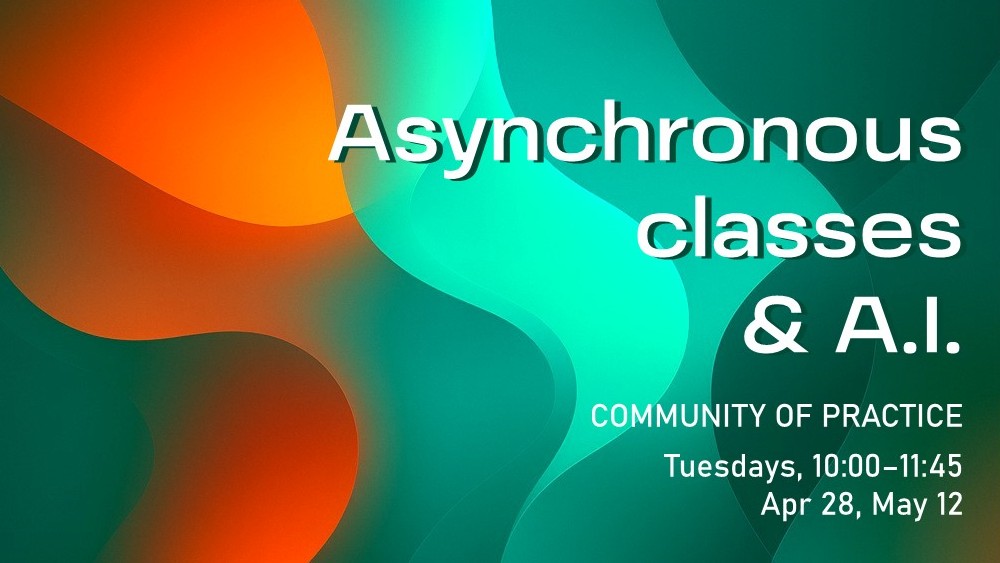
Tuesdays, 10-11:45 | Apr 28, May 12 | Zoom (Link to follow on registration)
Co-sponsored by CFD, Technology Ethics Initiative, Lemieux Library, Instructional Design Studio (formerly CDLI), and University Core
Facilitated by Andrea Verdan (Chemistry Department, Provost Fellow, and Center for Faculty Development) and Katherine Raichle (Psychology Department and Center for Faculty Development)
Generative AI is posing unique challenges for those of us who are teaching asynchronous online courses. How do we reassure ourselves that the learning is happening when direct contact with students is not possible? How do we reinforce how and when AI may be used – and know when or whether our policies are being followed? What's working and what isn't?
If any of those questions resonate, this space is for you! It provides an informal venue for those who desire conversation and support from colleagues to share ideas, practices, and challenges with AI.
How does a "Community of Practice" work?
For these gatherings, we use the "Communities of Practice" model (Wenger 1998), which means you're in charge of what's discussed. You decide which topics are most important for you as teachers who are grappling with the changing landscape of teaching in this new age of AI.
Each member of the group decides how much or how little to contribute. (For example, the model includes "legitimate peripheral participation" to acknowledge that not everyone wants to join in a discussion even when they choose to attend. Rather, they may choose to simply listen to others).
This community of practice provides an intentionally loose structure for sharing ideas and working out approaches to new challenges as they arise. Moreover, communities of practice create opportunities to forge new connections across colleges and disciplines for ongoing support.
The Center for Faculty Development's role is simply to facilitate the process for you. We also compile anonymized notes and ideas from each session to share with participants.
As with other events run by the Center, this forum is voluntary, formative, and confidential.
» Register
Modality: Online
For: All faculty teaching asynchronous courses
Faculty Leader Series

Mon, May 18 | 11:00–12:20 | Student Center 130
Facilitated by Colette Hoption (Center for Faculty Development; Management Department)
Decades of organizational research show that how people feel at work shapes how they behave. In academic units, emotions like trust, enthusiasm, and psychological safety predict collaboration, mentoring, and innovation; fear and burnout predict withdrawal and turnover.
Curiously, though, while universities often have strong strategic plans, it’s less common for them to examine the institutional cultures and microcultures (Roxå & Mårtensson, 2015) that put those plans into action. This workshop foregrounds emotional culture as the lever that makes strategy executable. By making the emotional climate visible and discussable, you’ll learn to name, assess, and intentionally influence the drivers that speed—or stall—your priorities.
What will we do?
Using the Emotional Culture Deck (a card-based activity that prompts open conversations about how people feel and want to feel at work), we will turn the abstract concept of culture into a tangible, hands-on exercise. Working first independently and then in small groups, we will sort, prioritize, and debate the specific feelings that drive faculty engagement—and those that stifle it.
In this session, you will:
- Map the current emotional landscape of your department
- Identify the specific cultural elements that are non-negotiable for you as a leader.
- Design 2–3 action items to shift the status quo toward your desired state.
Who is this Faculty Leader Series for?
This session is designed for Department Chairs, Program Directors, and faculty leaders who want protected time to analyze their team dynamics, develop a clear vision for their area’s culture and performance, and use a hands-on method to intentionally shape their work environment.
» Register
Modality: In-person
For: Department Chairs, Program Directors, and faculty leaders
Reception Event

Thu, Apr 30 | 3:30-5 | Loyola 201 | Appetizers, beer, wine, and non-alcoholic beverages will be served.
Co-sponsored by CFD, Center for Jesuit Education, and Office of Research and Sponsored Projects
Spring is typically the time of year when universities around the country are looking back and toasting the successes of the past 12 months.
Less celebrated – but no less important – are all those instances of risk-taking that didn’t lead to the results we had hoped for, such as
- Articles, chapters, and conference papers that were rejected
- Learning activities, assignment designs, and course designs that didn't work as intended
- Grants, fellowships, and funding applications that didn't come through (or were rescinded)
- Applications that were turned down
- Conference sessions that no one showed up for.
Too often, our “misses” remain private, yet they hold some of our richest opportunities for growth and connection. We invite you to come together as a community to acknowledge the full reality of your experiences over the last two academic years and to recognize, quoting Einstein, that “Failure is success in progress,” an expected part of our jobs as academics.
As author Helen Sword (2017, p. 178) writes, “habitual risk takers understand that failure, too, is worth celebrating.” In this spirit, the Center for Faculty Development, Office of Research and Sponsored Projects, and Center for Jesuit Education invite you to join us as we celebrate our “failures” and honor the challenges of the last 24 months that may have thwarted your best efforts.
» Register
Modality: In-person
For: All faculty (full- and part-time)