/138x0:2260x1354/prod01/channel_34/media/seattle-university/news--stories/images/Eric-Gilbertson-goggle-mountain.jpg)
Eric Gilbertson at Colfax Peak, September 2024 (photo by Ross Wallette)
Engineering Professor Eric Gilbertson measured Mt. Rainier and found global warming had shrunk Washington state’s iconic peak but that’s just one of his discoveries.
Mt. Rainier has shrunk about 10 feet from the measurement the U.S. National Parks Service publishes on its website.
The finding is inaccurate and Seattle University Professor Eric Gilbertson, PhD, was driven to do the hard work—in deadly, grueling conditions—to prove it.
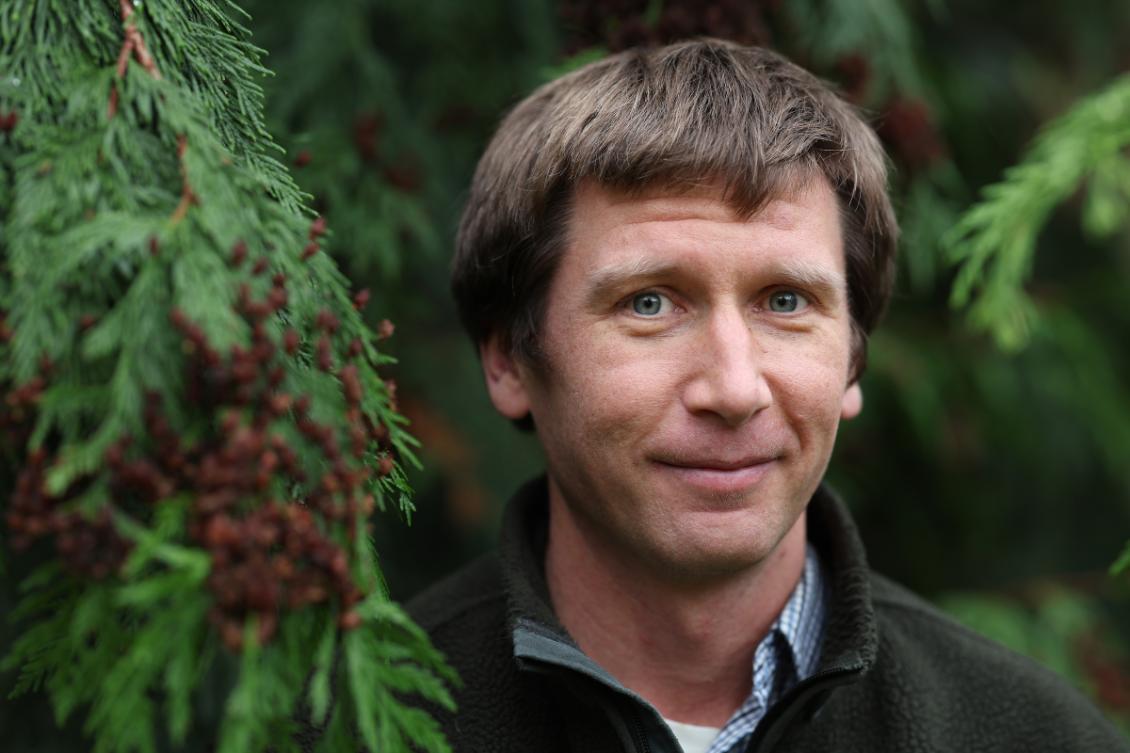
Professor Eric Gilbertson, PhD, on flat ground—the SU campus.
In a peer-reviewed academic journal article released in November 2025, Gilbertson published data showing how climate change affects even the tallest of earth's peaks, reshaping the landscape and our understanding of a swiftly warming planet. It’s also proof that Washington state’s most iconic mountain is losing its ice cap.
“It’s recognized around the world that glaciers are melting,” says Gilbertson, 39. “People just didn't realize that it hits the summits.”
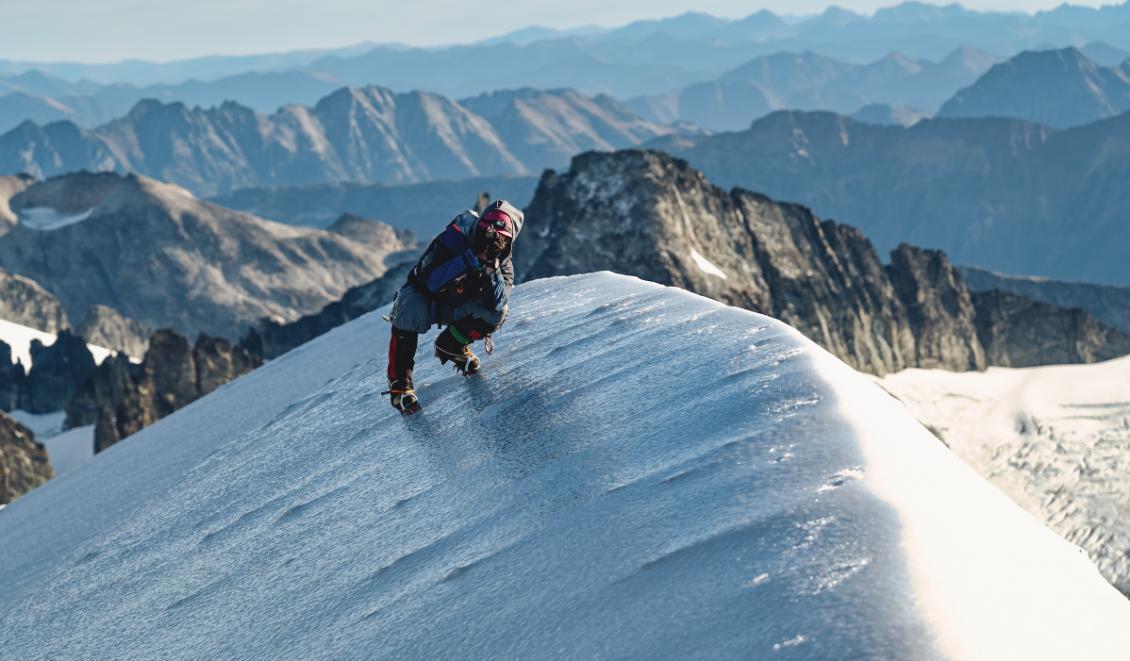
Gilbertson on Eldorado Peak, September 2024 (photo by Ross Wallette)
At least until 1998 the ancient icy tip at the top of the mountain, called the Columbia Crest, stood alone as the mountain's tallest point. Since then it has melted by over 22 feet, with only 16.5 feet left to go before it melts to rock, according to Gilberston’s findings.
In the process, a rocky peak 500 feet away on the southwest rim, about 10 feet lower, emerged as Rainier’s highest point.
This means that the mountain is actually 14,399.6 feet tall, to be precise, according to the findings of Gilbertson and his co-authors, and not 14,410 feet tall, a measurement from the official 1956 survey that is relied upon by the federal government.
About a year ago Gilbertson sent the U.S. Parks Service an earlier scientific paper Mt. Rainier’s shrinkage that he wrote with fellow mountain measurer Larry Signani, the mountaineer who led surveys of Mt. Rainier in 1988, 1998 and 2010.
Gilbertson had hoped officials would use Signani’s and his new data to reevaluate the height of the mountain, but that has not yet happened.
This motivated Gilbertson. And Gilbertson’s will is formidable. Attending MIT as an undergraduate through his PhD might be one of his breezier accomplishments.
By his own account, this is what pushes him to trudge up the world’s tallest peaks, often alone in faraway countries, sometimes lugging upwards of 75 pounds of gear, in the thinnest of air, punished by wind, ice and snow, for 30, 40 hours straight sometimes, fueled by nothing more than a single bottle of Gatorade.
“There's often a point where it would make sense to just bail and turn around because it’s taking longer than you expected,” he says, noting that his desire to measure a mountain is often enough for him to continue to the top. “But if I really, really prioritize, if I really want that goal, then I can be motivated enough to just push through.”
It might be an understatement to call Gilbertson an accomplished mountaineer and more accurate to simply call him a person who accomplishes very difficult things.
An Associate Teaching Professor in Mechanical Engineering since 2018, Gilbertson has summited the highest point in 147 countries—out of 195 possible.
And now he has set himself to climbing the 100 highest mountains in Washington in the winter, as he says nobody has ever ascended many of them when they are experiencing the most hostile conditions of the year.
Gilbertson and his twin brother, Matthew, who also attended MIT from undergrad through his PhD, maintain a website that tracks their progress in trekking to the highest points of a place, marking their first accomplishment in the summer of 1994 during a family road trip when the twins went to the top of St. Louis’ Gateway Arch National Park, a humble 470 feet.
When he’s not climbing mountains, Gilbertson is known to kick back and relax by juggling on a unicycle, another feat for which he has held records, notably juggling seven rings while pedaling on one wheel. It started for him at age 12 when he received a unicycle for Christmas. He then practiced for eight hours straight until he could ride across the room. Once riding it became easy, he started balancing objects on his nose and juggling.
“Juggling is open-ended because you can always add more, one more object,” he says. “It's unlimited, just like mountaineering. There are always more mountains.”
He’s also the kind of person who abhors shortcuts and gimmicks when tallying his accomplishments, which is what led him to begin measuring the mountains he climbs.
“This is how I kind of got into it,” he says. “If I go to a country and I want to climb the highest point, I want to be certain I get the right mountain because I'm going all the way over there.”
Not hearing back from the federal government about Mt. Rainier's shrinkage, Gilbertson vowed to use the best tools available to gather the most robust data possible.
“Now it's recognized by the scientific community as an accurate measurement,” Gilbertson says. “This is as rigorous as you can get.”
Measuring Rainier
Gilbertson’s journey to measure Mt. Rainier started in July 2023, when friends who guide climbers to the peak told him a “dirt hump” at the top looked higher than Columbia Crest.
He analyzed photos his friends sent and found an eight-foot height difference between Columbia Crest and the next highest point. From what he could tell Columbia Crest looked shorter. “But no one's going to trust just a picture,” he says.
On Aug. 28, 2024, Gilbertson climbed Mt. Rainier, lugging 20 pounds of surveying equipment
“When you're up there, it's obvious that the other one's higher, but no one's going to trust without a measurement,” he says.
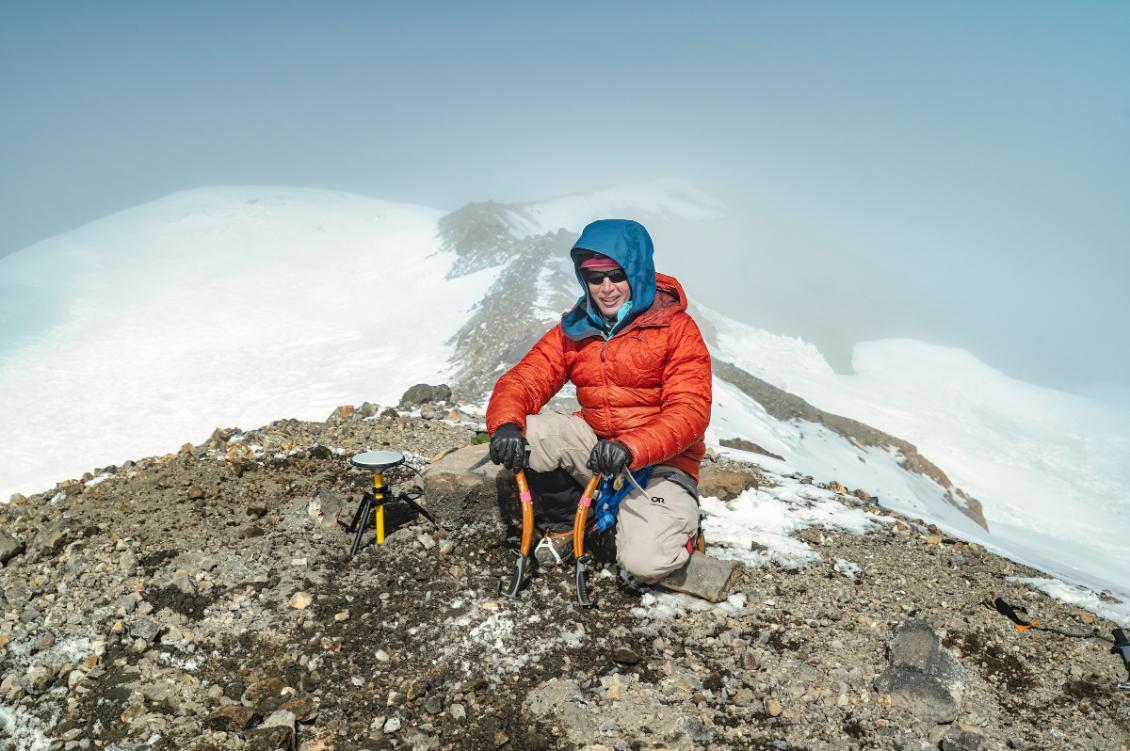
At the Mt. Rainier summit, September 2024 (photo by Ross Wallette)
Using GNSS measurements, technology that measures heights by clocking the time it takes for satellite signals to reach a receiver, he found that Columbia Crest had indeed melted down more than 20 feet. He took his findings and presented them to surveyors at the Land Survey Association of Washington.
“They were like, ‘that's great, but if you did these couple other things, it'd be more rigorous.’”
Following that advice, on Sept. 21, 2024, a month after Gilbertson’s first trek to measure the mountain, he climbed Mt. Rainier again. By that time, however, winter had started to creep, signaling the end of climbing season, and guides had pulled the ladders off the ground, dismantling the trail to the top.
Gilbertson was undeterred. “All the rangers at the base were like, ‘yeah, you have no chance. Just turn around,’” he says.
Instead of turning around, Gilbertson and two other climbers, equipment in tow and without the aid of the ladders bridging the yawning chasms, rappelled down into crevasses and climbed out.
This went on for about 30 hours straight. Sometimes they had to leap across gaps and dig an ice axe into the other side, moving in the dark of morning and night to ensure temperatures remained cold enough to keep the ice frozen and firm to support their weight.
“We got the exact same number as the previous time, but I did it in a more rigorous way now.”
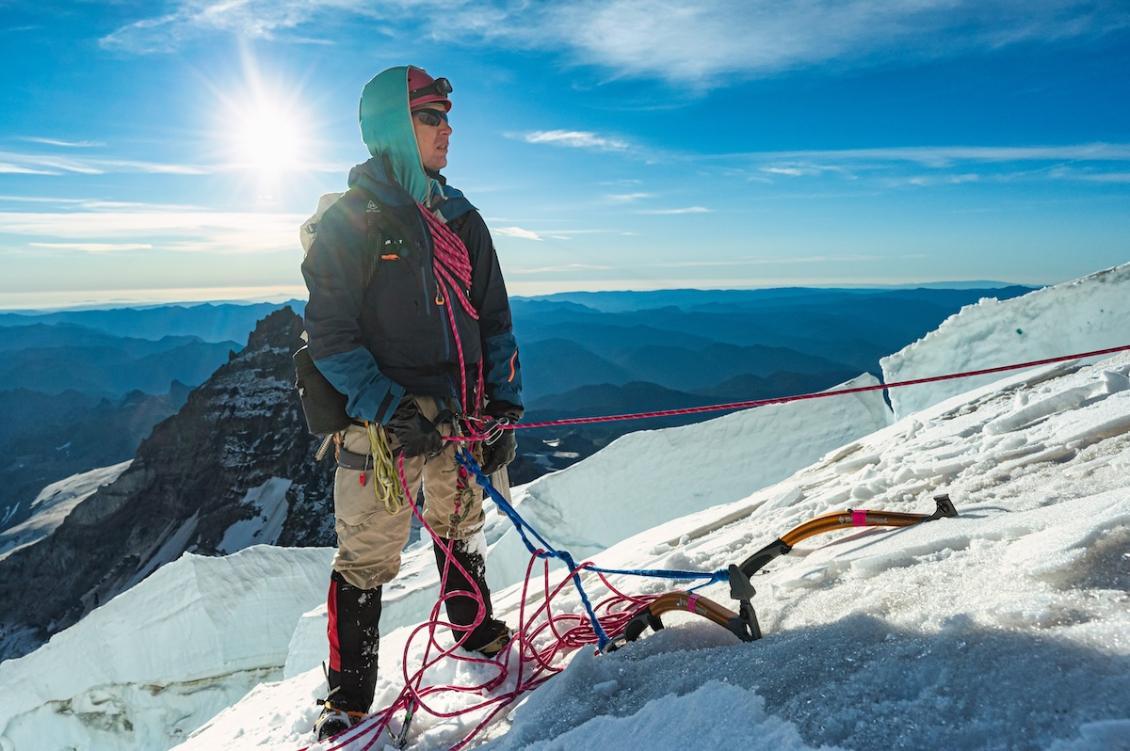
Ascending Mt. Rainier, September 2024 (photo by Ross Wallette)
Though the effort to remeasure Mt. Rainier is the part of the project that has received the most attention, in the summer of 2024 Gilbertson and others also trekked to the top of the four other known ice-capped peaks in the lower 48, all in Washington state, and measured them—Liberty Cap, Colfax Peak, Eldorado Peak and East Fury.
The findings were gathered for an article, “Rapid contemporary shrinking and loss of ice-capped summits in the western United States,” published online Nov. 10, 2025, in Arctic, Antarctic, and Alpine Research. Along with Gilbertson, the article's co-authors are John Abatzoglou (University of California, Merced), Kathryn E. Stanchak, PhD and Scott Hotaling (Utah State University).
“In this study, we showed that the mountain cryosphere in the western United States is receding at even the highest elevations in the region,” the co-authors concluded, with the “cryosphere” referring to parts of the earth’s surface that are made up of frozen water. “Thus, we have clearly entered a new era for the western U.S. cryosphere. Where there is perennial ice, it is likely melting.”
Gilbertson found all five ice-capped summits had shrunk, with four of the five shrinking by at least 20 feet. Only two of the five summits still had perennial ice as their highest point. The other three, Mt. Rainier included, now have summits of rock.
“I definitely want my measurements to be recognized as accurate because then people will recognize that this is really a problem,” he says.
Measure of a Mountain
Though the work is important, it came with tragic costs, placing in high relief the danger facing those who seek to take the measure of a mountain.
During an August 2025 attempt to measure Mt. Fury in the North Cascades, one of Gilbertson’s friends who was helping in the research fell to his death. Ross James Wallette, 43, of Kennewick, died while attempting a side trip to climb a peak near the main target. Gilbertson was a couple miles away and saw the rescue helicopter evacuation but was not with Wallette when he fell.
“We should still take the measurements,” Gilbertson says when asked how the death of his friend affects the project. “But we definitely need to be as careful as possible.
“The peaks are pretty serious,” he continues. “There's probably a reason that people haven't measured them. It's really difficult to measure them.”
Gilbertson has also personally discovered the hitherto unknown highest points in seven countries, including in Uzbekistan, which had never before been climbed, not to mention measured.
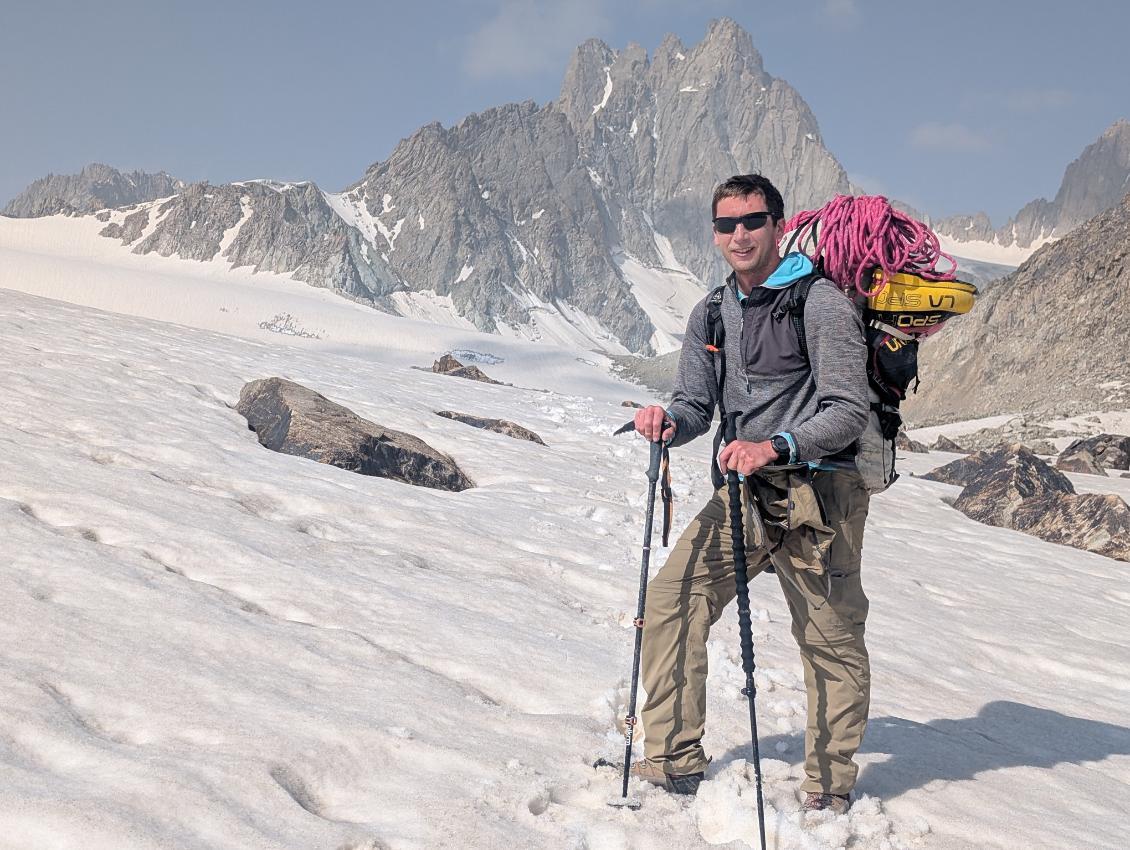
In Uzbekistan, Eric Gilbertson approaches Alpomish, visible in the background, July 2025 (photo by Serge Massad)
“The Soviet survey was in the 1980s, they just missed it, it was blank on the map,” he says.
In a second academic paper published, also in November 2025, Gilbertson and his brother Matthew shared the new national highpoints for Saudi Arabia (Jabal Ferwa), Uzbekistan (Alpomish), Gambia (Sare Firasu Hill), Guinea-Bissau (Mt. Ronde) and Togo (Mt. Atilakoutse).
Those discoveries are documented in the paper, “Determination of new national highpoints of five African and Asian countries” in Progress in Physical Geography: Earth and Environment.
Gilbertson published a third in Progress in Physical Geography: Earth and Environment, “LiDAR Accuracy on North American Mountain Summits,” in which he and his co-authors detail the technology he uses to measure mountains.
Among Gilbertson’s discoveries included in this paper are that Mount St. Helens has been eroding down four inches every year since 1989, Colorado has a new peak—East Crestone—which joins the club of mountains that exceed 14,000 feet, Michigan has a new state highpoint in Mount Curwood and Nova Scotia, Canada, has a new provincial highpoint in Western Barren.
A Rigorous Activity
Originally from Kentucky, Gilbertson and his brother were introduced to mountain climbing through their school’s climbing club, first trekking up the mountains of New Hampshire, modest adventures compared to what Gilbertson would later encounter.
At this point in his climbing career, Gilbertson trains for mountain climbing by climbing mountains.
He completes trips every weekend in Washington state, including 30-hour continuous pushes to get a first winter ascent or an overnight trip with two arduous days back-to-back. Then he usually rests during the week to recover, preparing him for 8,000-meter peaks that often require 24-hour pushes on summit days.
“I find I don't have to do anything specific to train for summer expeditions,” he says. “I just keep doing this routine in Washington and I'm pretty much ready to go for an expedition any time.”
Though he has focused on peaks that are lesser known, or unknown, Gilbertson still has sights set on the world’s major mountains. He made it to the top of K2 without huffing from bottled oxygen, considered one of the world’s most perilous climbs.
“It's a lot cheaper without oxygen,” he says. “You don't have to pay a Sherpa to go with you. You don't have to pay a bunch of people to carry all your gear up and down. It's also more of an athletic achievement if you can do it without oxygen. Because with oxygen you kind of turn into a robot, you can just do whatever. You don't have to eat, don't have to sleep, you can just go. It's kind of like a different playing field.”
After summiting K2, the planet’s second highest mountain, Gilbertson made an earnest attempt at Mt. Everest, the highest, unassisted and without supplementary oxygen. He spent about a month acclimating himself to the elevation, which included catching the flu from a crowded tea house. In his attempt at the summit, he pulled two all-nighters above 8,000 meters and pushed through a dislocated shoulder sustained in a fall and made it within about 300 meters, but then he started to wobble.
He tried to force down a Clif bar, but realized calories were not going to help him.
“I was starting to lose my balance and I know that's a sign of cerebral edema,” he says. “You can't just push through that, you have to go down.”
He recalls that the sky was clear, decorated with a few wispy clouds, and no other climbers in sight.
Gilbertson admits that sometimes after he arrives back at the trailhead—somehow returning from a peak always feels like it takes longer than ascending—he goes through a mental process where he swears off climbing only to begin thinking about the next one.
“There's often a feeling immediately after of never again. But then it passes,” he says. “People say this after a marathon, never again. And then after an hour and you're eating ice cream, you're like, eh, when's the next race? I think it's kind of the same thing.”
Explore On
Want more of Gilbertson? Check out recent stories by the BBC—who happened to reach him by phone in the … Amazon)—and the New York Times, the latter of which includes Eric’s brother Matthew.
Similar News & Stories
-
/26x0:2352x1469/prod01/channel_34/media/seattle-university/news--stories/images/CHESS-story-photo-rooftop.JPG)
A New Chapter Begins
SU NewsCollege of Humanities, Education and Social Sciences looks to the future. -
/0x348:800x853/prod01/channel_34/media/seattle-university/news--stories/images/Blessing-Animal-priest-with-brown-dog-800X1200.jpeg)
Bless the Animals
SU NewsEvent celebrates the Feast of St. Francis of Assisi and anniversary of the Chapel of St. Ignatius. -
/73x0:1058x622/prod01/channel_34/media/seattle-university/news--stories/images/Provost-campus-shot-1130X622.jpeg)
SU Names New Associate Vice Provost
SU NewsDr. Mason M. Moore will also serve as Chief of Staff for the provost.