Real World Problem Solvers
Written by Tina Potterf and Andrew Binion
Wednesday, June 3, 2026
/0x35:2400x1566/prod01/channel_34/media/seattle-university/news--stories/images/Project-Center-Zoo-photo-at-tree.jpeg)
A student team working on a project at the Woodland Park Zoo.
Through partnerships with leading companies and public agencies, Seattle University students transform classroom learning into practical, future-focused solutions.
This is the second in a two-part series on projects that will be featured at this year’s Projects Day, happening Friday, June 5. Read on for more about projects sponsored by Google, Woodland Park Zoo and Project Furnish, LLC. And check out Part I to learn more about projects with NASA, Metrolla and Snohomish County.
**
Project: Green Stormwater Infrastructure Design at Woodland Park Zoo
Student Team: Colette Chungu, Davey Peralta, Paolo Sandiko and Frances Pappajohn-Goldade
Sponsor: Woodland Park Zoo
Faculty Advisor: Collin Bond, EIT, ‘21
By Andrew Binion
The parking lot at the northwest corner of the Woodland Park Zoo, called the Bear Lot and covering about 74,000 square feet, is almost a park itself, with tall and majestic conifers shading the area for families and zoo visitors.
And with the help of a team of civil engineering majors, soon the parking lot will include green stormwater infrastructure, or GSI, to better accommodate the 38 inches of annual rain that falls on Seattle, helping advance the zoo’s goal of sustainability and environmental stewardship.
The students were tasked with helping the zoo implement GSI in this lot and the outcome of the work determined that it was feasible to implement six bioretention cells in conjunction with an area of water permeable pavement. The stormwater runoff enters a sewer system, ending up at the West Point Treatment Plant where it’s treated and then discharged into the Puget Sound. Under high flows that exceed system capacity the combined sewer system reroutes the water by passing treatment and discharging water straight into local water bodies, which in this case would be the Ship Canal.
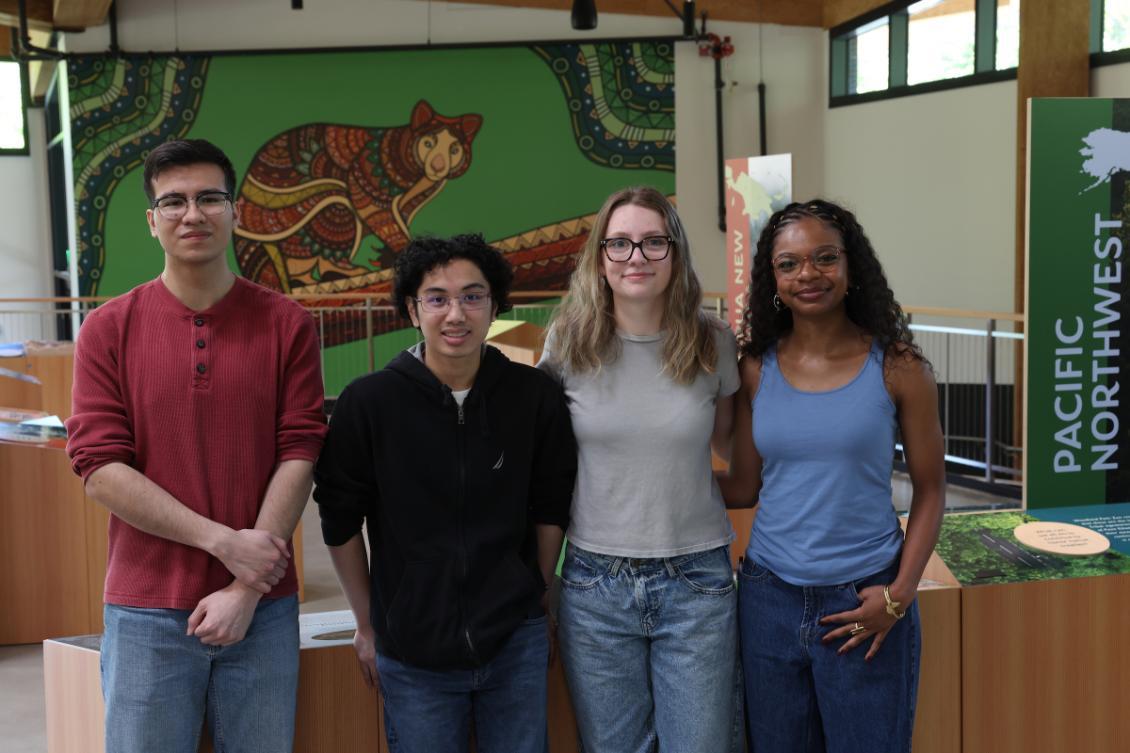
The student team at the zoo: Davey Peralta, Paolo Sandiko, Colette Chungu and Frances Pappajohn-Goldade.
At first, Frances Pappajohn-Goldade, ’26, thought the project was straightforward. She and the team of fellow graduating seniors Colette Chungu, Davey Peralta and Paolo Sandiko were to take the groundwork already done by the zoo—a water study conducted in 2023—and advance the improvement design to 30 percent completion at which time the zoo will hire an engineering consulting firm.
“When you really start to look into it, there's a lot more limitations than I originally had anticipated,” says Pappajohn-Goldade. Not only are there complex root systems that spread out in all directions under the tall trees, hemming in the options to locate the cells, but the team wanted to ensure their proposed GSI would work without the zoo needing to regrade the lot, which complicates the project. And redoing the entire surface lot would come with an additional cost.
“We have to work with the way the water already naturally flows,” she says.
Whereas some projects might see the challenges posed by the trees as an easy fix: just cut them down.
“Nope,” says Megan Schenck, Resource Conservation and Sustainability Manager for the Woodland Park Zoo. “We at the zoo want to keep everything intact.”
Part of the student’s introduction to where the rubber meets the road, no pun intended, is learning to use the city’s manual for stormwater management and consider pricing into their work, leveling them up to the work of professional engineers.
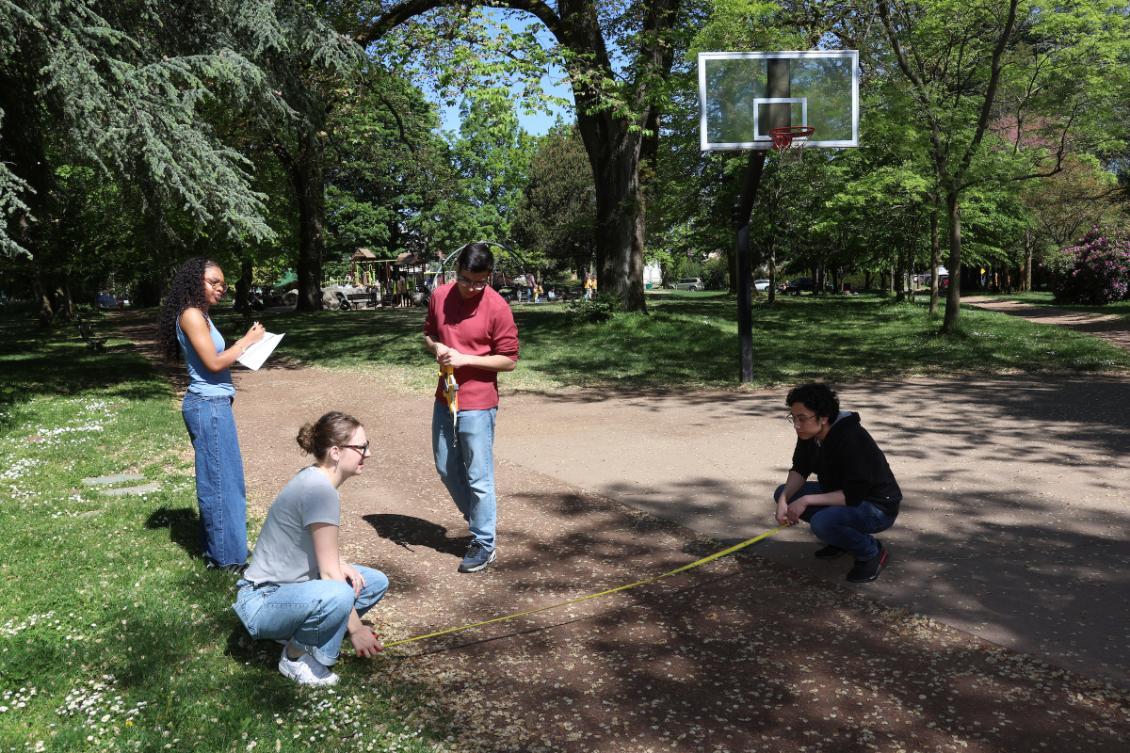
The team taking measurements on the zoo grounds.
“They're coming from classes where if I have a problem for you, hey, go solve how long it takes for this car to stop. The car's moving at this speed, the ground has this friction. Everything is right there at the top of the page in three sentences,” says the team’s faculty advisor Collin Bond, EIT, ‘21, an adjunct professor and a capital project manager for King County. “So, their greatest hurdle I think was in navigating the manuals that a lot of people in the professional space take for granted.”
Another problem-solving puzzle for the team is that the zoo was built in 1899, making it one of the oldest in the country and Schenck said there were doubts that the vintage maps on hand were totally accurate.
“It's not handed over on a silver platter,” says Schenck, who praised the partnership between the zoo and the SU team. “They had to do a little bit of digging.”
For the students, starting on a project in the early stages gave them a broader perspective beyond what a traditional internship can offer.
**
Project: TPM Fuzzer
Sponsor: Google
Student Team: Nebiyu Alemu, Xinxin Li, Davis Muro and Timothy Pranoto
Faculty Advisor: Tim Spinney
By Tina Potterf
When Xinxin Li and her team of peers got their senior captston project to work on throughout the course of the year through the Projects Center, she knew straightaway that this would not be just any project. For starters, the sponsor was Google.
“This was … one of those projects where you realize pretty quickly that you're not just building something for a grade,” says Li.
The student team—consisting of Li, Nebiyu Alemu, Davis Muro and Timothy Pranoto, all graduate-level students in computer science—were tasked with developing an open-source TPM fuzz-testing framework to automatically identify security vulnerabilities in Trusted Platform Modules (TPMs). Once released through the Trusted Computing Group (TCG), developers can integrate this framework into their systems to validate implementations. This initiative strengthens TPM security and enhances overall system reliability.
“The fact that our work could actually be used to find real vulnerabilities in real systems makes it feel different from anything we've done in a classroom,” says Li.
Like many of the projects that students work on, this one was not without challenges, especially considering that they weren’t that familiar with fuzz testing, TPM internals or cloud infrastructure.
As problem solving is central to a successful outcome, this required the students to adapt and pivot, figuring things out on the fly at times and conducting testing that ultimately didn’t always work. But they turned a learning curve into real aha moments while also learning new skills that helped build a better understanding of the project.
Working in collaboration as a member of a team also required communication and coordination. Says Li, “When four people are working on different parts of a system, the codebase, cloud pipeline and documentation, keeping everything aligned takes real effort.”
But being part of this team was for Li one of the real highlights of the entire experience.
“Everyone brought something different to the table and nobody was afraid to ask for help or offer it. There were late nights where someone would jump on a call just to help a teammate get unstuck,” she says. “That kind of support made a hard project feel manageable. Working on something real, with Google involved, gave us all extra motivation, but it was the team dynamic that made it actually enjoyable.”
Google’s Ana Mendes, who is a 2023 alumni of the MSCS program and a software engineer II at the tech company, says the partnership—now in its second year—with SU’s Project Center has been excellent. And its been rewarding “to work with highly capable students supported by a faculty advisor. This structure allows students to receive frequent guidance on task management and organization from their advisor, while we, as sponsors, focus on defining requirements and addressing technical queries.”
The students bring what Mendes calls an “eagerness and unique perspectives” to the work and sponsoring a project with real world application and implications is fulfilling, both on a personal level as an alum but also from a business standpoint.
"It allows us to advance valuable initiatives that are more experimental and novel in nature, which otherwise might not develop in traditional environments," says Mendes. “Academically, students benefit significantly from professional experience—learning how computer science is applied in the real world, understanding daily industry operations and building professional networks through visits to the Google campus."
There are many benefits to a company or organization who signs on to work with the Project Center. For Google, it’s an opportunity to showcase all that the company contributes to both the industry and academia, says Mendes, while also supporting students in gaining the technical skills that can be hugely beneficial in their post-SU professional pursuits.
“Engaging with students allows us to provide the training and experience necessary for them to become engineers who prioritize efficiency, ethics and user-centric problem-solving,” says Mendes. “Furthermore, the broader industry will benefit significantly once this fuzzing framework is released as an open-source tool.”
As their time working on this project nears its completion with graduation around the corner, Li says in addition to the technical skills attained she’s also discovered some things about herself through the course of the year.
“I’ve learned that being uncomfortable is part of the process. Early on there were moments where the technical complexity felt overwhelming, but you learn to break things down, ask better questions and get comfortable not having the full picture right away,” she says. “Over time that discomfort turns into confidence. This project taught us that we can work through problems we didn't think we were ready for.”
**
Project: Design and Construction of the Onepac
Sponsor: Project Furnish, LLC
Student Team: Jhet Cooperrider Young, Colin Crawford, Mike Ngoy, Eric Olson and Dale Mittelstaedt
Faculty Advisor: Eric Gilberston, PhD
By Andrew Binion
The marching orders to the mechanical engineering students—or more accurately, the hiking orders—were to design a modular backpack system that could break down into three sizes for different types of camping, along with converting the actual backpack into a chair and a tent.
At first the team, graduating seniors Jhet Cooperrider Young, Colin Crawford, Mike Ngoy, Eric Olson and Dale Mittelstaedt, couldn’t yet envision what the Onepac system would look like, so they started brainstorming.
“Just because we didn't know what it looked like didn't mean it wasn't possible,” says Mittelstaedt. “And so I was also interested in finding out where our research would take us.”
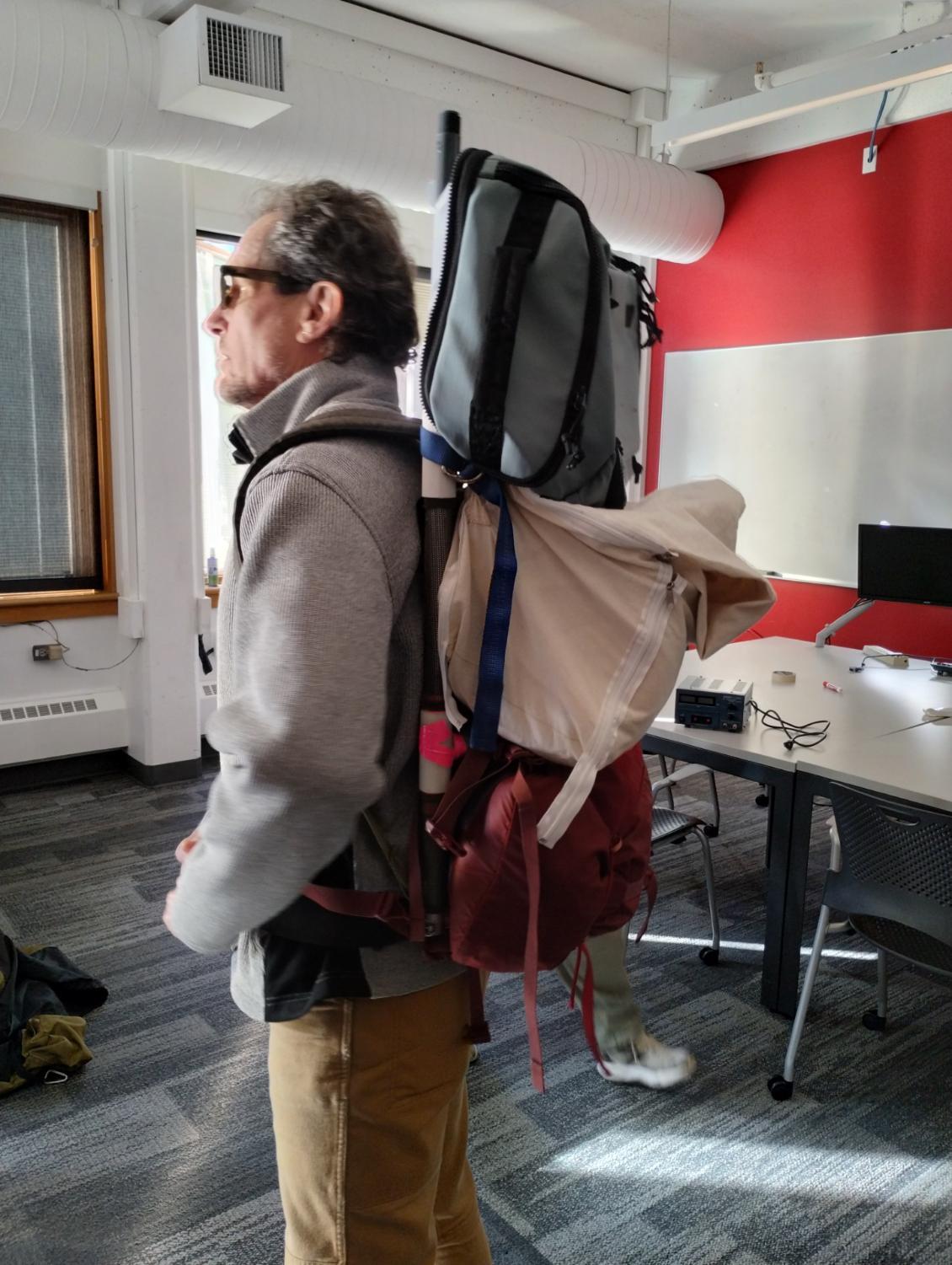
A closer look at the Onepac.
Starting at the drawing board the team began with building on a trial-and-error process to achieve the vision of Philip Brock, owner of sponsor Project Furnish, LLC. An environmentalist and outdoors enthusiast with a background in architecture and computer programming, Brock prizes products that are well-designed, multi-purpose and made for extended use.
Brock wanted to develop a modular system that would allow users to buy pieces à la carte but, when added together, would be a pack that could separate into a frameless 10-liter daypack, a 30-liter overnight pack and finally a 50-liter framed pack for extended backcountry use. If that wasn’t enough, the design would allow the pack to convert into a tent, with the tent poles stored in the frame. But that’s not all! The frame could also be converted into a chair that could support 250 pounds.
The idea of integrating the system came to Brock while he was on a week-long trip helping to maintain the Pacific Crest Trail. He realized that while in camp, a hiker’s backpack was just sitting there and often the hiker was sitting on the ground.
“So how can I have one thing that does all of that?” he asked himself.
As the team worked over the project, some of the initial solutions floundered, which they then used to make the final prototypes work even better.
“We learned to accept that failure is sometimes part of the process and we used it as an opportunity for growth and to make the design better,” says Mittelstaedt. “And we stopped seeing it as failure over time.”
Associate Teaching Professor Eric Gilbertson, PhD, an accomplished mountain climber, served as the team’s faculty advisor and commended the team’s innovative solutions, such as figuring out the shape of the backpack so that it could switch into the tent’s rain fly.
“They had some interesting ideas with zippers and origami folding so that they can go back and forth,” he says, noting that the market for the design would include people like him who forgo luxuries like chairs to save weight.
“If someone just wants to save weight, they're not going to bother with a chair,” he says. “I don't bring a chair, but because of the novelty, I might consider it if it's built into the frame.”
The team is producing two prototypes of the complete system. As the weather warms up Brock and his friends are going to serve as enthusiastic guinea pigs for the field test.
“And I'm ready,” Brock says.
Similar News & Stories
-
/0x70:1200x828/prod01/channel_34/media/seattle-university/news--stories/images/Shen-Ren-in-lab-with-students-USE-.jpeg)
Building a Research Enterprise
SU NewsNational Institutes of Health awards three College of Science and Engineering faculty prestigious research grants. -
/0x42:2400x1558/prod01/channel_34/media/seattle-university/news--stories/images/STEM-showcase-lead-pic.jpeg)
Research Takes Center Stage
SU NewsCollege of Science and Engineering hosts showcase for STEM-related student and faculty research. -
/0x119:2000x1382/prod01/channel_34/media/seattle-university/albers-school-of-business/news-and-events/albers-news/images/Student-spotlight-Lars-Kaser-SBI-Amazon-Spheres.jpg)
Finding Purpose at Albers: Lars Kaser's Path from High School Participant to Campus Mentor
Campus NewsFinance major Lars Kaser went from Summer Business Institute participant to peer counselor, and now helps first- and second-year students build their leadership skills.