/16x0:1173x738/prod01/channel_34/media/seattle-university/news--stories/images/Cornish-Kirk-lead-image.jpg)
Cornish Design BFA graduate blends art and technology to create interactive and humanistic experiences.
For Kirk Holland, earning a Bachelor of Fine Arts in Design marks the continuation of a journey that began decades earlier.
After leaving the University of Washington Tacoma while pursuing a computer science degree, Holland built a career in the restaurant industry before deciding it was time to return to school. That decision came in 2021, when an encouraging conversation with his girlfriend prompted him to reconsider what came next.
“Since my financial and mental health were more stable at this time, I thought I could finally take another crack at a degree,” says the 2026 graduate. “I had fallen in love with painting in 2013 and discovered that there was a field called UX (Interaction Design) that merged my computer skills and training with my newfound love for art.”
As a combat veteran and participant in the Veteran Readiness and Employment (VR&E) program, Holland carefully researched programs before choosing Cornish. Learning that the college offered a Bachelor of Fine Arts in Interaction Design—and meeting Design Chair Jake Fleisher—confirmed he found the right fit.
Inspired by principles of universal design, Holland is interested in creating experiences with the user in mind—that means people of all ages and abilities—and centered on accessibility, inclusion and human connection.
“As a veteran with disabilities myself and as someone who taught my grandparents how to email in the ’90s, I really enjoy making people feel included as technology advances,” he says.
For Holland, both art and user experience are fundamentally social. He believes meaningful design creates opportunities for conversation rather than distracting from it.
“Good art, in my opinion, is anything that contains a dialogue,” he says. “As long as a piece is talked about, it is alive.”
He applies that same philosophy to interaction design.
“I always say that good UX is any user experience that you can participate in while holding a conversation with the person next to you,” he says. “With the tasteful use of technology, we can let the interface be frictionless and let the art stand on its own—or we can design the interaction to become part of the experience.”
That thinking informed his BFA project, the Community Art Share Kiosk. The interactive digital gallery allows anyone to contribute artwork by scanning a QR code and uploading an image from their phone. 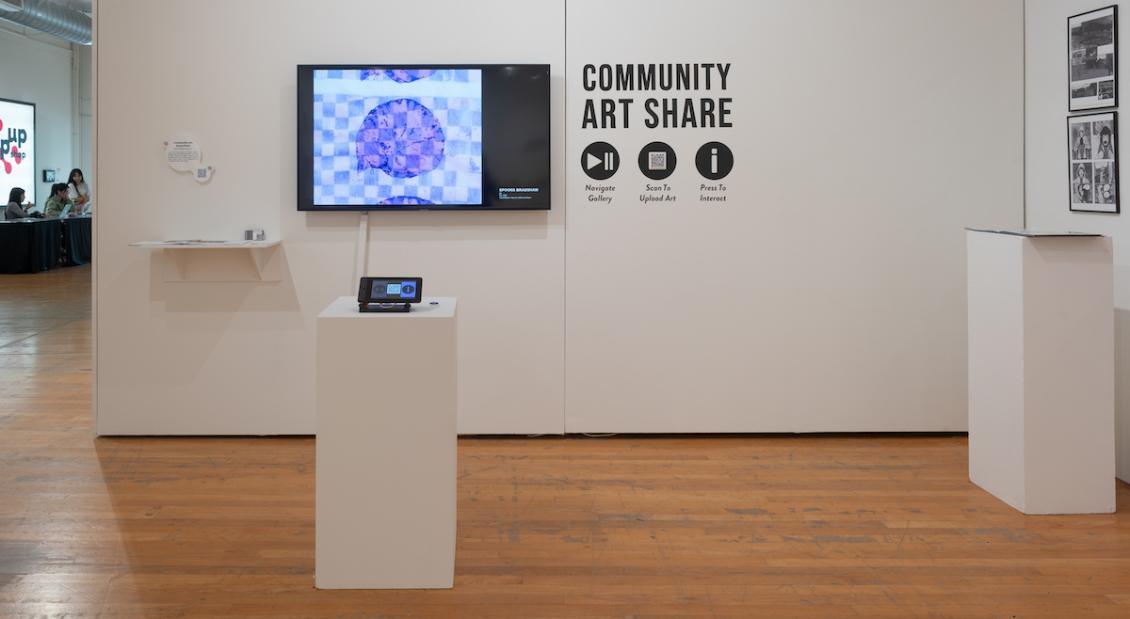 “It’s a place for anyone to be a part of a digital art gallery,” Holland says. “You find a picture of your art on your phone, scan the QR code, tell us a bit about it, and you are added to the gallery.”
Beyond the arts, Holland hopes to apply interaction design to everyday systems that often create barriers rather than opportunities. He points to government services and digital platforms as areas where thoughtful UX could make a meaningful difference, especially for older adults and people unfamiliar with rapidly changing technology.
“I want to use UX to streamline the whole need-a-login-for-everything, two-factor-authentication, are-you-a-robot mess that we’re currently suffering in,” he says. “There has to be a better way.”  Kirk at the opening of the 2026 BFA showcase.
Post-graduation Holland plans to spend the next year collaborating with organizations where art and technology intersect, including maker spaces and community-focused creative initiatives. Rather than rushing into a traditional full-time role, he hopes to continue building projects, volunteering and learning through collaboration.
“I want to build and continue learning,” he says. “I’m going to meet lots of people and travel and share my skills and enthusiasm with the world.”
For Holland, interaction design is ultimately about reducing friction—not only in technology, but in the ways people connect with one another. Whether through digital art, public spaces or civic systems, his work reflects a belief that thoughtful design can make everyday experiences more accessible, more welcoming and more human.
Similar News & Stories
-
/105x0:1815x1080/prod01/channel_34/media/seattle-university/news--stories/images/Princeton-Review-photo.jpeg)
The Value of an SU Education
SU NewsPrinceton Review highlights university in list of ‘Best Value Colleges' in the nation. -
/0x20:1200x778/prod01/channel_34/media/seattle-university/news--stories/images/Fall-move-in-with-Dr-Mast-and-staff.jpeg)
Welcome Back, Redhawks!
SU NewsThe campus comes alive as students return and fall quarter gets underway. -
/0x89:5090x3304/prod01/channel_34/media/seattle-university/college-of-arts-and-sciences/images/ChrisPerry_yck_017.JPG)
Supporting Community Mental Health and Whole-Person Care: Graduate Opportunities at Seattle University
Campus NewsSeattle University’s College of Humanities, Education and Social Sciences offers several graduate pathways to prepare students to work in community mental health.