Making a Splash
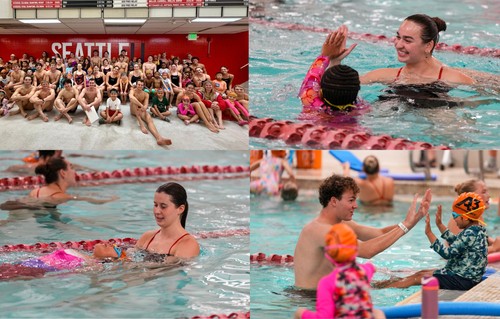
For the second consecutive year, Seattle University’s swim team has stepped into the role of instructors, helping local children learn to swim and develop important water safety skills through the Swim Safely Series program.
This fall, 44 SU student-athletes volunteered for the five-day program, organized in partnership with the nonprofit No More Under. The initiative provides free swimming lessons to 56 children, many of whom had little or no previous experience in the water.
The partnership with SU began in spring 2025, when No More Under approached Athletics about hosting the program. Founded by Chezik Tsunoda following the drowning death of her three-year-old son, Yori, in 2018, the organization works to prevent childhood drownings by addressing barriers to swimming education.
“The fact that this nonprofit was founded in the Central District makes it even more powerful because we’re able to serve our immediate community,” says assistant swim coach Jack Neton.
For Neton, the organization’s local roots give the partnership particular significance, allowing the team to contribute directly to the community surrounding the university.
The program takes place during the swim team’s preseason training, before the academic year begins. After completing their morning and afternoon practices, student-athletes return to the pool in the evenings to teach children. For SU swimmers, the Swim Safely Series offers an opportunity to put years of training toward something beyond competition, sharing their skills with children who might otherwise have limited access to swimming education.
While most athletes serve as instructors in the water, student coordinators help organize the sessions and manage logistics. This year, graduate student-athlete Kyle Lewis and another swimmer coordinated the program, with support from the coaching staff and No More Under representatives.
The lessons follow a structured curriculum developed by No More Under, beginning with basic water familiarity and progressing toward skills that could help children respond safely in an emergency.
On the first day, participants practice blowing bubbles, controlling their breathing and becoming comfortable putting their faces in the water. Subsequent lessons introduce back floating, calling for help, identifying lifeguards and understanding why they should never swim alone. Later in the week, participants practice rolling from their stomachs onto their backs and responding to emergencies. The final day focuses on life jacket use and self-rescue techniques, including reaching the pool’s edge or moving toward shallower water.
The goal is not to teach children to swim laps in five days, but to provide a foundation of water safety knowledge and practical skills they can continue developing through additional lessons.
Children are generally paired with the same instructor throughout the week, with no more than two participants assigned to each volunteer. This individual attention allows athletes to adapt lessons to each child’s experience and comfort level, whether they are entering the water for the first time or already have some swimming ability.
For Lewis, who helped coordinate the program, the relationships formed between the athletes and children are among the most meaningful aspects of the experience.
Lewis recalls children who were initially hesitant to enter the pool gradually becoming more comfortable as the week progressed. One particularly memorable experience involved a child working with women's swim team captain Mia David.
At the beginning of the week, the child struggled to remain in the water and often ended lessons early. Over the following days, he gradually became more comfortable, spending longer periods in the pool. By the final day, he wanted to take a photograph with David and continue swimming lessons with her.
His mother also shared that, as the week progressed, he had begun looking forward to returning to the pool each day to see his instructor.
Other memorable moments came on the final day, when children received certificates from their instructors. Lewis recalls how excited the younger participants were to receive recognition from the swimmers they had spent the week getting to know. For many, the certificates marked not only their progress in the water but also the relationships they had formed along the way.
The program also addresses a broader need for accessible swimming education. According to the September 2026 Swim Safely Series Impact Report, 62 percent of participating children were attending swimming lessons for the first time, while 67 percent of parents said free lessons were critical to their children’s participation. More than 140 families remained on the waitlist, highlighting the demand for affordable opportunities to learn.
The report also found that 71 percent of participants qualified for free-lunch programs, while 86 percent identified as Black, brown, Indigenous or people of color. Neton notes the diversity of families participating in this year’s program, including households where Spanish, Chinese and Ethiopian languages were spoken.
To help address barriers beyond cost, No More Under provides participants with swimming equipment and water safety resources. On the first day, children receive drawstring bags containing goggles, swim caps and water safety information for their families, including guidance on adult supervision around water. The organization also provides swim caps designed to accommodate different hair textures.
Families receive information about local swimming programs, including reduced-cost options and facilities offering instruction in languages other than English. The emphasis on continued learning is important because five days of instruction cannot replace regular practice.
For SU swimmers, volunteering also offers a different perspective on a sport that has long been part of their everyday lives. While swimming is part of their daily routine, many of the children they teach have never had the same access or opportunities.
“It just opens their eyes to the differences that people have in their experiences in the pool and in the water. And so I think a lot of people took a lot of pride in being able to kind of pass on some of the knowledge that we have in swimming and be able to put that toward a good cause,” says Lewis, ’27, (Master of Science in Finance).
Looking ahead, the university hopes to continue the partnership and has explored the possibility of additional sessions. Potential spring sessions and an extended program have been discussed, says Neton, although expanding the initiative would require balancing the team’s training schedule, academic commitments and the availability of the athletes.
“We really enjoy working with No More Under and can feel the impact even in just one week."
Similar News & Stories
-

Stronger Together: Seattle University and Amazon
Campus NewsSeattle University at Amazon alumni lead mentoring, recruiting and volunteering efforts that open doors for Albers students. -

An Engaged Community Organizer
SU NewsOutgoing CCE Executive Director Kent Koth discusses achievements, leadership and what’s ahead. -
United in Service and Community
SU NewsOn this Veterans Day SU celebrates our veterans and military-affiliated students.