Purposeful Projects, Innovative Ideas
Written by Kiyomi Kishaba and Andrew Binion
Wednesday, May 27, 2026
/0x209:1152x944/prod01/channel_34/media/seattle-university/news--stories/images/Project-Center-NASA-art-inside-psyche-team.jpeg)
From virtual reality experiences inspired by NASA’s Psyche mission to drone research helping track invasive species, students tackle real-world challenges at Projects Day.
This year, when Seattle University’s Project Center presents its 38th annual Projects Day, it will once again put on display the culmination of months of work by science and engineering students on real-world projects sponsored by dozens of companies, organizations and nonprofits.
There are 54 projects across seven departments from 37 sponsors, a mix of returning sponsors and first timers. And some companies are sponsoring multiple projects including Amazon, which is sponsoring six projects, along with 14 new sponsors.
“Even in uncertain times, Projects Day at Seattle University is proof that the next generation is ready,” says Project Center Director Rachael Brown. “Students show up, roll up their sleeves and tackle the real challenges reshaping many industries today, all while building confidence, growing as problem-solvers and forging the networks that will carry them throughout their careers. When the economy shifts, applied learning like this isn't a luxury—it’s how the next generation of leaders gets built.”
In this first in a two-part series spotlighting projects, we look at projects sponsored by NASA, Metrolla and Snohomish County.
**
Project: Psyche Inspired VR: Art Comes Alive
Sponsor: NASA
Student Team: Rehaan Ahamed Cherukattil, Jakob Balkovec, Daniel Sekits, Anastasia Spangler
Faculy Advisor: Susan Reeder, Teaching Professor, Computer Science
By Kiyomi Kishaba
NASA’s spacecraft is less than a month away from flying by Mars for a gravity assist, a key point on its trajectory to investigate the unique, metal-rich asteroid, Psyche.
The NASA Psyche mission, led by Arizona State University, was selected for NASA’s Discovery Program in 2017 to investigate Psyche. The asteroid is orbiting the Sun between Mars and Jupiter and appears to be made of nickel-iron core material—the remnant of an early planetesimal. Psyche presents a unique opportunity for scientists to investigate the violent collisions that created Earth and other terrestrial planets. In 2023, NASA launched the spacecraft that will reach Psyche in 2029 to capture images and collect data.
An important student component of this mission is the Psyche capstone program, which involves select teams of undergraduate seniors from colleges and universities throughout the country applying their knowledge and skills to real-world projects, focused on the Psyche mission.
“The Psyche mission team holds as a core value that there are space exploration-related jobs in all disciplines,” says Psyche mission principal investigator Lindy Elkins-Tanton. “The ubiquity and diversity of capstone and senior design courses at colleges and universities…has provided an accessible and sustainable way for missions like ours to engage with undergraduates in small groups or at scale.”
SU’s computer science team of Rehaan Ahmed Cherukattil, ’26, Jakob Balkovec, ’26, Daniel Sekits, ’26, and Anastasia Spangler, ’26, were selected to participate as one of more than 90 senior design teams at 14 universities nationwide.
The project prompt—virtually showcase hundreds of art pieces created through the Psyche Inspired program.
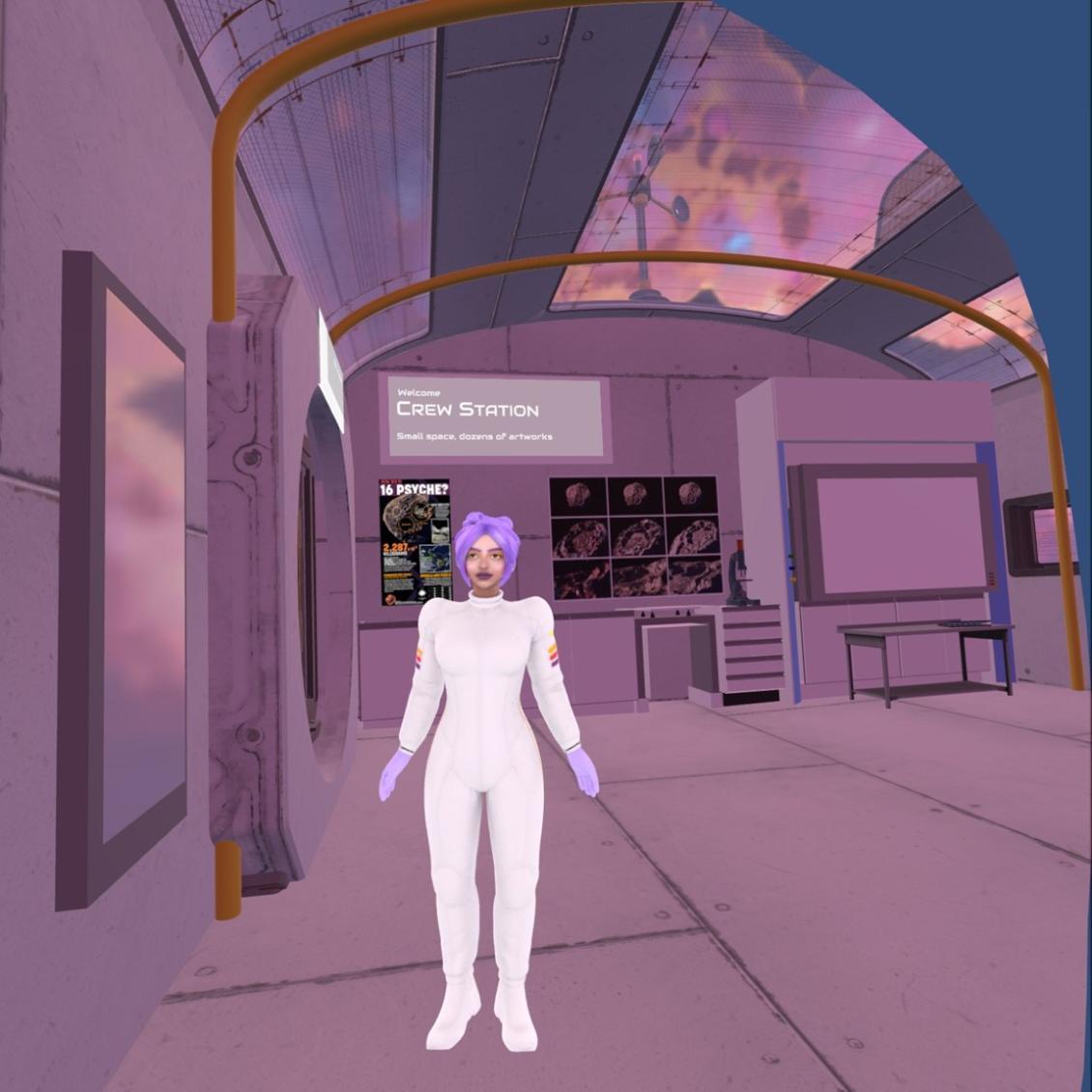
Psyche Inspired invites undergraduate students from any major to share the excitement, innovation and scientific and engineering content of NASA’s Psyche mission in new ways through artistic and creative works. The art runs the gamut from embroidery to sculpture to food, as shown through SU alumna’s Cameryn Laborte, ’22, Psyche Inspired decorated cookies.
“The core mission was bridging the physical and digital divide by transferring physical artwork into a fully realized virtual reality world,” says Balkovec. “We had the physical pieces shipped directly to us so we could scan and import every detail. We finished the first milestone, a functional VR gallery, in just two weeks. Seeing how quickly that scene came together was sort of a wake-up call for us. We stepped back, looked at what we had built and realized we had the momentum to do something much more ambitious.”
Despite having limited game development experience, SU’s student team dove into creating an interactive virtual reality game with a storyline. The user begins on Earth in a scene called Gateway Gardens, designed to mimic a public park and ground the user in a familiar environment. The user then boards a train to a scene called JPL Plaza set on Mars, representing the next major waypoint for the Psyche spacecraft. The plaza is a simplified recreation of NASA’s Jet Propulsion Laboratory, including the mission control room, a clean room and the spacecraft assembly facility. From there, the user boards a train to Dome Gallery, a scene housing the majority of the art collection including 2D, 3D and interactive artwork.
“The team was excited to begin the project and got more done during the Fall Quarter than most teams I've advised,” says Computer Science Teaching Professor Susan Reeder, who is the faculty advisor on the project. "They were given little information to begin with and managed to figure out how to make 3D scans of physical artwork—a task with several steps—and incorporate them into a VR environment.”
One of Balkovec’s favorite art pieces is the Butterfly Effect, a clay depiction of the asteroid with colorful butterflies. The student team took that inspiration and created a full butterfly room, complete with animated butterflies that the user can walk through before reaching the artwork in the center.
“I didn't come into this with a background in game development, so the learning curve was steep, but we eventually found our rhythm. The real key was just staying on the same page as a team and keeping a constant dialogue with our sponsor,” Balkovec says. “We put a lot of work into the parts of the game that players never see, so watching people actually play through it is the best part of the process.”
Cassie Bowman, associate research professor in the School of Earth and Space Exploration at Arizona State University, is the lead of the Psyche Student Collaboration Program and the sponsor liaison for SU’s student team. She was impressed by the students’ tenacity and big-picture thinking in pushing the boundaries of what could be done in VR.
Once completed, the virtual reality game will be part of NASA Psyche public events held across the country. In the long term, Bowman hopes to provide universities with the ability to host small events to showcase Psyche Inspired artwork through the virtual reality world.
**
Project: Investigation of Optimal Drone Flight Parameters to Capture Water Surface Features
Sponsor: Snohomish County
Student Team: Catherine Orange, Isabella Zazzali, Liliana McClain and Amanda Bunt
Faculty Advisor: Wes Lauer, PhD, PE
By Andrew Binion
Fragrant waterlilies, with their pink lotus-like flowers floating on a pond’s surface, sound just lovely.
“They are an invasive species,” clarifies Amanda Blunt, ‘26, an environmental science major, of the nymphea odorata—otherwise known as invasive fragrant water lilies.
Despite its enchanting name, the noxious weed that proliferates in shallow water during summer months is blamed for damaging water quality, choking out native plants, assisting in mosquito breeding and possibly even posing hazards to swimmers who can get tangled in dense patches of the aquatic plant’s underwater stems.
That’s why officials in Snohomish County, north of Seattle, fly camera-equipped drones over lakes to monitor the spread of the lilies. But even with this advanced technology, which stitches the photos together in a “mosaic” of an entire waterbody, environmental factors like reflecting sunlight and ripples can distort the view.
“It's like the water surface becomes a mirror,” says Gi-Choul Ahn, PhD, principal GIS analyst for Snohomish County Snohomish County Conservation and Natural Resources and Surface Water Management. “We see cloud features, we see blue sky on the water surface, but our goal is to see what's happening on the surface of the water or just slightly below the surface of the water.”
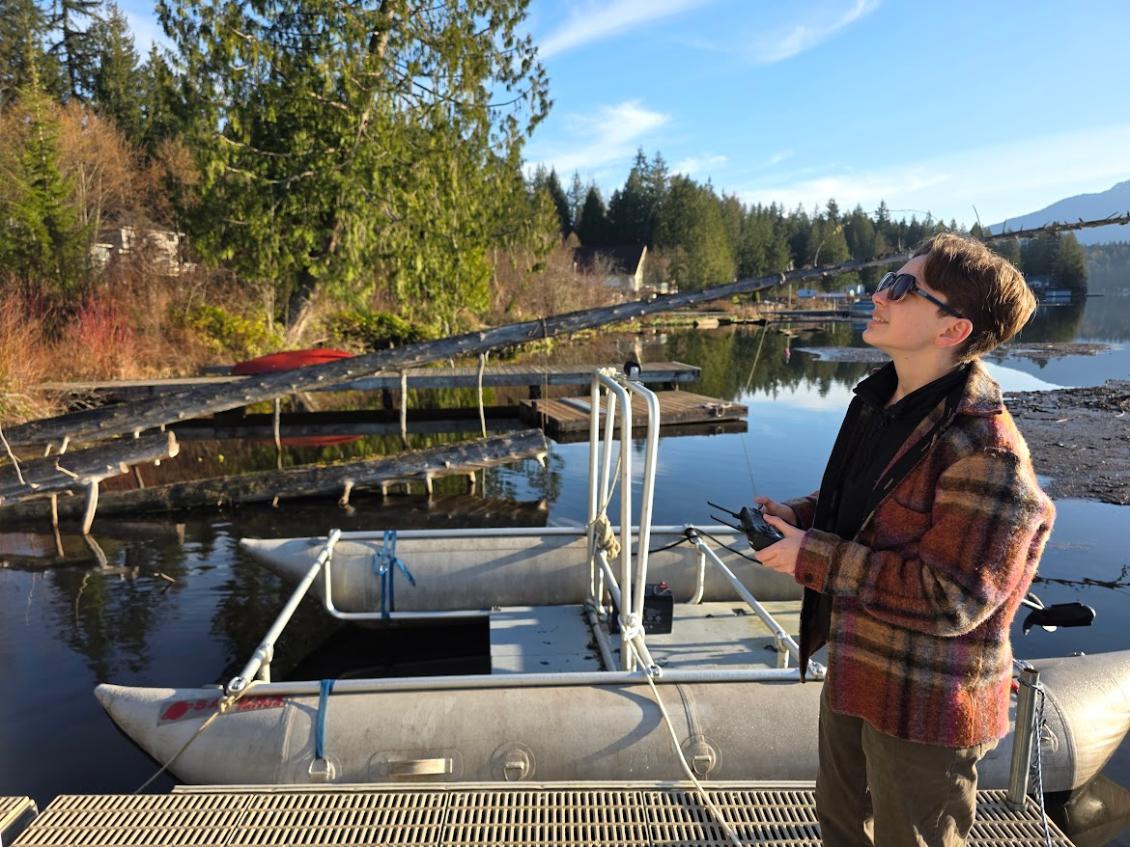
Enter Blunt and the team, tasked with the “Investigation of Optimal Drone Flight Parameters to Capture Water Surface Features.” The group includes fellow environmental science majors Catherine Orange, Isabella Zazzali and Liliana McClain, all of whom will graduate this year.
At first, the team thought the problem might be easily solved. That thinking didn’t last long.
“It’s not just X, Y, Z variables. It's 10 billion variables,” Blunt says. “There’s all these environmental variables that we can't control and only a few drone parameters that we can control.”
The team constructed an experiment to test different approaches to filming from above to construct a flight configuration matrix. First, they fabricated wooden “lilies” to use as markers in open water to assist in tying the images together—a solution they came up with themselves. Then they tested variables such as speed, altitude and angle and strength of sunlight, first at Lake Washington, closer to campus, then at Lake Roesiger in Snohomish County.
The group will present their findings in July at the Society for Conservation GIS in Colorado and is aiming to publish in a journal.
Through the year-long project, students are diving deep into literature on similar projects, as well as skill-based learning like geographic information systems and aerial imaging.
“They had a lot of reading because this is an area where there is a lot of active research,” says faculty advisor Wes Lauer, PhD, PE, professor and chair of the Department of Civil and Environmental Engineering, which has won more than 25 national awards for its projects in the past two decades. “They had to distill that material down to something that was usable that could guide a set of flight plans.”
What has most impressed Dr. Ahn, however, is the students’ methodical approach to gathering data and their commitment to clear, consistent communication—an ability that carries exceptional value in the professional world and works hand‑in‑hand with the strong critical thinking and problem‑solving skills they are developing.
“In the real world, I think there's nothing better than excellent communication,” says Dr. Ahn.
**
Project I: Modular PTZ-LiDAR System with Universal Mounting
Sponsor: Metrolla
Student Team: Kyler Fogerty, Alex Liu, Laurel Maronick, Aidan Rust, Tony Tran
Faculty Advisor: Mehmet Vurkac, PhD
Project II: Lidar-Camera Autonomous Calibration
Sponsor: Metrolla
Student Team: Pepper Berry, Anwi Gundavarapu, Ethan Holden, Kenny Nguyen
Faculty Advisor: Lisa Milkowski, PhD, Associate Teaching Professor
By Kiyomi Kishaba
When Adam Szablya, co-founder and CEO of Metrolla, needed a problem solved, he turned to Seattle University’s Projects Center.
“My dad, Steve Szablya, used to be faculty at SU and oversaw the facilities department, so I have connections at SU and recalled the Projects Center,” Szablya says. “I was interested to see what students would come up with and if it was even possible.”
Szablya founded Metrolla in 2020, responding to a need in the market for versatile data collection systems that allow companies to optimize the spaces they work in. Using advanced LiDAR (Light Detection and Ranging) technology, Metrolla’s DataBlade™ product creates 3D maps of environments and analyzes the data for a specific goal. For example, data analysis of a construction zone could be used to optimize worker safety, trigger safety warnings and track any incursions into the work zone.
“The problem to address was our LiDAR camera system needs to be calibrated,” Szablya says. “The manual calibration takes four and half hours, which is not scalable.”
For this project the student team of engineering students (Kyler Fogerty, ’26, Alex Liu, ’26, Laurel Maronick, ’26, Aidan Rust, ’26, and Tony Tran, ’26) focused on developing a modular Pan-Tilt-Zoom (PTZ)-LiDAR system that utilizes non-commercial equipment. The team created a universal mounting system for both the PTZ camera and LiDAR sensor, a great cost-savings opportunity.
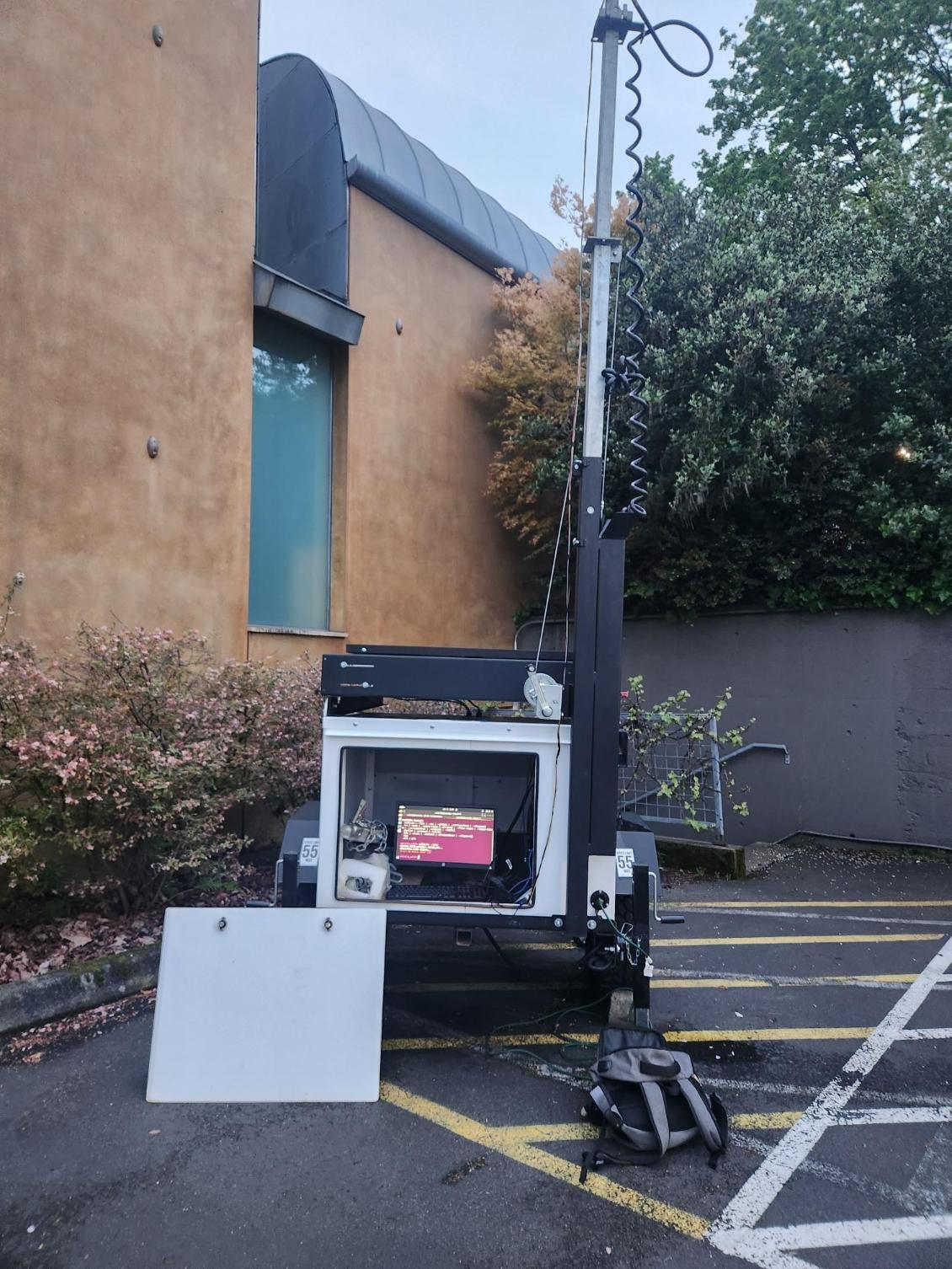
This is one of two projects from Metrolla. The second features a team of computer science students (Pepper Berry, ’28, Anwi Gundavarapu,’27, Ethan Holden, ’26, and Kenny Nguyen, ’26) who were tasked with automating the calibration sequence between the LiDAR sensor and PTZ camera to eliminate manual effort and improve system efficiency and reliability.
“Metrolla’s trailers have a camera and a LiDAR system on them, which take data in two specific ways, and because of the way they’re installed, we don’t know how to perfectly line them up,” says Berry. “We are making an automatic process in which we take the input data of the camera and LiDAR and create software to calculate the offsets.”
To do this, the team filters the data and matches the points where the two spaces overlap.
“If you have a parking lot with a cluster of four cars, you know that cluster exists in both planes and have to match up to each other,” Berry says. “Right now, the whole thing has been tested with fake data and it completely works. The next step is using real data.”
One of Metrolla’s trailers, outfitted with a seven-foot pole, is parked in the Pigott parking lot on campus for both teams to reference and use for testing. Once the pipeline is solidified, the computer science team will work to create documentation for Metrolla’s engineers to use the process going forward.
“My team has been a great asset in this. They all play really integral roles in the work we do,” Berry says. “I’ve learned more about how startups and smaller businesses work and having access to somebody like Adam is not always something you would have in a larger company.”
Szablya has worked closely with the student teams throughout the academic year and is impressed with the results.
“The brilliance shines through in ways you didn’t expect. I would never have thought of using a 3D modeling engine to get point vectors, or separate objects for building an algorithm,” he says. “It’s really cool to see what they’ve been coming up with.”
The final software solution will be added to units in the field to be fully tested. Once certain criteria are met, the solution will be provided to one of Metrolla’s customers to improve a previous product and potentially be sold to other clients.
“This isn’t an empty project. We have partners wanting to sell this and competitors deploying stuff like this, so there is a market for it,” Szablya says. “What we’re achieving is hugely valuable.”
Projects Day is noon-6 p.m., Friday, June 5, in Sullivan Hall (School of Law building). Virtual attendance available via Zoom. Learn more and RSVP to be part of the action.
Similar News & Stories
-
/0x57:1200x815/prod01/channel_34/media/seattle-university/news--stories/images/Semester-wins-military-photo.jpeg)
On the Right Path
SU NewsMove to semesters will benefit veteran and military-affiliated students beyond graduation. -
/26x0:2352x1469/prod01/channel_34/media/seattle-university/news--stories/images/CHESS-story-photo-rooftop.JPG)
A New Chapter Begins
SU NewsCollege of Humanities, Education and Social Sciences looks to the future. -
/91x0:1581x941/prod01/channel_34/media/seattle-university/news--stories/images/Makerspace-collage-copy.jpg)
Creativity Flows at Makerspace
SU NewsA place where students, faculty and staff can tap into their artistic side, experiment and bring ideas to life.