Clio Speaks: History Today
Seattle University History faculty essays.
Clio Speaks is a regular column for the Seattle University History community, with essays authored by faculty and the affiliated, on a variety of topics related to their research and classes.
It is a space for musings informed by expert knowledge in all the areas that the History Department reaches. These informal essays offer personal perspectives on history and yield insights into the past, present, and future.
We hope you enjoy them.
An interview about archaeology with Claire Hood, '24
Dr. Randall Souza: This summer I was lucky to have two Seattle University students from the College of Arts and Sciences join me to participate in an archaeological excavation I co-direct in Sicily. Having previously taken classes on ancient Mediterranean history with me, these students joined the American Excavations at Morgantina: Agora Valley Project for the 2023 season. They learned and practiced proper excavation methodology on the site of an ancient public building, possibly a sanctuary, and also spent time with the post-excavation materials analysis, geospatial recording, ceramics analysis, and environmental analysis teams, all the while adapting to life in a rural town in central Sicily. Sadie Nelson interviewed one of the students, Claire Hood, about her experiences this summer, ranging from the city’s ancient history to its modern lifestyle and everything in between.
 This interview has been edited for clarity.
Sadie Nelson: What led you to want to go do archaeology for a summer? Did you have anxieties on the plane as you deboarded and stepped foot onto Sicily?
Claire Hood: It was my first time traveling alone, so that was a fun adventure to fly internationally for the first time alone and go to do archaeology. I've always been curious about human existence, and that's the draw for history and specifically archaeology, of comparing the ancient past to the present and how a lot of things influence one another.
SE: That's so fun; did you ever picture yourself going to do archaeology for a summer?
CH: I never imagined doing archaeology as a possibility for my summer, and it was an incredible experience to do something really far outside my comfort zone.
SE: What was the setup of the camp like?
CH: We were in a town called Aidone, and then we took a bus every morning. We were then driven to the site and then we spent the whole day at site, and we would dig from 7 a.m. to 5 p.m.
SE: Did you get sunburnt?
CH: No. I did not get sunburnt, which was impressive. I got a pretty bad farmer's tan when I wasn't wearing my sun shirt, and I definitely got used to wearing a goofy hat all summer.
SE: Was it really hot?
CH: Every day? Yeah. So, there was a record-setting heat wave called Cerberus, and that happened during Week 2. And so, it changed our digging schedule. We started digging at 6 a.m., until 2 p.m. so that we could beat the heat. And one day was really fascinating because there were wildfires and there was a wildfire on site. And so, there were firefighters, like, just over a hill putting out a fire. And we could see the smoke over the hill. And we were just digging at the site. And we could only dig at the site because the firefighters were there.
SE: That's crazy. What was that experience like? Were you scared at all? Plus, it's like an ancient site; were you nervous about destroying something by accident?
CH: I mean, there's always nerves when using like a large tool.
SE: What were the tools that you used?
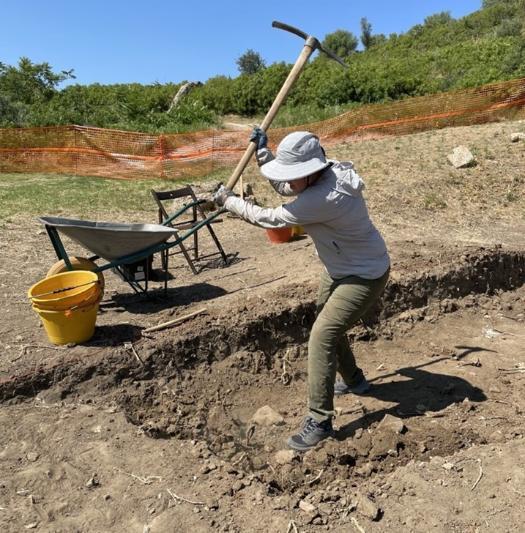
CH: We used pickaxes, and large shovels. I'll show you a picture.
CH: We used pickaxes, and large shovels. I'll show you a picture.
Copy of the photo shown
SE: That’s like Minecraft, that's fire. You kind of look like a beekeeper.
CH: Yeah, that's my funny hat. So that's, that's my pickaxe.
SE: How did you use these tools? Would you just measure on the ground and then get to work?
CH: We wouldn't measure. The site supervisor determines where you dig. Then we would pickaxe through topsoil.
SE: What’s topsoil?
CH: Topsoil is the upper layers of dirt. The amount changes depending on where in the trench you are digging. Normally there were multiple inches. Probably there were some areas where the trench was like 3 feet deep, and in other areas where the trench was like 6 inches deep, depending on how much topsoil there was and where the walls and other artifacts were located.
SE: How can you tell when the type of soil changes? Are you picking at it and the soil suddenly changes?
CH: Yes. So, as you're pickaxing, you have to be really aware of what you're pickaxing, and how all of the soil changes happen.
SE: Was it difficult to do this given the heat wave?
CH: Yeah. It was extremely strenuous work. Extremely strenuous physical work while having like a mental game of paying attention to the dirt you're digging and what's in the dirt and paying attention to like pottery shards and soil changes. And we had like 4 keywords that we would use to describe the soil. And [we had to pay attention to notice] if there was a soil change.
SE: What were these words? Are they Italian?
CH: They're not Italian. I can't remember them exactly. I should know, something like coarse, silt, sand. [But these are the descriptors]and then you would also identify the color. You are constantly calling over your trench supervisor to look at things and being really aware and sensitive to what you're digging.
SE: That's so cool. How was your experience learning history outside of a classroom setting? Instead of reading and discussing something, how was it different to have dirt in front of your face? What was it like having that form of history?
CH: I would say it was a cool discovery. The element of discovery, I think was really cool, to unearth, for example, a wall that hasn't been seen in thousands of years.
SE: What were you thinking about as you were digging? What was it like uncovering records of people's lives thousands of years ago? Well, I don't know about thousands, actually what was the time frame?
CH: It was from 300 BC.
SE: Oh, that's so old. That's crazy. So that was right before the Hellenistic period.
CH: Yeah, around the Hellenistic period. It was almost hard to have perspective on how old the pieces of pottery were. They were thousands of years old, but it was really grounding to be able to pull out a piece of pottery and take it to the trench supervisor and look at the thread on it and identify where it was from.
SE: That's crazy.
CH: And during lunch, we would wash pottery and sort pottery occasionally. We didn't do it too often because we didn't find a lot of pottery we could save.
SE: What determines if you can keep the pottery?
CH: It depends on what level of soil it's in because that's how old it is. One issue with the site we were digging at was that the topsoil had been used for farming, so there was evidence that a plow had gone through, and we found horse teeth and bones.
SE: Was it chilling to find post-mortem objects?
(What was it like finding dead stuff? Was it creepy?)
CH: I would say washing it afterwards was like the creepier part; removing the dirt from the bones. But I would say finding bone was one of the coolest parts of the things we found.
SE: How was the experience of uncovering stuff physically?
CH: There's a certain level of exhaustion that you feel the whole time, and so it depends on the task because there were a lot of tasks that were like trench maintenance. You're not necessarily going to find something when you're scarping a wall. But it's super important to have a scarp that is 90 degrees (flat base and side). But [at the same time] you understand that though this task of scarping may not be the most fun, because I'm not going to discover much, it's still an integral part of how the trench functions.
SE: Did you enjoy scarping?
CH: Yeah, I personally loved scarping because of how scarping is where you make flat 90-degree walls on the side of the trench. So you take a hand pick and you're just making it as flat as possible, and so that allows you to see soil changes in the layers.
SE: That sounds like a nice, not tedious task, but it's something that's small and you can accomplish so you feel better afterwards?
CH: Yeah. Except for when your trench supervisor tells you to do the whole trench.
SE: What are your takeaways from this experience?
CH: There's a level of gratitude for academic work that doesn't require physical labor. Thinking about typical courses, it's a whole lot less demanding to be reading a book in the comfort of my own home than it is to be shoveling dirt. But it's also less thrilling to read a book. It's more thrilling to be in the field and doing something that's never been done, and to have the curiosity. If I weren't a curious person, it would have been a lot more challenging.
SE: What did you eat? I remember hearing something about eggs.
CH: I did eat multiple hardboiled eggs every single day.
SE: Do a lot of people in Sicily eat eggs, or is it more an archaeology thing?
CH: It's an archaeology norm because you're doing so much physical labor, you just have to get the calories in your body. And so I would eat yogurt and hard-boiled eggs every morning. And some mornings I would take an extra
egg into the field and have a pocket egg.
SE: Did you ever break your pocket egg by accident?
CH: I broke my pocket egg many times and so I would eat my pocket egg in the afternoon after it had been sitting in the sun for probably 6 hours, but I was hungry, so I ate my pocket egg.
SE: What did you do on the days when you weren't doing archaeology? When you went out on the town, how was that?
CH: Being in the town was really awesome because no one spoke English.
SE: Did you pick up any Italian?
CH: I learned enough Italian words that I could use Spanish okay to communicate and go to the grocery store and understand when it was open and closed. But then I would go to the grocery store a lot of times and it was closed, because they would close the grocery stores at random times.
SE: Was it a mission to get to the grocery store?
CH: There were probably 3 grocery stores you could go to, and it was always a gamble of which one was going to be open. There was one that had karaoke, and we were there on our second day. Our first full day there, we had a scavenger hunt around town.
SE: Oh, that's cute. Did Dr. Souza plan it?
CH: We went all around town and had to speak to locals and get clues from them. And we would go to the bar and ask people at the bar a bunch of questions, and they didn't understand our English. My team actually ended up winning the scavenger hunt.
SE: I mean, of course they did. They had a secret weapon. It was you.
CH: Yeah, during the scavenger hunts that day we had a site tour as well. And so, between the scavenger hunt and all of our daily activities, it was supposed to be a rest day because we had all flown in the day before. But on our rest day we did about 10 miles of walking.
SE: How was it starting the dig?
CH: The next day, we started digging. I would say the funniest concept of archaeology is the idea of clean dirt,
and that dirt can be clean, that even though it's still dirt it’s clean.
SE: What is clean dirt?
CH: When you're in the trench, you do a trowel line where you scrape off dirt from dirt. And so it's clean dirt because you've removed the top layer of dust with a paintbrush or some brush [larger than a paint brush]. But then you have clean dirt. And I always thought that was kind of funny.
SE: What was it like working? Did you have a team?
CH: There were about 18 student volunteers, I think. And then we had trench supervisors who were people that were finishing their PhDs. There were also advisors who were professors. It was really helpful to learn about the PhD process from completing their PhDs because I hadn't been exposed to what it was, what a PhD entails. It gave me a lot of perspective on what it's like to be a professor. It takes a lot of drive to want to finish a PhD, and it takes a lot of curiosity, and you really have to be invested in a topic to do your PhD on. So that was a really good perspective to gain from the people.
SE: It is good that you got takeaways from this experience about post-college life.
If you could go do archaeology anywhere, hypothetically with unlimited money, where would you go? I don’t know if you have an archaeology fantasy now.
CH: I mean, I would go back to Morgantina because it was so sweet, but I would learn scuba-diving archaeology.
SE: That's so cool.
CH: Yeah, one of the professors or one of the trench supervisors did [scuba-diving archaeology]. It just seemed really cool.
SE: The larger body for academic archaeology here in the United States is the Archaeology Institute Association or the AIA. I wanted to ask your opinion on their mission statement, and how it relates to your experience having done some archaeology. The organization is aimed at creating “public understanding of the material record of the human past to foster an appreciation of diverse cultures and our shared humanity.” What do you think of this statement, and is that something you experienced?
CH: I would say that's a great way to frame what archaeology's purpose is, because a lot of people I've talked with are like, well, what's the point of archaeology? And it's to understand how we got to
the present, in my opinion. One of the most interesting factors is what were people doing thousands of years ago that we're also doing today?
SE: In participating in the dig, did you feel a humanized connection to people in 300 BC?
CH: Yes. And I would say Professor Souza's class really does that; we are expected to draw connections between the present and the past. And there was a lot of curiosity about how [things functioned in the] past. For example, seeing the bath houses on site was extremely exciting.
SE: What are those bathhouses near the site like?
CH: They had excavated them years ago, and it was really cool to see because the site is also visited by tourists. So there were some days when tourists would come to site and watch us from a fence and take photos of us. And that was how hilarious it was, since we were a tourist attraction for a moment.
SE: Did you wave at the tourists watching you?
CH: No, no, I didn't acknowledge them because they were up on a ridge watching us. But some of them
watched us for 20 minutes.
SE: But it is cool that you felt a connection to people in the past and related to them as people. Well, I don't know how to explain it, but it’s nice to think that people in 300 BCE enjoyed similar things to us now.
CH: Yes. An example is even the mosaics, how they become 3D-like. If you look at a certain angle, principles of graphic design with a drop shadow and a stroke around certain things still applied back thousands of years ago, just in mosaic form instead of through Adobe InDesign.
SE: So as a journalism major, have you had similar experiences of learning outside the classroom? How did that compare to archaeology?
CH: I had worked in an office for an entire year before with Seattle City Light as an intern, and so archaeology was extremely different from being in a skyscraper every day. It wasn't necessarily better or worse, it was just different. And I really liked how hands-on everything was about archaeology. There was something new every single day that I appreciated.
SE: What did you do when you weren’t digging? How did you enjoy Sicily?
CH: [On the especially hot days] we would rest in the afternoons, and it would be 110 degrees in town, and you would just sit on a bed and try to read a book. But it was 110 degrees out.
SE: Who were your roommates?
CH: My roommates were from Texas and Louisiana. They were super into archaeology. They were Archaeology majors. One was just about to start her PhD, so that was exciting. She had done a dig before. And then the other two were just Archaeology majors. That was interesting because I was not an Archaeology major, and they knew a lot. They knew a lot more than me about different history things. But before we left for the trip, the lead professor sent us a bunch of texts that had been published out of Morgantina, and so it was really helpful to read beforehand the texts about the history of the site.
SE: That’s nice, I like the practice of just learning about where you are or are going to.
CH: Yes, it was really exciting because there were so many discoveries and it felt like we're about to discover something you know?
SE: Well, thank you so much for letting me interview you. Do you have any final thoughts?
CH: [Doing archaeology gave me perspective on what it means to work really hard on something that you’re passionate about.
Dr. Randall Souza
Dr. Randall Souza is a professor in the Department of History, who focuses on Ancient History and Mediterranean Archaeology. His research has centered on Siciliy during the fourth and third centuries BCE, and he has significantly contributed to the Contrada Agenese Project in Morgantina. For any questions regarding History and/or archaeology in this piece, please contact him.
Claire Hood
Claire Hood is a current senior set to graduate after this quarter, who is majoring in Communications with a
specialty in journalism. She is also interested in history and has taken a significant number of History courses. As such, the History Department is lucky to have had Claire as a student due to her thoughtful engagement. This summer, Claire participated in an archeaological dig in Morgantina Siciliy.
Sadie Nelson
Sadie Nelson is a current junior majoring in History and Women, Gender and Sexuality and is the student assistant for the History and Political Science Departments. She interviewed Claire about her experience in archaeology this summer.
Dr. Aldis E. Purs
Dr. Aldis E. Purs is a lecturer in the Department of History, who teaches many topics including introductory and comparative history, history of coups, Eastern and Central Europe, and more! For any questions regarding this piece, history, music, or all of the above, please contact him at apurs@seattleu.edu
 In October 2023 my wife Laurie and I completed a magical trip to Nepal, visiting the Kathmandu Valley and then trekking in the mountainous Khumbu region.
Beyond the beauty of the mountains and the hospitality of the people the trip offered many opportunities to think about how the stories of this region illuminate the larger themes in world history that I emphasize in my classes, to note a few.
 While I was trekking in the Khumbu region the UN General Secretary António Guterres happened to visit the region. He focused his trip on illuminating the challenges that these remote regions and their people were facing from climate change. Rapidly melting glaciers are increasing risks from flooding in the steep valleys below Mount Everest. Shifting monsoon seasons are also threatening the agricultural foundation of the region as well as the tourist industry which sustains many who live there. The impacts of the development of a fossil fuel economy in the nineteenth century and its impact on our world today is a major theme of my course.
Many Sherpas in the Khumbu region, facing the challenges of a limited economy in the high mountains, are leaving the area, either seeking work in the Kathmandu Valley or abroad. These migrations, exacerbated by the issues of climate change, are depopulating many of the villages in the region and threatening the cultural survival of these Sherpa communities. These stories of the push and pull of migration are a central theme of my world history courses.
Nepal is also a fascinating mix of cultures. About eighty percent of Kathmandu is Hindu and about twenty percent Buddhist. Both religious identities were proudly and strongly on display (there were several religious festivals underway while we were there) but there seem to be little or no tension between peoples of different faiths; their culture of acceptance and tolerance is a lesson worth noting for all of us in the modern world.
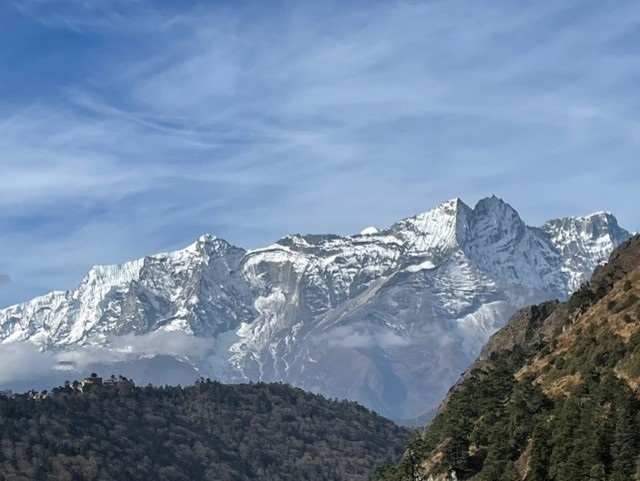
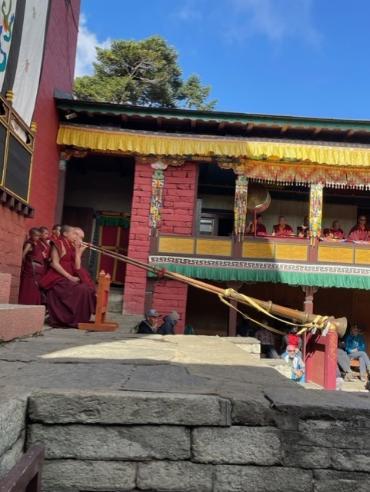
Photos courtesy of Tom Taylor. Top to bottom: Dr. Taylor at Ama Dablam base camp; monks blowing horns at Tangboche Monastery; Mount Everest.
 Two years ago, my wife and I became Mennonites (Anabaptist Christians), and my mother began to share some new stories.
One of those stories was about a Swiss ancestor who had been driven into exile for refusing to do military service.
Beyond those few facts, my mother didn’t have much information, but she knew there was a Wikipedia page about him, so we looked him up. His name was Christian L. Stauffer, and he was an Anabaptist preacher from the village of Eggiwil in the Emmental region, about twenty miles from the city of Bern. The Wikipedia page mentions that he was exiled in the fall of 1671 and spent the last months of his life in Dirmstein, Germany.
On its own, that story would have been interesting to me, but not terribly impactful. However, this was not the first time I had seen the name Christian L. Stauffer. In fact, I had been reading books and articles on Mennonite history, beliefs, and practices, and brief references to Christian L. Stauffer had already caught my attention because Stauffer is my mother’s maiden name. I decided to learn more about Bernese Anabaptists, and the books and articles I found included a surprising number of references to the Stauffers and other families with which they were intertwined. I also learned that Christian L. Stauffer was one of approximately 700 Anabaptists who fled in 1671, in what was the largest migration out of Switzerland in the seventeenth century. 2
Täufer (Anabaptists) were present in the Swiss Cantons of Zurich and Bern as early as 1525. Though they shared many core beliefs with Lutheran and Reformed Protestants, they represented a more radical option within the larger story of the Reformation. They differed not only from Catholics but also most Protestants in their rejection of infant baptism in favor of believer’s baptism. They also stood apart due to their commitment to nonresistance, refusal to take oaths, and unwillingness to hold government positions that would require them to employ or authorize lethal violence. With few exceptions, they respected governing authorities and obeyed laws that were not contrary to the teachings of Jesus. Nevertheless, Protestant reformers like Martin Luther, Ulrich Zwingli, and John Calvin considered Anabaptists to be heretical and seditious, and urban councils in Zürich and Bern concluded they were a political threat that had to be eliminated.3 Persecution of heretics was both a spiritual matter and an aspect of state-building.
In the sixteenth century, Swiss authorities executed Anabaptists, but in the seventeenth century they chose other ways to apply pressure. Raids on illegal church services, selective arrests of pastors and prominent individuals, incarceration, transport to Venice to serve as galley slaves, forced exile, and discriminatory laws were the primary mechanisms of coercion. In Bern, the state refused to recognize Anabaptist marriages since they did not take place in the official church and were not formally registered by Reformed clergy. This meant that from the state’s perspective, Anabaptist children were illegitimate and had no right to inherit the family property upon the death of their parents. In 1671, the Bern council intensified the persecution, requiring public oaths of loyalty, announcing a major “hunt” for Anabaptists, and taking hostages to enforce compliance. Faced with these circumstances, many Bernese Anabaptists chose exile and left for the Palatinate (a German state within the Holy Roman Empire) or Alsace (recently annexed to France).4
According to Ernst Müller’s Geschichte der bernischen Täufer (History of the Bernese Anabaptists), the exiles of 1671 included 75 distinct households, among them seven headed by Stauffers. We know this because Dutch Anabaptists traveled to the Palatinate to provide aid to the refugees, and they sent back detailed reports on the humanitarian crisis as it unfolded. The seven Stauffer households mentioned in their communications included four married couples, two single men in their twenties, and one married man whose wife and six children had returned to Switzerland by January 1672. Their ages ranged from 3 months to ninety years old. At least eight children from these families were initially left behind, including five of the six children of Daniel Stauffer (a son of Christian L. Stauffer) and Barbara Neukommet Galli, who was pregnant when they went into exile. One of those left-behind children, Christian Galle Stauffer, was only eight years old in 1671, but we know he made it to the Palatinate by 1696. In the eighteenth century, some of his descendants migrated to colonial Pennsylvania and Virginia, and one of his descendants currently lives in Seattle and is writing this essay.5
It's not hard to identify the “push factors” that drove the Stauffers and other Anabaptists out of Switzerland, but what were the “pull factors” that drew many of them to the Palatinate? It appears to have been a combination of religious toleration, economic opportunity, and migration networks.
Historian Frank Kronersmann explains that in the second half of the seventeenth century, several territorial princes in the Holy Roman Empire began issuing decrees of toleration for religious minorities. Often, their motives were economic rather than humanitarian in nature. The Thirty Years War (1618- 1648) had devastated their territories, and they needed to attract immigrants who would recolonize and farm the land. This was the context behind concessions granted to Anabaptists from Bern by Karl Ludwig, Elector Palatine (1649-1680).6
Though Karl Ludwig was Reformed, he set his religious preferences aside and overrode the objections of Reformed clergy for reasons of state. His Concession of 1664 gave Bernese Anabaptists permission to settle, thereby legalizing the unauthorized immigration that his government had tolerated since the 1650s. To appease the Reformed clergy in his principality, he limited Anabaptists to no more than 20 participants in their worship services, prohibited adult baptism, and required payment of an annual recognition fee of six gulden per household, to which he later added an additional fee of 3 gulden in exchange for exemption from military service.7
Initially, the refugees who arrived in the Palatinate in 1671 were destitute, and many had no possessions with them other than their bedding and small amounts of money. With assistance from Dutch Anabaptists and other Anabaptists already in the Palatinate, the refugees were able to begin reconstructing their lives in a new setting, and over time they gained a degree of stability.8 However, records from half a century later indicate that more than 50% of the Anabaptists in counties surveyed were still quite poor, compared with 32% classified as “average” and 13% as well off. In the early eighteenth century, most Palatine Anabaptists were smallholders or landless agricultural laborers. Their legal status was also uncertain because the concessions that allowed them to be there could be revoked at any time (as Reformed clergy and laity frequently demanded). Reformed and Catholic subjects resented the newcomers, especially those who were economically successful, and sometimes accused them of enjoying special privileges or manipulating markets.9 The precarity of their status and the hostility of neighbors led some to migrate to colonial Pennsylvania and Virginia, including my ancestor Johannes Kreibel Stauffer, who left in 1737.
In June 2023, my mother turned 80, and in July we travelled together in Switzerland, Southwest Germany, and Alsace. We did not expect to find a lot of new information, but we wanted to see the places where our ancestors had lived or through which they had passed. It was a memorable experience, and full of delightful and surprising moments. Early conversations with fellow travelers and restaurant staff indicated that there were still plenty of Stauffers in and around Bern. When we arrived in the village of Eggiwil, one of the first people we met immediately connected the Stauffer name with Luchsmatt farm, from which Christian L. Stauffer and his family had been expelled in 1671. Later that day, we were able to see the farm and talk to the current owners, who also were aware of its history. Apparently, other Stauffer descendants, many of them Mennonites from the United States, had made pilgrimages similar to ours.
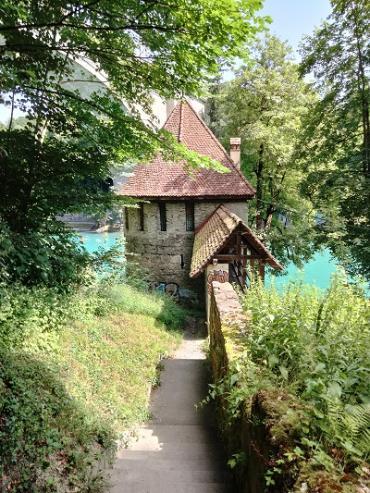
In the city of Bern, we visited the “Prison Tower,” the “Blood Tower,” and the site of a former “orphanage” (all former prisons for Anabaptists). A side trip to Sumiswald brought us to Trachselwald Castle, also a former prison, but now home to a museum exhibit on Swiss Anabaptists past and present. We visited the Täuferversteck (Anabaptist hiding place) on a farm near Trub that is still owned by the descendants of those who hid there from bounty hunters in the seventeenth century. Later that same day, we had a long conversation with a man we met while hiking outside of Eggiwil, and just before we parted ways, he revealed to us that he was also a Stauffer.
These forays into family history have given me a lot to think about. Some of my ancestors were refugees, temporarily homeless and destitute, and some of them went through the trauma of family separation. They had to rely on the charity of others and live in a country that grudgingly tolerated them because they were economically useful. Some of them were illegal migrants or unauthorized residents due to arbitrary limits on the number of Anabaptist households in the Palatinate. I can’t help but think of migrants in the present day who have similar experiences: impossible situations in their countries of origin, the semi-toleration of states and corporations that need their labor or their taxes, hostility from nativists who fear a changing ethnic and cultural landscape, and—if they are fortunate—support, compassion, community, and belonging in their new homelands.
Photo: Blood Tower in Bern, Heath Spencer
1 “Christian Stauffer,” last edited 7 June 2023, https://en.wikipedia.org/wiki/Christian_Stauffer.
2 John D. Roth, Stories: How Mennonites Came to Be (Harrisonburg, VA: Herald Press, 2006); John D. Roth, Beliefs: Mennonite Faith and Practice (Harrisonburg, VA: Herald Press, 2005); Delbert L. Gratz, Bernese Anabaptists and Their American Descendants (Goshen, IN: Mennonite Historical Society, 1953).
3 Roth, Stories, 59, 65; John D. Roth, “The limits of confessionalization: social discipline, the ban, and political resistance among Swiss Anabaptists, 1550-1700,” Mennonite Quarterly Review 89:4 (October 2015): 518-520.
4 Gratz, Bernese Anabaptists, 12, 25, 30-38; Richard Warren Davis, “The Stauffer Families of the 1671 Migration to the Palatinate,” Mennonite Family History 12 (1993): 4; John Landis Ruth, The Earth is the Lord’s: A Narrative History of the Lancaster Mennonite Conference (Waterloo, ON and Scottsdale, PA: Herald Press, 2001); 108-110.
5 Ernst Müller, Geschichte der bernischen Täufer (Frauenfeld: J. Hubers Verlag, 1895), 200-204; see also the more recent English translation: Müller, History of the Bernese Anabaptists, trans. John Gingerich (Alymer, ON and Lagrange, IN: Pathway Publishers, 2010), 220-224; Davis, “Stauffer Families,” 9.
6 Frank Kronersmann, “Toleration, Privilege, Assimilation and Secularization: Mennonite Communities of Faith in the Palatinate, Rhine-Hesse, and the Northern Upper-Rhine, 1664-1802,” Mennonite Quarterly Review 82 (October 2008): 535-536.
7 Ibid., 535-541.
8 Ruth, The Earth is the Lord’s, 110-113.
9 Kronersmann, “Toleration, Privilege, Assimilation, and Secularization,” 537, 555-556.
Professor by Day, DJ by Night
Most, if not all, of the faculty and staff of the History Department have superpowers. I, at least, have a secret identity. By day, during the week, I am a mild-mannered history teacher walking the corridors and classrooms of Seattle U (well, mostly Pigott, Casey, Admin, and Lemieux Library). On Sunday nights at 7:00 pm, however, I become Professor DJ Grumpy and broadcast a radio show, History as Music/Music as History on Space 101.1FM.
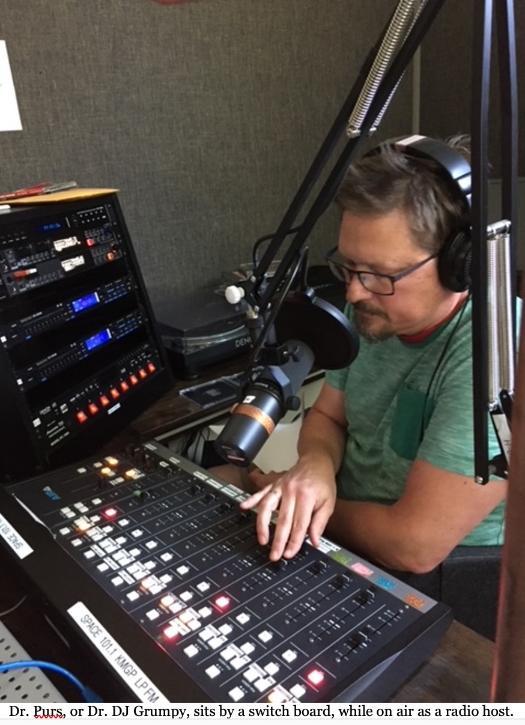
I DJ to bring people to the nexus between music and history, to bring songs to history, to bring historical context to music. Historians tend to labor under false preconceptions that our job is dusting off old tomes and reciting lists of great political figures (almost always men) and studying the causes and outcomes of battles and wars. Some people still think we write, and then force students to recite, bullet points of a grand narrative/origin story of modern states.
Instead, for more than 100 years, from the days of Marc Bloch and Lucien Febvre, historians do almost the opposite – we examine how and why the narratives were constructed, what is misrepresented, and who gets left out. One of the most successful biographies of the last decade is not of a president or a general, but of a modest, cotton sack containing a tattered dress, a lock of hair, and three handfuls of pecans (spoiler, they were probably not pecans). Today, history is alive and fluid, messy and chaotic – it challenges us as much as it instructs us. But how do historians introduce this history to people familiar with a stereotype? I do it through an irreverent, eclectic radio show.
The idea was a eureka moment for me, even though I had studied history for decades and music for even longer. More than five years ago, I was in my car listening to a fundraising drive on KEXP. I was already an amplifier, tired of listening to the drive, and turned the radio dial. Serendipitously I stopped on 101.1 FM, a brand new, low power, community-based, volunteer radio station. The music was good, the station was quirky but passionate, and I suddenly had an idea for a show. I had no background in radio but pitched an idea by email and then in an interview, and then found myself sitting in front of a mixing board being taught how to make a radio broadcast.
My first idea was an hour (which grew to two) on anthems. If you have taken my HIST 1210 course, you probably remember a day listening to anthems and deconstructing them. God Save the King relays idea about ruler and ruled, La Marseillaise something entirely different. For radio this would be easy, Jimi Hendrix (you know him, he plays guitar on the corner of Broadway and Pike) famously played the Star-Spangled Banner, but he also played God Save the Queen. James Reese and the Harlem Hellfighters played a jazz version of La Marseillaise when they arrived in Brest to fight on the Western Front in WWI. Similarly, when Marvin Gaye sang a soulful Star-Spangled Banner at the 1983 NBA All-Star Game, he brought an underrepresented community into the anthem ritual. Likewise, when Billy Bragg sang The Internationale at Pete Seeger’s behest at the Vancouver Folk Festival in 1989, he dedicated it to the students demonstrating in Tiananmen Square and used the lyrics to show socialism’s promise as well as to indict some states’ failures to live up to these ideals.
More than 275 shows later, and counting, I still broadcast music and introduce history. Some shows are direct, The History of the Berlin Wall or the 50th anniversary of General Pinochet overthrowing the legitimate Allende government in Chile. Other shows seem quirkier or esoteric, but the History of Haircuts or Trees in Music may be theoretical cousins to the History of a Modest Sack in prose.
Feel free to tune in on Sundays at 7:00 pm on 101.1 FM (or streaming at space101fm.org). My standard show has about 52 minutes of music and 8 minutes of me talking (maybe a ratio my students would want in my classes). If you see me wandering the halls and classrooms of SU, I am always up for a discussion about music, or history, or both.
Dr. Randall Souza
Dr. Randall Souza is a professor in the Department of History, who focuses on Ancient History and Mediterranean Archaeology. His research has centered on Siciliy during the fourth and third centuries BCE, and he has significantly contributed to the Contrada Agenese Project in Morgantina. For any questions regarding History and/or archaeology in this piece, please contact him.
Claire Hood
Claire Hood is a current senior set to graduate after this quarter, who is majoring in Communications with a
specialty in journalism. She is also interested in history and has taken a significant number of History courses. As such, the History Department is lucky to have had Claire as a student due to her thoughtful engagement. This summer, Claire participated in an archeaological dig in Morgantina Siciliy.
Sadie Nelson
Sadie Nelson is a current junior majoring in History and Women, Gender and Sexuality and is the student assistant for the History and Political Science Departments. She interviewed Claire about her experience in archaeology this summer.
Dr. Aldis E. Purs
Dr. Aldis E. Purs is a lecturer in the Department of History, who teaches many topics including introductory and comparative history, history of coups, Eastern and Central Europe, and more! For any questions regarding this piece, history, music, or all of the above, please contact him at apurs@seattleu.edu
In Fall 2022 I taught "Global Studies" for Semester at Sea, an experiential university program that combines classes on ship with travel opportunities in eleven ports.
Three days out of Spain, I was planning on giving an introductory lecture for my class on the Mediterranean Sea migration crisis. As I was wrestling with how to humanize this story for the diverse population of 450 students and numerous adult travelers that were part of the Fall voyage, I heard a student call out from the aft deck, “I think I saw something. I think it was a flare.”
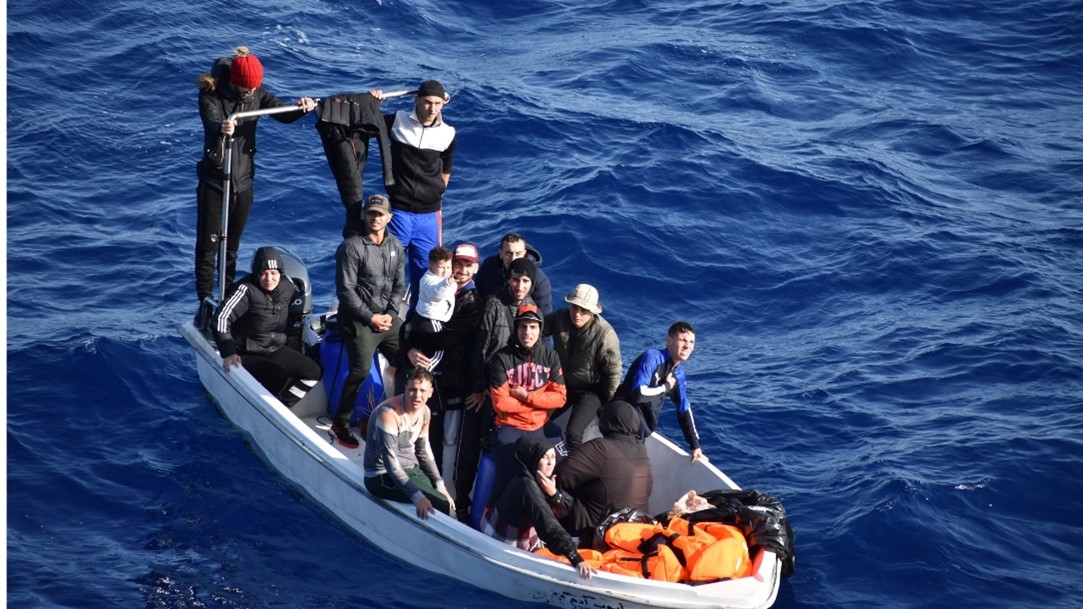
Three days out of Spain, I was planning on giving an introductory lecture for my class on the Mediterranean Sea migration crisis. Each year, tens of thousands of refugees take to the perilous waters of the Mediterranean in a desperate search for safety, and the seas east of Spain are one of the major crossing points from North Africa to Europe. Many attempting this crossing are fleeing the incessant wars across the Horn of Africa, Afghanistan or Syria. Others are fleeing the crippling effects of climate change- drought across North Africa and disappearing coastlines in Bangladesh and Sri Lanka. Others are fleeing political, religious and/or social persecution in their home country. They come from many places, winding up on the shores of the Sea and take to the waters, hoping to get to Europe. Tragically, every year far too many perish enroute.
Trying to convey the experience of these refugees, and the reasons they take such a desperate journey, is often difficult. The numbers are staggering but their individual stories are often lost in part because those numbers are so staggering. Government agencies and non-government organizations churn out statistics ,but the faces of the refugees lucky enough to survive the crossing and get to Europe are often hidden behind the fences of the refugee camps they wind up in or the hollow rhetoric of politicians who claim to know their situation without ever talking to them.
As I was wrestling with how to humanize the story of the Mediterranean refugee crisis for the diverse population of 450 students and numerous adult travelers that were part of the Fall voyage, I heard a student call out from the aft deck, “I think I saw something. I think it was a flare.” Those of us nearby raced to the back deck and looked out. Someone had some binoculars. Indeed, it seemed there was something out there, a boat. And it was making its way toward us. Word got to the captain, and our ship slowed its engines. Slowly, amidst choppy seas, the boat approached and we heard cries for help. It was an 18-foot rowboat with thirteen people, ten men, two women and a young child aboard.
Over the next hour and a half we circled the craft. Students were frustrated. “Why aren’t we taking them in? There is a baby on board! Who are they? Where did they come from? What’s going to happen to them?”
Eventually a Spanish coast guard boat arrived (we were a few miles inside Spanish territorial waters) and loaded the people on the boat aboard. We restarted our engines and continue heading east, across the Mediterranean. Over the next days we had endless conversations about what had happened as we tried to understand what we saw, who we saw. Seeing a boatload of refugees, in the flesh, rather than as an abstract set of statistics, made the students ask many of the same questions I wanted them to think about when I was planning to talk about the story of migrants a few days later but gave these questions an immediacy, a set of faces, that my lecture could have never done. The face of the other had broken through and the students could not think of refugees and migrants in the same way again.
It turned out, we found out while talking to our captain after we had set sail again, that indeed the refugees were likely hoping to get picked up by the Spanish coast guard. Had we had to rescue them or decided to take them on board the stipulations of maritime law would not have been allowed them to be taken to a European country and they would have presumably eventually been sent back to North Africa. Because the Spanish took them in they would be eligible to apply for refugee status in the EEC which is the goal of many of those risking this crossing. The incident turned out to be a quick immersion in the complicated legal issues that immigrants have to negotiate along with the perilous waters of the Mediterranean.
One of the most important tools an historian has is empathy; the attempt to “put yourself in the shoes of the other.” Whether trying to understand the experience of slaves crossing the Atlantic in the crammed holds of ships or the lives of Jewish families in the terrors of the Warsaw ghetto, historians reading the sources have to try and understand how people living through these events experienced them. I can’t say witnessing this incident has allowed me to fully understand the experience of these refugees but having seen their faces in that boat, I will never think of the refugee crisis in the Mediterranean Sea in the same way again.
As a social historian I believe strongly that history is OUR story; it is not just the story of elites and the powerful but the story of our lives, the lives of our family and friends. It is the story the common, even the mundane because it is often in those experiences of the ordinary that we often find the true insights into the extraordinary events of human history.I had the opportunity to put this to practice this past fall when I wrote an article, The Extraordinary Life of an Ordinary Man: Jan Kozlowski and the Russian Revolution. It has just come out on World History Connected.
Jan was a young man growing up in Russia before World War One. As war and revolution erupted, he found himself embroiled in those globally changing events. As the Germans invaded the region around Riga where he lived, he and his mother fled to what they hoped and expected was the safety of Petrograd (St. Petersburg), Russia’s second capital. Those hopes and expectations, however, were dashed when the Bolsheviks seized control of the city in 1917 and Jan and his mother found themselves potential enemies of the new proletariat state. She made the agonizing decision to send him to Siberia in the hopes that he would escape the unfolding civil war. Instead, the civil war found him, and Jan watched his brother get shot by the Bolsheviks. Desperate and alone, he jumped on a passing train and spent the next couple of years fleeing east. Eventually he made it weak, sick and wounded to Vladivostok on the Pacific coast. He was barely sixteen. There he met American soldiers stationed in the city, and it was with their support that he eventually made his way to the United States and a new life.
Jan’s story illustrates how these global events impacted and were experienced by an ordinary person. But, for me, it is more than that. You see, Jan was my wife’s grandfather, and therefore the story of his life, flight and exile is the story of our family’s history. And even more, as I explore in my article, it is how we came to know his story that is equally important and fascinating. For Jan his story was a painful reminder of the brother he lost, the mother he never saw again, and the homeland he fled. He never told it to his only son Jon, my father-in-law. When it would come up he’d say, “yea, that was then.” “It isn’t important.” But when Laurie turned twenty one, she asked for his story and he relented. On a few sheets of graph paper and a map he outlined, starkly and cryptically, the traumas of his young life.
As a historian it was an incredible opportunity and challenge to take those sparse notes and to try to unpack Jan and his world. It was an incredible opportunity and challenge to be responsible for my family’s story and to bring it to life, not only for them, but for the larger historical community. I never met Jan—he passed before I met Laurie--, so in those notes I had to understand the man, his feelings and emotions as he watched his brother die and as he struggled for what he thought may be his last breath on the streets of Harbin. I had to negotiate her memory, and that of my father-in-law, a man whom they loved deeply and were close to, yet also didn’t know in many ways.
Both Laurie and Jon, as you can well imagine, are very invested in the story, and part of the challenge and joy of the project was their intimate interest in it. We grew closer as I contextualized Jan’s life in a way that they only had faint glimpses of before. Yet, honestly, at times, I felt their interest stifling me as the historian and writer. After all, it was their story but it was my article. Whose judgment was right when we tried to fill in the numerous gaps and disagreements? It was their grandfather or father, but I had a historical sense of how one would respond in a given situation. In the end, the writing became better for these discussions. As you’ll see, if you read the article, I tried not to ignore these disagreements of interpretation but rather let them play out in how we try to understand a person and their times. I let the process of how we were trying to unpack his experiences, and the methods we employed to do so, be present in the analysis. And we left the empty spaces of the historical voids empty when we couldn’t make reasonable assumptions to fill them in.
The Experience of an SU Alumna Teaching Overseas
“Please come and teach us, professor. I love to learn!” As the student said this to me, her eyes beamed from under her headscarf.
That was the line that convinced me to uproot my life and move halfway around the world. It was supposed to be my last year of graduate school, and the academic job market had tanked in the wake of the Great Recession. I sent out a slew of applications, including to several schools in Asia. One of the offers I received was from an international women’s university. The school provided an English-language liberal arts education to underprivileged women from across Asia. I admired the mission of the university, which had been founded just a few years earlier. But was I ready to move to a country that I had never visited?
That was the line that convinced me to uproot my life and move halfway around the world. It was supposed to be my last year of graduate school, and the academic job market had tanked in the wake of the Great Recession. I sent out a slew of applications, including to several schools in Asia. One of the offers I received was from an international women’s university. The school provided an English-language liberal arts education to underprivileged women from across Asia. I admired the mission of university, which had been founded just a few years earlier. But was I ready to move to a country that I had never visited?
I met the student with the beaming eyes during a campus visit to the school. When she learned that I was a prospective professor, she earnestly urged me to take the job and extolled her love of learning. Her enthusiasm persuaded me, and I spent a year at the school teaching Asian and Vietnamese history.
It was exhilarating to work at an international institution. Students hailed from Afghanistan, Bangladesh, Bhutan, Burma, Cambodia, China, India, Nepal, Pakistan, Palestine, Sri Lanka, and Vietnam. They spoke dozens of languages, and their faces offered a visual kaleidoscope of the continent’s ethnic diversity. Walking through the courtyard between classes, I often found myself mesmerized by the sight of students from different countries chatting noisily with each other. It was just so neat to see a young Vietnamese woman in a T-shirt and jeans giggling with a Sri Lankan friend in a tiered skirt and a Palestinian friend in a hijab. The students actually had much in common in spite of their differences. They all spoke English and shared the unique experience of attending an American-style liberal arts university in Asia. Perhaps equally important, they consumed the same popular culture, from K-pop to Bollywood.
Despite the thrill of teaching these young women, I quickly discovered that international diversity created challenges in the classroom that I had never faced back home. When I teach in the US, I assume my students share a basic body of cultural and historical knowledge. Most come out of the American educational system, study US history in high school, and are broadly familiar with Western history. In contrast, my students at the international university had gone through a variety of educational systems and had studied their national histories. Few topics were familiar to everyone in the class. For example, the 1947 partition of India was common knowledge for South Asian students but not the Southeast Asians. Conversely, most of the Southeast Asian students were familiar with communism as a concept, but many South and West Asians were not. Some students had had so little exposure to Western history that they did not know about the Holocaust. A young Bangladeshi woman told me she had never seen a world map and expressed anxiety at the prospect of taking a map quiz. I learned that I had to teach every historical topic as if my students were hearing about it for the very first time.
There were other pedagogical challenges that stemmed from my students’ language and academic preparation. Almost all the young women I taught were foreign language learners of English. They found textbooks easy to understand but struggled to read scholarly articles and documents from before the twentieth century. Compounding the language problem was the fact that most students had received poor preparation for studying history at the college level. In secondary school, they had learned patriotic nationalist histories by memorizing facts. Moreover, many students came from educational systems with early tracking. Having chosen the “science track,” these students had little experience with the humanities before college.
Yet what these young women lacked in preparation they made up in effort. They eagerly raised their hands to ask questions in class. They lined up outside my office to seek assistance on assignments. When readings proved difficult, some students reread the homework twice or even three times. Never in my life have I met such a hardworking cohort of students. To be sure, I had occasionally encountered struggling but determined students in the US. But at the international university, I had classrooms full of students who, despite their weak academic background, doggedly worked to improve their performance. I couldn’t help but feel inspired by their fierce desire to learn.
There were other attractions of working overseas. I was interested in teaching Asian history to Asian students. I had taught American history as a teaching assistant at the University of California, Berkeley, and had seen how meaningful it could be for American students to learn about the collective past of their own society. The international university promised the possibility of a similar experience, but this time I could teach my specialization in Asian history. The diverse composition of the student body made it even more exciting, as students could learn about their countries’ histories in relation to the history of the Asian region as a whole. Above all else, I was eager to show students that Asian history is interesting and meaningful to their lives. I wanted to teach them that history is about analyzing primary sources rather memorizing facts, as they had assumed. I wanted the students to see that learning about the past can help us think more critically about our own historical narratives and envision a wider range of possibilities for the future. Of course, I didn’t expect a survey course to achieve all those lofty goals.
Fortunately, my students were primed to understand history in a deeply personal way. Many had lived through poverty, war, oppression, and natural disasters. Some had spent years as refugees, while others were minorities in their home countries and had persevered despite discrimination. Those who had not personally experienced conflict and hardship had parents or grandparents who had. My students intuitively understood that seemingly impersonal historical events had profound consequences for ordinary people. In that sense, it did not take much to convince these young women to embrace history. My deficiencies as a novice teacher could hardly deter students who had overcome far greater obstacles.
The students got far more out of my courses than I could have ever imagined. When we studied the modernization of Japan during the Meiji restoration, I assigned the autobiography of the Japanese reformer Yukichi Fukuzawa. Several Afghan students were captivated by the book and declared their intention to translate it into their native language. “If people in Afghanistan could read this book, they could understand that we can modernize our country and become strong just like Japan,” one student explained. Other students felt a deep connection to the oral history accounts of the partition of India. A Pakistani student said that the reading confirmed for her that Muslims did suffer discrimination back in India before the partition, but it also made her realize that non-Muslims experienced similar treatment in present-day Pakistan. The partition was the largest mass migration in world history, and a Palestinian student admitted that learning about the event made her reconsider her country’s past in a different light. “I always thought it was the worst thing in the world that the Palestinians were displaced, but after I read this, I thought maybe this was worse,” she said thoughtfully. Many students later told me that they had come to realize that their own experiences were part of history too.
It was conversations like these that reassured me that I had made the right decision to come to the international university. They also steeled me for the trouble that unfolded that year. When I accepted the job offer, I did not realize that the school would be plagued by mismanagement, high turnover, and a toxic work culture. The old administrators left just as I arrived, and the interim leaders made arbitrary decisions without faculty input. I often wondered whether I was doing good as an educator striving to fulfill the university’s mission or causing harm by helping to prop up a bad institution. With the hindsight of almost a decade, I realize that my experience at the international university was an extreme example of a larger pattern. The school embodied the brightest and darkest faces of academia that I have ever encountered, but it was hardly unique. All institutions of higher education espouse noble ideals while struggling to live up to those same aspirations. What kept me there that entire year – and what keeps me in academia now – is that the light of those ideals is bright enough to outshine the worst shortcomings of our imperfect institutions.
Nu-Anh Tran is Assistant Professor at the University of Connecticut. She holds a joint appointment in the Department of History and the Asian and Asian American Studies Institute. She received her BA from Seattle University and her PhD from the University of California, Berkeley. Her forthcoming book, Disunion: Anticommunist Nationalism and the Making of the Republic of Vietnam, examines democracy and authoritarianism in South Vietnam during the 1950s and 1960s.
During a Pandemic
During this period of the Coronavirus pandemic, I have been staying with my parents in Old Tappan, New Jersey, working really remotely, 2,900 miles away from Seattle.
My parents have been living in this area for the last forty years, whereas after high school I have been mostly away and visiting several times a year.
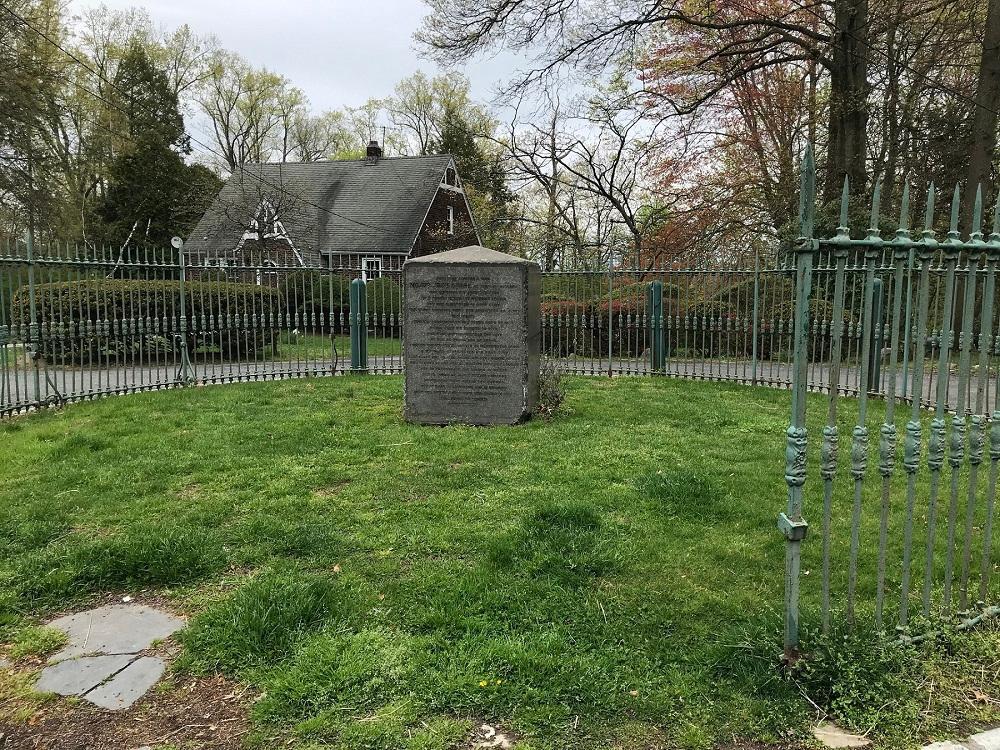
Andre Monument, Tappan, NY. Photograph by H. Hazel Hahn.
During this period of the Coronavirus pandemic, I have been staying with my parents in Old Tappan, New Jersey, working really remotely, 2,900 miles away from Seattle. My parents have been living in this area for the last forty years, whereas after high school I have been mostly away and visiting several times a year. Normally, a big appeal of this suburban area is the proximity of New York City, 17 miles away, with its supersized cultural and economic prowess. These days, however, going into the city is not an option. New York and New Jersey are the two states with the highest number of cases and deaths in the US, with New York City half of all the reported cases in New York State. In the five weeks I’ve been here, I’ve only been to supermarkets and pharmacies, where wearing a face mask is mandatory. Another of my favorite things to do here, swimming, is also not possible, as gyms are closed. State and county parks are also closed. But it is permitted to take walks. I take a long walk every day. I’ve been becoming more familiar with the suburban layout and architecture of this area than I had ever imagined. Other people walking or jogging wave and smile, while strictly keeping a distance.
Today, while on a walk, I saw a building with a parking lot full of cars, something I would never have noticed before the pandemic, but now a rarity. It must be a building for some “essential work,” I thought. I learned from googling my location on my phone that it is a nursing home. I was reminded that some nursing homes in New Jersey are hit particularly hard by the virus, and that visits by families are banned. While walking, I was documenting traces of the current crisis, by taking photos of signs, both handmade ones with rainbows on windows and ones on lawns thanking healthcare workers and other frontline workers.
Then eventually I came upon a woodsy hill that stood out in singular ways from all the surrounding areas. The streets were narrow. The buildings looked much older. One of them was decrepit. Trees looked very old, too. How charming and different, I thought. Suddenly I felt transported. Then I saw a street sign: Andre Hill. How unusual, I mused. I had just been walking on very typical wide suburban streets with typical street names like Central Avenue, Wildwood Road, Oakwood Drive, and Chestnut Avenue. And the vast majority of street names end with Street, Road, Avenue, Drive, Lane, or Court. And here is a street named Andre Hill. I walked on the hilly street, intrigued and admiring the houses. There was no one about. It was silent, except for birds singing, and branches swaying in breezes. Then I heard whistles of a train. When I reached the end of the street, I saw a sign with an arrow, put up by New York State: “ANDRE MONUMENT. On the hill south is the site of the gallows where Major John Andre, British spy, was hanged, and buried, on Oct. 2, 1780. State Education Department 1932.” I was stunned. Major John André, the famous spy! He was hanged and buried here?! I walked back up the street, looking for the monument. I didn’t see it. Just then a man with a dog appeared. I asked him if he knew where the monument is. Right there, he pointed. I had walked past it. There is a granite monument with inscriptions, on a round patch of grass, surrounded by a green railing. The monument, in Tappan, NY, is yards away from the New York/ New Jersey state border.
In 1780 John André was on a secret mission to General Benedict Arnold to arrange the surrender of West Point to the British. But he was captured, in civilian dress with the plans of West Point in his boot, in Tarrytown, NY. He was taken across the Hudson River to Tappan and held at the Old 76 House. Had I walked further nine minutes, I would have gotten to it. Built in 1668, this building is known as “the oldest bar in America” where George Washington surely drank, as his headquarters at the time was the nearby DeWint House.[i] It is believed to be haunted.[ii] I had passed by it a few times but never on foot. André was tried at the Dutch Reformed Church by a military tribunal of fourteen generals.[iii] Yes, I’m embarrassed to say there is a whole Tappan Historic District.
The site of the hanging and a shallow grave was left unmarked. In 1821, André was exhumed with a great ceremony, for his body to be transported to Westminster Abbey in London. The British consul James Buchanan found support for the plan among the clergy and the well-to-do residents of Tappan, and he mollified protesters by buying them all a drink.[iv] In 1879, a century after the execution, the businessman Cyrus W. Field decided to put up a stone monument at the still-unmarked site. A man over ninety years old showed him the exact location, saying that he was present when the grave was opened in 1821, and that “the roots of an apple tree [...] were twisted about the head of the coffin.”[v] The monument turned out to be controversial as some saw it as an insult to Washington. It was vandalized and was twice blown up with dynamite in the 1880s.
André has had a remarkable afterlife. Born in London into a wealthy Huguenot family, he was handsome, intelligent, and generally highly regarded. When he was arrested on charges of espionage, it was thought out of the question to spare his life, because the American spy Nathan Hale had been executed by the British four years earlier. From the moment he was sentenced to death at the age of twenty-nine, sympathy began to build for him among certain segments of the American public. George Washington himself referred to André, in letters he wrote seven and ten days after the execution, as “He was more unfortunate than criminal” and “an accomplished man and gallant officer.”[vi] These quotations are inscribed on one side of the monument. Stories about his dignified conduct at the gallows, and the public’s reaction to the execution, spread widely and were embellished into myths and legends. A story had it that after André was laid in a coffin, local women covered him with garlands and flowers, and that locals planted two cedar trees by the site. It was said that a crowd of 2,000 people formed long lines to respectfully view the body, and that from a peach given to André by a girl, a peach tree grew at the head of the grave.[vii] Historian David Vinson writes that André’s performance at the gallows affirming his self-identity as an officer-gentleman served to mitigate the view of him as a spy and “occasioned in public memory his status as a model of patriotic virtue”[viii] and that he was “appropriated as a hegemonic apparatus” by both the U.S. and Britain “to mask national anxieties and to perpetuate hegemonic values” “regarding national identity, masculinity, and sensibility”.[ix]
In Britain, the heroization and romanticizing of André began immediately after his death. In Westminster Abbey, a monument to André erected in 1782 is topped by a mourning Britannia and a lion, symbols of the empire and nation. An inscription notes that he was “universally Beloved and esteemed by the Army in which he served and lamented even by his FOES.”[x] On the monument in Tappan, an inscription by Arthur Penryn Stanley, Dean of Westminster, reads (in all capital letters):
Here died, October 2, 1780,
Major John André, of the British Army
Who, entering the American lines
On a secret mission to Benedict Arnold,
For the surrender of West Point,
Was taken prisoner, tried and condemned as a spy.
His death,
Though according to the stern rule of war,
Moved even his enemies to pity;
And both armies mourned the fate
Of one so young and so brave.
In 1821 his remains were removed to Westminster Abbey.
A hundred years after the execution
This stone was placed above the spot where he lay,
By a citizen of the United States, against which he fought,
Not to perpetuate the record of strife,
But in token of those better feelings
Which have since united two nations,
One in race, in language, and in religion,
With the hope that this friendly union
Will never be broken.
The TV series Turn: Washington’s Spies (2014-17) reaffirms and elaborates on André’s honorable, gallant, and romantic officer-gentleman persona, as portrayed by the fine actor J.J. Feild. The series is a critical success. I only watched the first episode and decided that it wasn’t for me, because watching it was somewhat stressful due to frequent scenes of violence accompanied by noisy sound effects. Also, it did not seem historically accurate at all for the reason that everyone in the series seems so twenty-first century. Perhaps I will give it another try.
What can I conclude from my experience today? It might sound callous or strange, but I must say that stumbling upon a site where someone was hanged 240 years ago made this a wonderful day. It inspired me as a historian. I felt stunned, awed, thrilled, and humbled by the presence of this historic monument in my neighborhood, and the unique atmosphere of that site. I keenly felt the gravitas of a human life ended, one among many lost in the vast theater of the American Revolution. It made me want to learn more about André’s life and the Revolution. I feel like I had a proper adventure, a most unexpected discovery during a daily walk. It’s likely I would never have come upon this monument, a 30-minute walk away from my parents’ house, hadn’t it been for the Coronavirus crisis, because I would be busy heading to New York. There was something very reassuring about the way I stumbled upon the monument through meandering, helped by a tangible sign on a street put up by the New York State Education Department, and via an old-fashioned way of asking a stranger about its location. In a period when we seem to be living much of our daily lives through Zoom and other virtual means, it makes me doubly appreciate tangible, physical traces of the past, present, and future.
H. Hazel Hahn is Professor and Chair of History at Seattle University. She is the author of Scenes of Parisian Modernity: Culture and Consumption in the Nineteenth Century (2009), co-editor of Architecturalized Asia: Mapping a Continent through History (2013), and editor of Cross-Cultural Exchange and the Colonial Imaginary: Global Encounters via Southeast Asia (2019).
[i] Clint Lanier and Derek Hembree, “Exploring the Oldest Bar in America,” Huffpost, 9/03/2013. Accessed 4/29/2020.
[ii] Kevin Phelan, “Ghosts of revolutions past haunt N.Y. eatery,” USA Today, May 15, 2016. Accessed 4/29/2020.
[iii] Tappantown Historical Society, Accessed 4/29/2020.
[iv] David Vinson, The Extraordinary Afterlife of Major John André, the "Common Spy" Eighteenth-Century Studies, Vol. 52 No.1 (Fall 2018), 106.
[v] Isabella Field Judson, Cyrus W. Field, His Life and Work [1819-1892] (New York: Harper & Brothers, 1896), 300.
[vi] “He was more unfortunate than criminal”: from a letter of George Washington to Comte de Rochambeau, 10 October 1780; “An accomplished man and gallant officer”: from a letter written by Washington to Colonel John Laurens on 13 October 1780. Cited in Benson John Lossing, The Two Spies: Nathan Hale and John André (New York: D. Appleton and Company, 1910), 115.
[vii] Brian Richard Boylan, Benedict Arnold: The Dark Eagle (New York: W.W. Norton & Co., 1973), 247-54; Vinson, 99.
[viii] Vinson, 102-3.
[ix] Vinson, 95.
[x] Official website of Westminster Abbey. Accessed 4/29/2020.
The Ghosts of the Soviet Union in Central Asia
Dr. Tom Taylor, Emeritus Professor, History Department, Seattle University
February 2026
Soviet Ghosts: The Soviet Union Abandoned: A Communist Empire in Decay (2014) contains photographs by Rebecca Litchfield who traveled across the lengths and breath of the former Soviet Empire in Eastern Europe and Russia photographing the dilapidated factories, the empty schools with desks sitting idly and textbooks scattered across the dusty floors, and the monuments of former Soviet leaders now shrouded in vines and creeping grass. She sought, she wrote, to capture “the haunting memories of ordinary people who once lived and worked there.”[i]
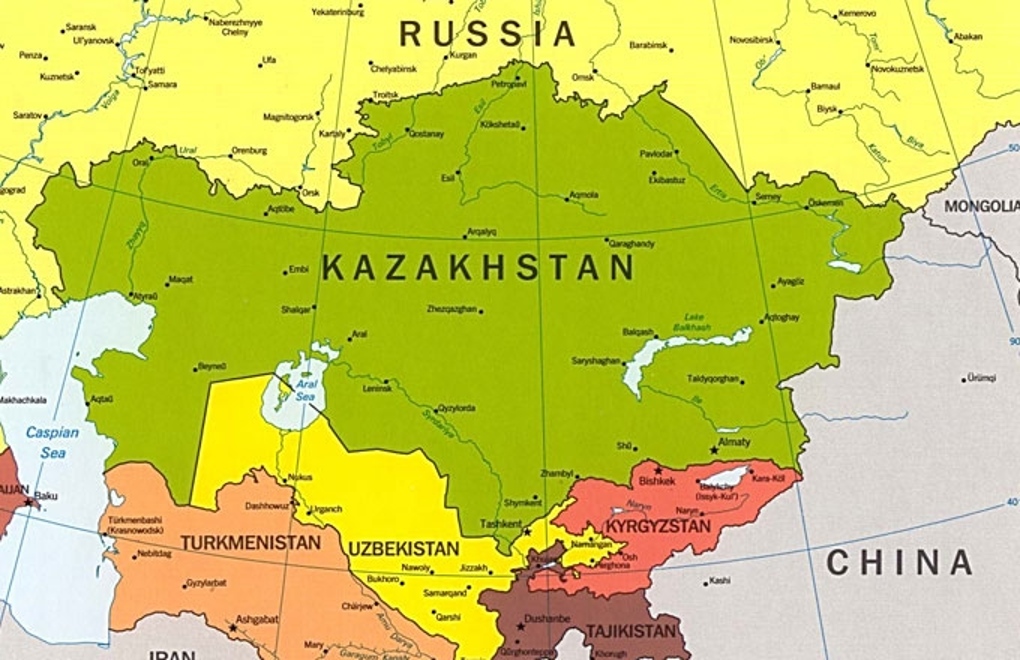
I have been thinking about Litchfield’s book as I reflect on a trip I took to Central Asia recently. The five countries I visited- Kazakhstan, Kyrgyzstan, Tajikistan, Uzbekistan and Turkmenistan- had also been part of the Soviet Empire, and part of Russia’s colonial world well before that. They too experienced the convulsions of revolution that shattered the mystique of power and permanence that perpetuated the empire’s survival for decades. They, too, have grappled with the legacies of that era for more than three decades and struggled to make sense of what it meant for their past and, more importantly, their future. They, too, are haunted by the ghosts of the Soviet Empire.
[i] Rebecca Litchfield, “Soviet Ghost Book.” Accessed January 20, 2026. https://www.rebeccabathory.com/blog/soviet-ghosts-book.
Introduction
Soviet Ghosts: The Soviet Union Abandoned: A Communist Empire in Decay (2014) contains photographs by Rebecca Litchfield who traveled across the lengths and breath of the former Soviet Empire in Eastern Europe and Russia photographing the dilapidated factories, the empty schools with desks sitting idly and textbooks scattered across the dusty floors, and the monuments of former Soviet leaders now shrouded in vines and creeping grass. She sought, she wrote, to capture “the haunting memories of ordinary people who once lived and worked there.”[i]
I have been thinking about Litchfield’s book as I reflect on a trip I took to Central Asia recently. The five countries I visited- Kazakhstan, Kyrgyzstan, Tajikistan, Uzbekistan and Turkmenistan- had also been part of the Soviet Empire, and part of Russia’s colonial world well before that. They too experienced the convulsions of revolution that shattered the mystique of power and permanence that perpetuated the empire’s survival for decades. They, too, have grappled with the legacies of that era for more than three decades and struggled to make sense of what it meant for their past and, more importantly, their future. They, too, are haunted by the ghosts of the Soviet Empire.
There are more than a few weighty tomes of material for anyone interested in trying to begin to understand the history of the Soviet Union in Central Asia and its impacts still today. (And I will include a few of the ones I have read at the end of this piece.) What I will offer in this essay is an anecdote, a vignette of how I witnessed this legacy in each of these countries in the hopes that they will encourage you to learn more about this critical part of the world and, ideally, get a chance to travel there and collect your own insights.
Perhaps the most obvious way that the moans of the ghosts of the Soviet Union continue to echo across the deserts, mountains and steppes that define much of the geography of the region is in the language. In each country Russian remains the lingua franca if you will, continuing to be the common language of business, education and politics in many regions. And Russian cultural traditions—from literature, to theater to music—, continue to have a strong presence, to the extent that each country struggles to establish their own linguistic and cultural identities.
Part of the reason for this is practical. Most of these countries have not had the resources— whether books or teacher training to revamp their school curriculums—and continue to use old texts and teach methodologies inherited from decades ago. Trade, commerce and international relations also remain strongly tied to Russia, and knowledge of its language and culture is essential for the survival of most of these countries, economically and geopolitically. Given the significant economic challenges of the majority of these countries—these challenges themselves a legacy of that Soviet system—, many, from these countries, work in Russia, sending their funds home to keep their families going. (And, as the war in Ukraine rages on Russia is, reportedly, increasingly dragging these men into military service for the Russian army. If they refuse, they are sent home, where work is very difficult to find.[ii])
Kazakhstan
My tour of Central Asia started in Almaty, Kazakhstan. Kazakhstan is the ninth largest country in the world, in terms of land area. It sits just to the south of Russia; the Ural Mountains, dividing the Russian and Siberian parts of the country, extend into northern Kazakhstan. Its proximity to Russia made it a major region during the Soviet era, and this proximity shapes almost every aspect of its post-Soviet life.
During the Soviet period, Kazakhstan served many purposes for the Communist regime. Its vast lands became utilized for Stalin’s collectivization projects, and gulags full of exiled Soviet dissidents dotted the landscape. The region of Semipaletnsk, in the eastern part of the country, was the major area for Soviet nuclear testing. It remains, much like Hiroshima in Japan, a region where cancers and chronic diseases caused by radiation exposure are exceptionally high long after the last bombs exploded.
A small city museum in Almaty revealed another story of that sometimes-painful Soviet past. Having few visitors, it was actually opened just so my small group could tour it. The museum guide was a young man, a recent graduate with a degree in History from the main university in the city. His descriptions of the neolithic diorama and the artifacts of the region’s early history were professional and clipped. We moved through quickly until we came to a non-descript room near the end of the tour. It was mostly full of posters and portraits. The posters were protest posters created when Gorbachev tried to bring in an outsider as the head of the Kazakh Communist Party in December 1986. (In Almaty it is called Zheltoksan, meaning December.) He had been preaching openness and reform, but his actions seem to say that those ideas only applied in Russia, not the satellite Soviets. Students, then workers, then other citizens of the city, took to the streets to protest what they saw as an afront to their Kazakh identity and as a confirmation that they had no say in their future. Security forces responded with truncheons and bullets. The portraits on the walls were of victims of the crackdown. Our guide was visibly moved as he walked us through the room. It was a memory that clearly lived on in the hearts of the city.
Kazakhstan is the wealthiest of the countries of Central Asia, based on GDP/capita (which is now also higher than Russia’s). Much of that wealth comes from its vast natural resources: oil and natural gas, uranium and high concentrations of rare earths. Yet, despite these resources and the country’s relative prosperity, it is Russia that significantly benefits from Kazakhstan’s resources. During the Soviet period, when the petrochemical industry was first developed in Kazakhstan, the oil extracted there was sent to north where it was refined and then used by the Soviet state. Still today, our guide told us, this is how things work. Kazakhstan’s refining capability remains severely limited, and almost all of its oil is sent to Russia; Kazakhs only get to keep 20% of what it produces. When I asked him why his government doesn’t seek to change this system, he answered: “We say here; if not Ukraine, Kazakhstan. We don’t have the forces and resources to oppose Russia if it decided to focus is aggression south. We can’t afford to rile the bear, and so we put up with these unfair systems from the past.”
Tensions between the two countries over Russia’s aggression in Ukraine is heightened by a significant influx of refugees after Russia renewed its attempted conquest of Ukraine in 2022. An estimated 200,000+ Russians, many of them young men not wanting to be conscripted into the army, have crossed the border into Kazakhstan, mostly in the north, into the capital Nur-Sultan and also Almaty, the country’s largest city and cultural and economic center. Not only has this angered Putin, these refugees are, our guide noted, are taking jobs in the IT sectors that young Kazakh college graduates want. His sons, partly for this reason, were now living and working in Europe. Almaty residents also complain that these refugees are driving up the rent. As of now, these refugees are not causing major tensions, but that could change as the war drags endlessly on. And the refugees’ language and customs could potentially frustrate the Kazakhs hoping to strengthen their own language and identity in the post-Soviet era.
Many of Litchfield’s photographs are of monuments and, and I, too, found them an important window into not only how the former Soviet Empire projected its identity and control over this region, but also how these now-independent countries have dealt with those representations of their colonial subjugation. In Almaty, two monuments most poignantly captured these projections of Soviet power and the Kazakh efforts to come to grips with its legacy. Both are in the Monuments of Glory Park in the center of the city. Both, unlike many of the monuments that Litchfield chronicled in her book, remain standing, untouched, and surrounded by lush and immaculate flower beds. Many walk by, stopping and reflecting.
One statue honors the fallen soldiers who served in W.W.II, what the Soviets called “the Great Patriotic War” against Nazi aggression. The other memorializes the soldiers of the Russian Civil War (1917-1920) after which Kazakhstan, like the other countries I visited in Central Asia, came under Soviet control.
Russian Civil War Memorial, Monuments of Glory Park, Almaty, Kazakhstan
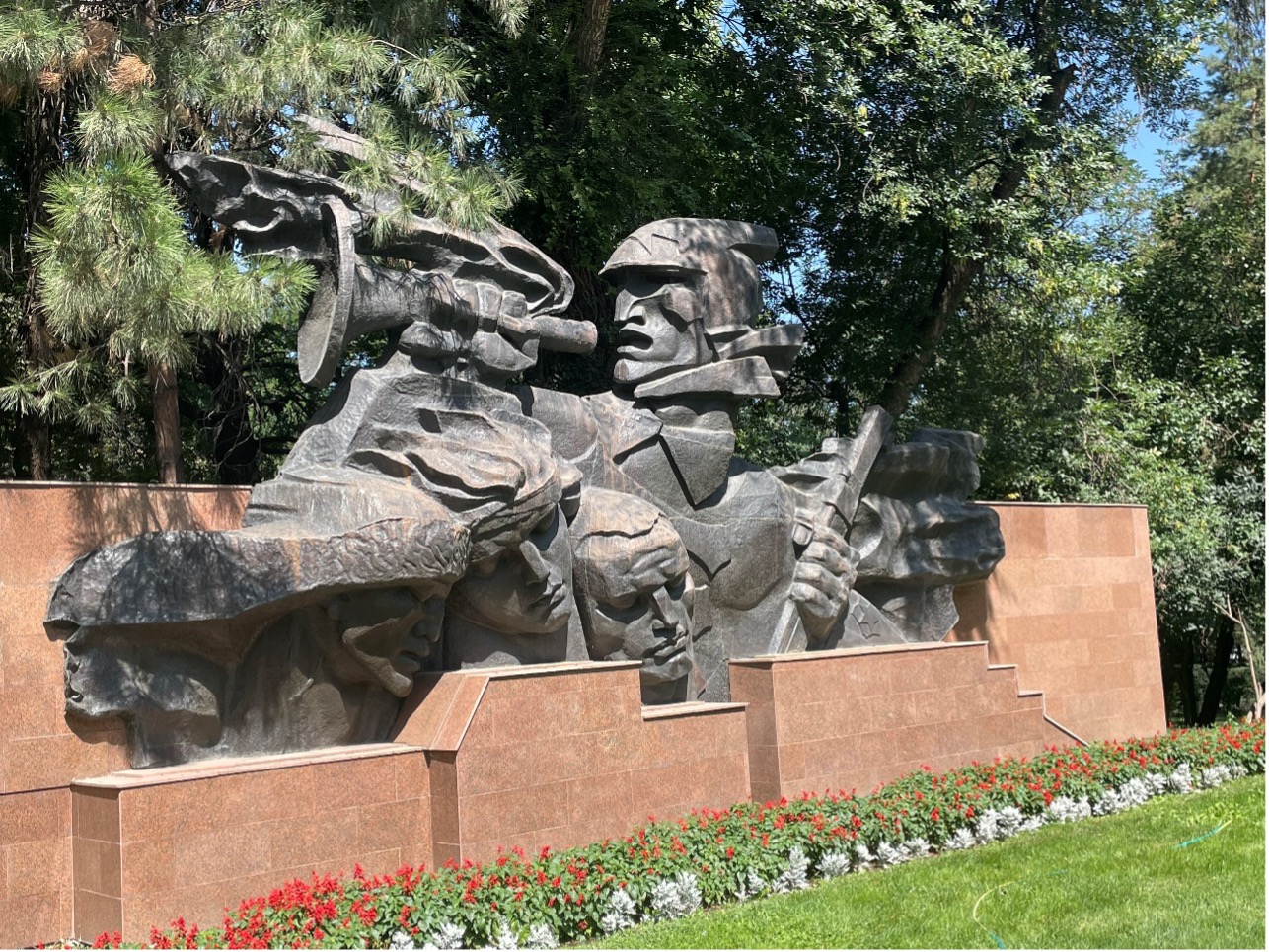
Photograph by the author
The second statue intrigued me as it symbolized the era when the region lost its independence and came under Soviet control. I wondered why it had not been removed after 1991, but my guide said: “Why?” What would that accomplish? There is no need to provoke our former colonizer. There was no need to rile the Russian bear.
Kyrgyzstan
In Kyrgyzstan, where I went next, another memorial testified to the complex efforts to move beyond the Soviet past. In Bishkek, Kyrgyzstan’s capital, was a massive statue of Lenin that had been erected in 1984, during the fading decade of Soviet control. In 2003, over twenty years after Kyrgyzstan achieved independence, the government finally decided to move it, “for renovation.” They moved it off the central square where it stared out over the city. It didn’t go far. Rather than melt it down or shunt it off to a monument graveyard, they moved it behind the central square to a smaller, less conspicuous park. There, Lenin no long looks over the city, but his right arm does point to the Ministry of Foreign Affairs building and, in many ways now symbolizes Russia’s significant role in controlling its former colony.
I asked our guide why the statue had not been simply torn down, defaced by angry mobs, as they had in many parts of the Soviet Empire. “We are a poor, weak country,” she replied, “we have to get along.” Part of that getting along was with their former occupier. Kyrgyzstan remains very dependent on Russia for its security. Independence had meant regional wars that had resulted in the country losing chunks of its territory to its neighbors and needed Russia’s security agreements to not lose more. It is the poorest of the former Soviet “Stans” also so, like other Central Asian countries, is very dependent on the remittances that workers send back home. “We can’t afford to alienate Russia,” she added, “so we keep the statue.”
Just across the street they have also kept the National Russian Drama Theater. When I was there it was closed, undergoing major renovations which were mostly financed by the Russian government. I asked my guide why Kyrgyzs hadn’t renamed and reclaimed this national cultural symbol. Her answer was practical and, after hearing similar answers to similar questions a few days before in Almaty, perfectly understandable. “We simply do not have the resources to do it ourselves,” she replied, “and we need to get along with Russia. Better to not make waves where we don’t need to.”
Lenin Statue, Bishkek, Kyrgyzstan
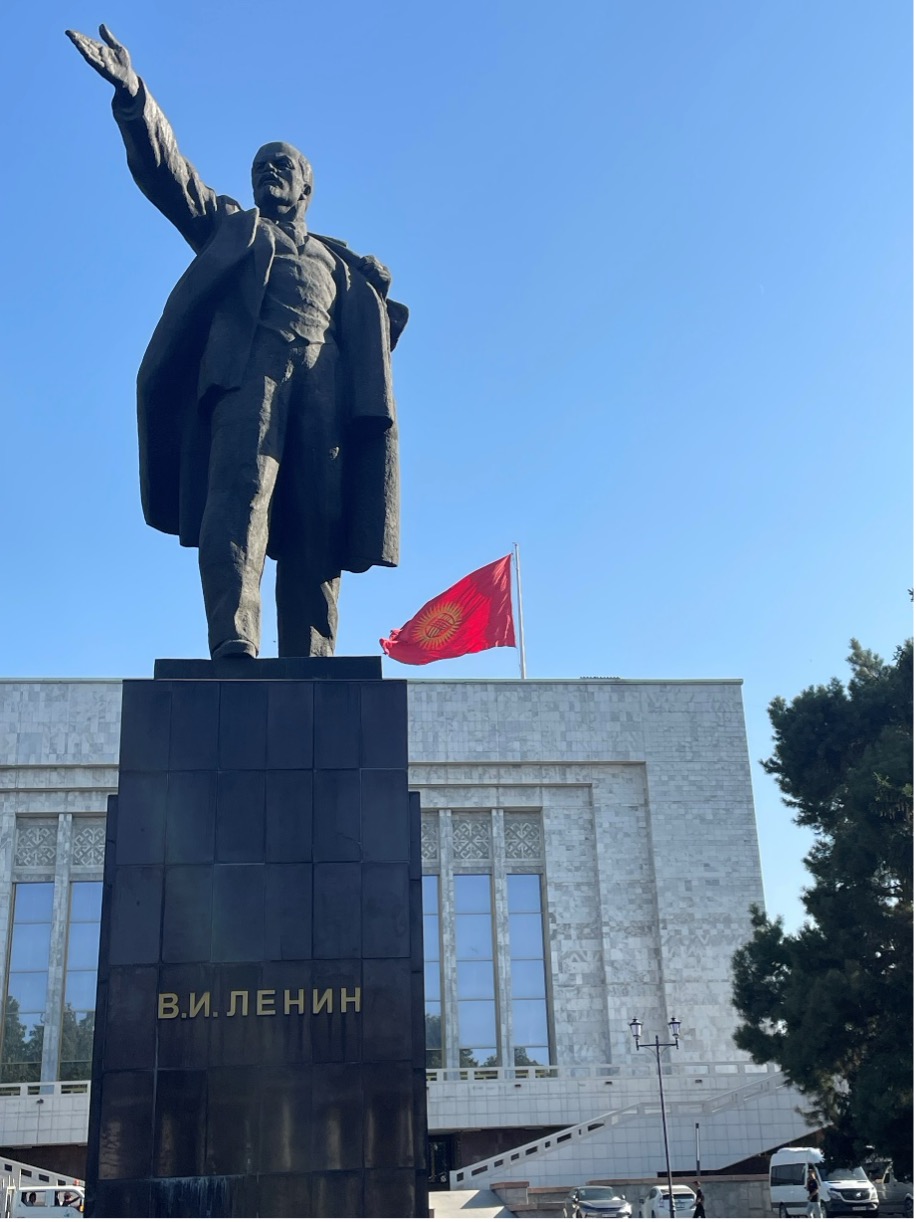
Photograph by the author
Getting along was also an intergenerational necessity. Many older Kyrgyz remain nostalgic for the “better old days” of the Soviet Empire. (And this was true in each of the countries I visited.) The Soviet era meant peace, not regional conflicts. It meant work, even if not very well paid. (When I traveled into East Germany in the 1980s people would often tell me: “the government pretends to pay us and we pretend to work.” This seemed to be the labor system in Soviet-controlled Central Asia also.) It meant some semblance of a health care system and education opportunities.
Women in Kyrgyzstan told me that the Soviet system meant work, education and social opportunities that hadn’t existed before. Our guide noted that there has been an increase in Islamic practice and worship since the end of the Soviet period. Ramadan, for example, has recently become widely observed. While a positive symbol of freedom, she said, many mosques and madrasas are funded by Saudi Arabia, and she was concerned this could lead to an increasing conservative strain to religious observance.
Kyrgyzstan does not abut Afghanistan (the “sixth Stan,” as I came to think of it), but it casts an ominous shadow over the country and the rest of Central Asia. It was the Soviet Union’s invasion of Afghanistan in 1979 that marked the beginning of the end of the Soviet empire. And, especially since the resurgence of the Taliban in Afghanistan in the last several years, concern about the spread of its conservative theocracy across the mountains into Tajikistan, Uzbekistan, Turkmenistan and beyond is an ever-present fear. Russian bases across Central Asia remain, for them, their guarantee that this will not happen. It is a guarantee that comes with a high price.
The post-Soviet world in Kyrgyzstan, as in the other countries of Central Asia, is uncertain. The rules of the political and economic games are still be worked out. Some have benefited, especially if they have connections to government officials, but many suffer under the verities of the emerging capitalist economies. Wages are low and unemployment is high. (Officially it was almost non-existent at 1.4 percent in 2025 but no one in the country believes those figures. Nearly every family has members intensively seeking work. Many turn to the informal sector or abroad. Remittances account for close to a third of the country’s GDP, and 94% of them come from Russia.[i]) Education and health care are more expensive, as government support for these services has been slashed. The decision to keep the statue, our guide concluded, was done as much to mollify her parents and in-laws as it was Russia. It was a theme I heard in every country I visited.
Kyrgyzstan is proud of its democratic record, at least comparatively, in the post-Soviet period. They note that they are the one country in the region to have a truly democratic election since independence. It happened in 2010 when, after riots in Bishkek against the kleptocratic practices of the government, Roza Isakovna Otunbayeva was elected President. She is still the only woman in post-Soviet Central Asia to serve in that role. But it is backsliding. The current President is following the authoritarian playbook, stifling political opposition and handing out perks to his cronies. Public discourse is more circumspect.
Uzbekistan
For Uzbekistan, Soviet occupation meant, among many things, environmental destruction. Uzbekistan does not have significant reserves of oil and gas like some of the Central Asian countries, but it has sun-drenched land and water. And, as in neighboring Turkmenistan and Tajikistan, Soviet centralized economic planning decided it was a favorable place to grow cotton. There were a couple of caveats for the project. One, much of Uzbekistan’s land is semi-arid or desert. But the Amu Daryna River, the largest river in the region, flows across the length of the country, and massive diversion and canal projects were built. Much of this land infertile, sandy, and not loamy, but massive amounts of fertilizer could alleviate that.
Cotton became the dominant sector of Uzbekistan’s economy but at a great price. The Aral Sea, where the Amu Daryna flowed into for millennia, an absolutely essential area for wild life and for the livelihood of hundreds of thousands of people, is now almost completely gone. Over 90% of Aral Sea’s southern portion has disappeared. Where birds migrated is now exposed salt flats. Where people once fished, boats now rust on the sands miles from the continually receding shores. Much of the country’s land is now heavily polluted from the fertilizers and pesticides needed to grow the “king cotton.”
Cotton production needs one more thing to be profitable: cheap labor. Recall that the plantation economy of the United States in the nineteenth century was mostly built on cotton and the slave labor to plant, tend and pick the prickly bulbs of fiber. In Uzbekistan, the labor to pick the cotton came from schoolchildren, university students, and government officials who each fall would be pulled from their desks, loaded in buses and sent to the fields for weeks to harvest the crop. Uzbekistan, under intense international pressure, largely halted this practice about ten years ago. The practice still exists in Tajikistan and Turkmenistan; when I went to these two countries after leaving Uzbekistan, the harvest season was just staring and calls for students and government workers had just gone out.
Cotton-Picking in Uzbekistan
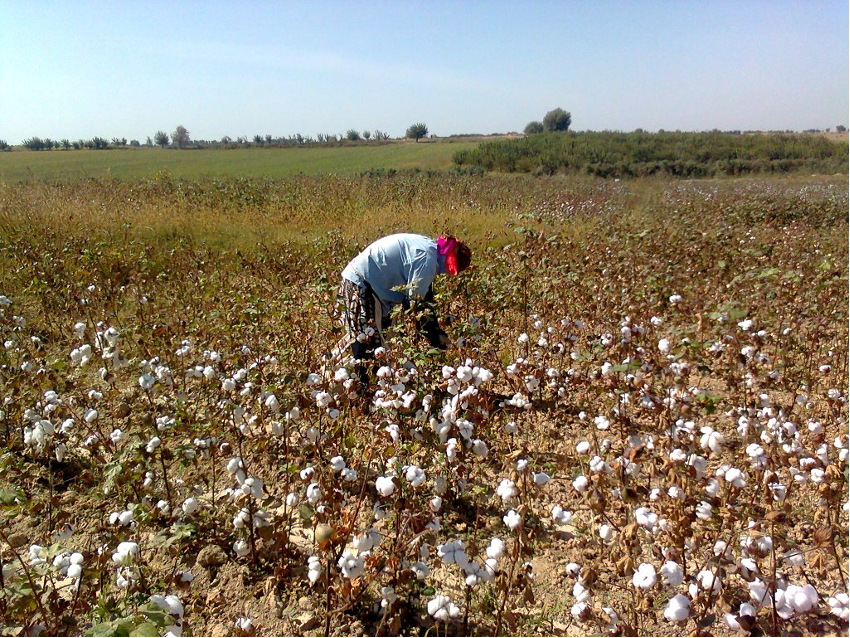
Source: Cazzie Reyes, “History of State-Imposed Forced Labor in Uzbekistan's Cotton Industry,”
October 19, 2015 https://www.endslaverynow.org/blog/articles/history-of-state-imposed-forced-labor-in-uzbekistans-cotton-industry
Like the petrochemical industry in Kazakhstan, Uzbeks grew the raw material, and the Soviet Union transformed it into the finished product. The Uzbek government is now trying to redress this colonial-era dependency system. They are encouraging the establishment of textile manufacturing plants, so that the value-added benefits of cotton production remain at home. They have tried to limit the amount of cotton grown as a way to begin to address its environmental costs. However, jobs over the environment is often the ultimate decision.
It’s not an easy choice. When I asked our guide in Bukhara about these issues, he said, interestingly, that the decision to regulate cotton production was having an adverse effect on other aspects of the agricultural economy. It seems that Uzbek cattle were fed the seeds and husks of the cotton plant and, because of the new policy on cotton production, beef prices were rising fast. People weren’t happy and often called for old quotas, even knowing their environmental and human toll.
Tajikistan
The end of Soviet control in Central Asia did not mean the end of Sovietism, far from it. Soviet economic policies, cultural and linguistic modes remain deeply imbedded. Just as in Russia, where Putin rose from KGB spy to political power to now lifelong dictator, so too have many Central Asia countries, despite hopes and promises of democratic reform, remained mired in the authoritarianism of the Soviet past. Nowhere are these continuities on as full display as in Tajikistan and Turkmenistan.
I didn’t get a chance, given the short nature of my trip (five countries and seven or eight border crossings in fourteen days), to visit Dushanbe, the capital of Tajikistan. However, in some ways, thinking about the legacies of the Soviet political system and the persistence of authoritarian regimes in Central Asia, it was instructive to visit Pendjikent, a provincial city of about 55,000 people not far over the Uzbek border. For while I couldn’t visit the gargantuan presidential palace of Dushanbe that is an overbearing statement of the executive power of the country’s President Emomali Rahmon, it was hard to miss his presence on the streets and in the museums of this border town. Portraits of him adorned several public spaces often accompanied by pithy quotations highlighting his wisdom and achievements. The regional museum, which told the rich history of the region dating back well into the BCE era, devoted a whole wing to his accomplishments, his meetings with dignitaries, and testaments of his selfless work for the common good.
Portrait of Tajikistan President Emomali Rahmon outside of Regional Museum in Pendjikent, Tajikistan.
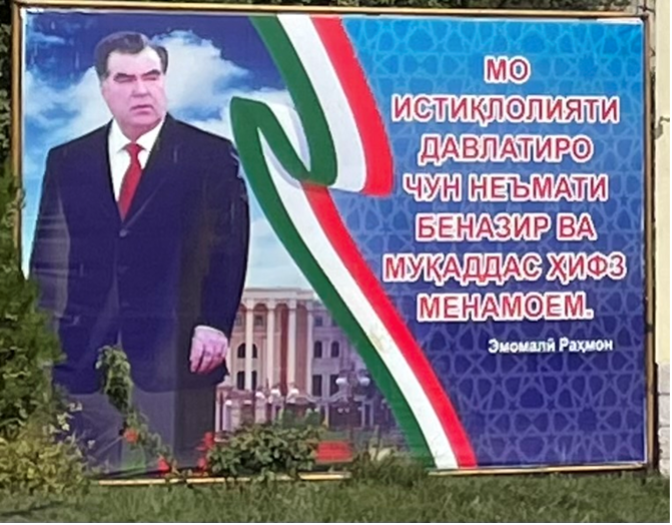
Translation: “We will protect state independence as a unique and sacred blessing.”
Photograph by the author
[i] Anton Chipegin, “Russian Inflows Drive Kyrgyz Remittance Surge,” The Times of Central Asia. Accessed July 9, 2025. https://timesca.com/russian-inflows-drive-kyrgyz-remittance-surge/.
Rahmon is the only Tajik leader in the post-Soviet era. Like many of the other first leaders of the newly independent Central Asian countries, he had worked his way through the ranks of the Soviet bureaucracy and was, therefore, well positioned to assume leadership in the political vacuum of the early 1990s. Fast forward, and he’s now serving his fifth presidential term. He’s added the titles of “His Excellency” and “Leader of the Nation.” And, at age 73, there is a strong possibility of him standing for reelection next year, in 2027. If not, it seems clear that he is grooming his children for that role. One of his sons is the mayor of Dushanbe, and one daughter is his chief of staff.
The hagiography surrounding Rahmon is captured in his bio on the Tajikistan Foreign Ministry website:
“Due to his wise decisions, persistence and extraordinary courage, Emomali Rahmon saved the country from the threat of disaster, brought together the nation and returned thousands of refugees back to their homes… The most important achievements and successes of the country are the result of selfless labour and bold steps taken by Emomali Rahmon… The reward for these extensive efforts were love and respect that Emomali Rahmon won from the people of Tajikistan and among the tens of thousands of our compatriots abroad. He also earned huge respect from the world community that every time shows to him as to an authoritative leader of Tajikistan, an experienced politician and an exponent of universal values and ideals.”[i]
Many governments and human rights organizations don’t quite see Rahmon’s presidency in these noble lights. The US State Department’s assessment of his regime from 2023 (we have now suspended these reports under the Trump II administration) concluded:
“Significant human rights issues included credible reports of: arbitrary or unlawful killings, including extrajudicial killings; torture and cruel, inhuman, or degrading treatment by the government; harsh and life-threatening prison conditions; arbitrary arrest and detention; serious problems with the independence of the judiciary; political prisoners; transnational repression against individuals in another country; arbitrary or unlawful interference with privacy …[ii]
And, it should be noted, the State Department’s list goes on for a while longer.
Given the government’s wide-ranging repression of speech and its frequent arrests of any dissidents I was reluctant to ask anyone about Rahmon, but a short chance conversation with a young woman provided an interesting take. I asked about the portraits adorning the city, and she noted her family had some hanging proudly in their home. The country had suffered severely because of civil and regional wars after the end of the Soviet period, she said. And, while those wars ended in 1997, Tajikistan shares a long border with Afghanistan, and Tajiks remain worried about the consequences of a resurgent Taliban culturally, socially and geopolitically. Rahmon has respected the religious values of the country’s majority Muslim population but emphasizes that it is a secular country, and religious extremism, aka the Taliban, is ruthlessly suppressed. Young women, like her, now had a chance to get an education and have a career, and knowing the fate of young women across their southern border in Afghanistan, these were opportunities not to be taken lightly. Rahmon was tough but necessary. He had brought stability, and that was appreciated. There was some optimism for the future; at least if you avoided public criticism of the state.
It was hard to know what I thought of her responses. As an historian I am trained (maybe over- trained) to be source-critical and, consequently, originally thought that these words were said not in sincerity but in fear of being overheard as being critical of the regime and its leader. It is a possibility certainly, but so was her sincere belief that Rahmon was making things better, at least for those in her position. She could get an education, she could consider a career, she could have conversations with foreign visitors, and she was likely much more secure than were her parents, who experienced the turmoil of wars and civil unrest after the end of the Soviet Union. Much like the older generation’s nostalgia for the Soviet era, it was another lesson in not assuming motivations where my tourist’s knowledge of the lived experiences of people was limited by the nature of our short interactions and perhaps clouded by our positionalities.
Turkmenistan
Turkmenistan has been described as “The North Korea of Central Asia” and its capital Ashgabat as “Pyongyang (the capital of North Korea) meets Las Vegas.” I haven’t been to North Korea but did get a chance to tour Ashgabat; and I can’t say these monikers are inaccurate. To be one of the rare visitors to Turkmenistan you don’t get a visa but a personal letter of invitation from the President. Your guide—and you cannot enter without an authorized guide—must sign an affidavit with the government which ensures that we will never be left alone. The tour is quick and circumspect; the chance to engage with locals close to zero. As a graduate student I traveled a fair bit to East Berlin during its heydays of Communism. And visiting Turkmenistan brought back a lot of memories; I spent a fair bit of time glancing over my shoulder and looking for microphones under the bed.
And Ashgabat is, to say the least, a very strange place. To start with, all vehicles in the city must be white or more rarely silver. Why? Because the first President of the country wanted it so. It boasts the greatest number of white marbled buildings of any city in the world. Why? Because the first President of the country wanted it so. It claims to have the largest indoor Ferris wheel in the world and not too long ago the highest flagpole anywhere. (They are working to reclaim that title.) Why? You get the point. And even though that first President is retired, his successors— the father and son duo of Gurbanguly and Serdar Berdimuhamedow—have carried on the traditions. The whole city is a weird expression of the cult of personality that would have rivaled anything during the height of Stalinism.
Street Scene with Marbled Buildings and all White Cars, Ashgabat, Turkmenistan
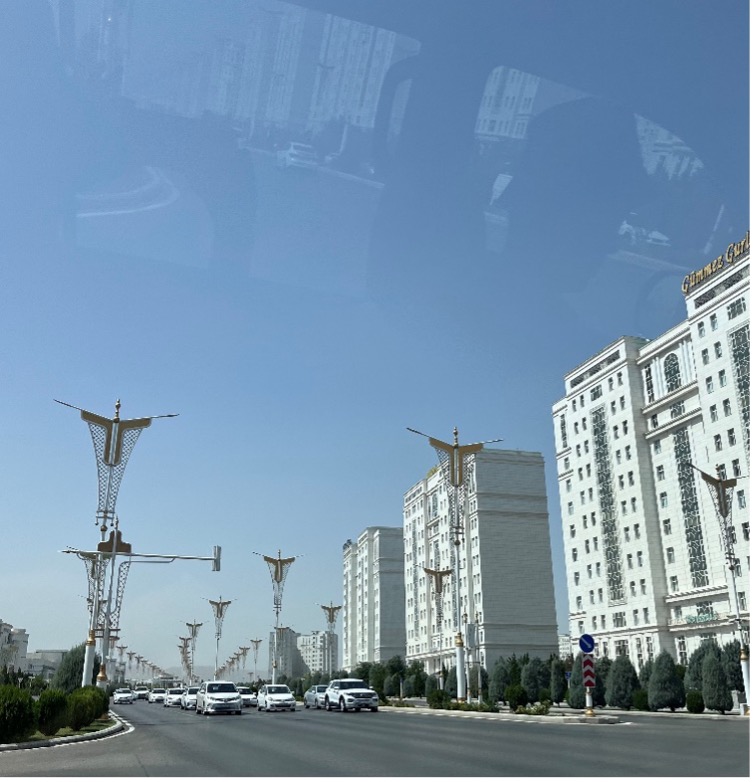 Photograph by the author
The authoritarian kitsch of Turkmenistan was maybe best represented in the national museum. Like the monumentalism of other parts of the city, the building was enormous, and yes, draped in white marble. When I visited, my small group (two of us and our guide) was about the only group of visitors. A troop of gallery attendants watched our every step and glance.
The tour started with the post-Soviet era. (Unlike other museums I visited during this tour, the museum had almost nothing on the Soviet period.) This section barely covered the country’s long-serving first President, Saparmurat Niyazov (1991-2006), and instead focused on the father and son successors, the Berdimuamedows. Their story was told from their supposed humble beginnings to their diligent studies, hard work and then their tireless efforts for the betterment of their people. And interestingly, despite such an exuberant display, our guide was not allowed to walk with us through that part of the exhibit and only joined us as we proceeded to examine the artifacts of the region’s deep and interesting history. I can only speculate on why, and it seems to me that they didn’t want to make him take questions on the country’s leaders and have to either deflect or lie. It seemed clear to me anyway, that this exhibit was like the movie set of an old western where the store and saloon fronts were façades with nothing behind them. To quote from Macbeth, they were “all sound and fury signifying nothing.”
Conclusion
When I tell people about my trip, I emphasize that I went to Central Asia, despite the fact that the tour was billed as “a tour of the five ‘Stans.’”[i] I say so because these countries and the people are distinct, complex and diverse. While it seems appropriate geographically to identify them collectively as located in the center of Asia, lumping them together as “the five Stans” seems to diminish their uniqueness.
Yet, I can understand, as this essay has tried to briefly explore, that they do have a shared identity, and a shared history that comes from their long experience as colonies of Russia and then the Soviet Union. And they share a common legacy of coming to grips with that past more than three decades later. Each was strongly impacted by Russian cultural dominance that is still felt in the use of the Russian language across the region. Each country’s economy was dominated by Soviet central planning projects that defined their economies to serve the needs of Moscow more than their own people. Their economies still remain shaped by those projects. Each was key to Soviet security interests. In every country I heard the numbers of Kazakh, Kyrgyz, Uzbek, Tajik and Turkmen men and women who served and died defending Nazi aggression in Russian lands during World War II. And this region remains either tied to Russian foreign policy interests today or, at a minimum, “can’t afford to rile the Russian bear.”
What this era means for the peoples of Central Asia is not easy to summarize. Anger at the loss of culture, the destruction of the environment, the servitude of its people to a foreign occupier is common, palpable. So too, is a sense of nostalgia for a simpler, more secure past. Independence has not been easy for many, and the challenges of the market economy have left many behind. Hopes of representative governments and democratic elections have often withered under the control of new authoritarian leaders. If I had to put my finger on one sentiment, it would be: “It happened. It was good and bad. We want to move on and make our future.”
________________________________________________________________________
· The tour is also promoted as a Silk Roads Tour, and it should be emphasized that this region’s history is much more than the era of Soviet occupation. That history is evidenced in Kazakhstan, where I looked at artifacts of neolithic peoples in the city museum, in statuary in Turkmenistan from the era when Alexander the Great conquered and settled the area, or in the dusty ruins of the Sogdian city that flourished in the Pendjikent valley from the 5th to the 8th century. Those heritages still shape the cultures and identities of the lands and peoples, and those stories are eminently worthy of being told.
Suggested Readings & Media:
Fatland, Erika, Sovietistan: Travels in Turkmenistan, Kazakhstan, Tajikistan, Kyrgyzstan, and Uzbekistan, trans. Kari Dickson (Pegasus Books, 2018).
“Gurbanguly Berdimuhamedow: Last Week with John Oliver,” (2019). https://www.youtube.com/watch?v=-9QYu8LtH2E.
Lillis, Joanna, Dark Shadows: Inside the Secret World of Kazakhstan (I.B. Tauris, 2018).
Lillis, Joanna, Silk Mirage: Through the Looking Glass in Uzbekistan (Bloomsbury Academic, 2025).
Litchfield, Rebecca, Soviet Ghosts: The Soviet Union Abandoned: A Communist Empire in Decay (Carpet Bombing Culture, 2014).
Thubron, Colin, The Lost Heart of Asia: A Journey Through Post-Soviet Central Asia―Uncovering Hidden History and Ancient Secrets (Harper Perennial, 1994).
[i] “The Five Stans Tour,” Adventures Abroad. Accessed February 16, 2026. https://www.adventures-abroad.com/tour/the-five-stans/CA3?gad_source=1&gad_campaignid=23514512377&gbraid=0AAAAAD6G7_tECJtu1O3sheOmIpwnlZbN3&gclid=CjwKCAiAncvMBhBEEiwA9GU_fi1y5Fa4FQ-G-T--HU1TeUKM1zMQSxmkGUP3TghdK7xepGNGl3fKRhoCNMMQAvD_BwE
[i] “The Founder of Peace and National Unity – Leader of the Nation, President of the Republic of Tajikistan,” Ministry of Foreign Affairs of the Republic of Tajikistan. Accessed January 10, 2026.
https://www.mfa.tj/en/main/view/2422/the-founder-of-peace-and-national-unity-leader-of-the-nation-president-of-the-republic-of-tajikistan
[ii] “2023 Country Reports on Human Rights Practices: Tajikistan,” US Department of State. Accessed January 5, 2023. https://www.state.gov/reports/2023-country-reports-on-human-rights-practices/tajikistan/
[i] Rebecca Litchfield, “Soviet Ghost Book.” Accessed January 20, 2026. https://www.rebeccabathory.com/blog/soviet-ghosts-book.
[ii] Muhammad Tahir, “Russia’s shadow army: Central Asian migrants are dying in Ukraine,” Atlantic Council, June 20, 2025. Accessed July 9, 2025.
https://www.atlanticcouncil.org/blogs/new-atlanticist/russias-shadow-army-central-asian-migrants-are-dying-in-ukraine/