Inaugural Address
Read Maura B. Mast’s remarks, as prepared, for her inaugural address.
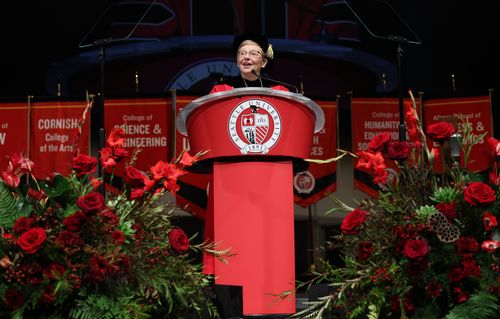
Following are President Maura B. Mast’s remarks, as prepared, for her inaugural address on Nov. 17, 2026. Visit Presidential Inauguration for recordings of the ceremony and Mass.
Members of the Board of Trustees, Board of Regents, and Society of Jesus; Provincial leadership; distinguished delegates from colleges and universities; elected and civic leaders, faculty, staff, students, alumni, benefactors, friends of Seattle University, and friends from my high school and college days—thank you for being here today. I am deeply grateful for your presence, your partnership, and your commitment to this extraordinary university.
To my siblings—Brigid, Cece, and Brian: thank you for your love, encouragement, and sarcasm over the years. I am grateful that you made the journey to celebrate with us today.
To my children—Brendan, Mao, and Nuala: watching you grow has deepened my understanding of what it means to learn, to question, to discover, and to find one’s place in the world. I’m so happy that you can rejoice with us.
And a special thanks to my husband, Jack Reynolds. Jack: you have been my partner through moments of uncertainty and joy, moves to new institutions and new lands, and participation in more math conferences than anyone should reasonably be expected to endure. Throughout all of this, you have offered wise counsel, a grounded perspective, and regular reminders that I am human and need to take a break from time to time. Thank you for your patience, your humor, your perspective, and your love.
The two other people I want to thank are my parents, Mary and Cecil Mast. I know they would be incredibly proud to see me with my siblings and our partners, gathered here to celebrate this moment. Today is especially poignant for me and for my family because today is the anniversary of my mom’s death. She died in 2003, and my dad in 2008.
A Foundation of Hospitality, Service, and Education
One special way in which my parents shaped me and my siblings was by instilling in us a love of hospitality. Growing up, I watched my parents regularly extend their table to my friends, to those new to Notre Dame and new to the United States, and to graduate students who couldn’t get home for holidays. One of my favorite memories of my parents in our house in South Bend was just a few months before my mom died. Mom and Dad hosted a small brunch that, in typical fashion in our house, turned into afternoon tea, and then turned into dinner and drinks—filled with great food, lively conversation, and many laughs.
My parents’ love of hospitality offered a natural way for them to connect faith and service through their involvement in the St. Vincent de Paul Society in South Bend, Indiana. They saw service not as an act of generosity bestowed from a distance, but as an act of encounter that changes us, and they did their best to align their work with St. Vincent de Paul’s observation that “it is only for your love alone that the poor will forgive you the bread you give them.” If this sounds counterintuitive, it’s because it is. We are transformed when we allow ourselves to encounter the humanity of others—when we walk with others, when we accompany others.
My parents also believed deeply in the power of Catholic higher education—another context in which we are called to value the dignity of the individual and be transformed by engagement with them. Their lives were shaped by educational opportunities and openness to change. My dad received a last-minute tuition award to attend DePaul Academy in Chicago, left high school to serve in World War II, and then used the GI Bill to complete his undergraduate degree at DePaul University. He believed so strongly in the value of Catholic higher education that he sought a faculty position at the University of Notre Dame and spent his career there, demonstrating to the next generation—both his students and his children—the power of a mission-based education that puts the student at the center.
It is because of the examples set by my parents that I stand before you today. Their commitments to hospitality, service, and education shaped me profoundly and put me on this path to answer the call to serve as president of Seattle University.
The Jesuit Tradition of Welcoming Change
Seattle University’s 20th president, Fr. William Sullivan, writing on the centenary of the university, reflected on how our Jesuit approach to education brings these ideals together in a distinctive way:
“…a university is necessarily dynamic. Change and growth are integral characteristics of our institution. Seattle University has prospered because it has welcomed change rather than resisted it. While it is good to invite and accept change and growth, it is equally important that an institution understand and reinforce those characteristics which define it and make it unique. Seattle University has always been true to several defining commitments: to academic excellence in teaching and learning, to education in values, to service, and to the institution’s religious character.”
This dynamic nature—welcoming change while remaining true to our foundations—is no accident. It is part of a long tradition of Jesuit and Catholic education responding to the questions of each generation with imagination, courage, and hope.
When the Society of Jesus was formed in the 1540s, education was not one of its defining works; in fact, its earliest documents expressly excluded teaching. Yet the early Jesuits saw how education could serve the common good, and in 1548 they opened their first school in Messina, Sicily. By integrating Ignatian spirituality into a humanistic curriculum focused on holistic spiritual, intellectual, and moral transformation, they democratized civic education and expanded it across the globe.
Over the centuries, Jesuit and Catholic institutions continually encountered new social, intellectual, and cultural realities—perhaps none more pivotal than the middle of the twentieth century. Around the Second Vatican Council, the Catholic Church engaged in a broad examination of how it might faithfully engage the modern world. If the early Jesuits asked how education could serve the needs of their time, the generation of Vatican II asked a related question: how should Catholic higher education, rooted in a centuries-old tradition, engage a rapidly changing world?
Here at Seattle University, those abstract concerns became concrete during a visit from Fr. Pedro Arrupe, Superior General of the Society of Jesus, in 1966. Addressing this community, Fr. Arrupe said:
“The Catholic University will fulfill its exalted mission only if it achieves true academic distinction. This requires, among other things, that the University be open to the winds of change… [playing] a decisive role in the community it serves, facing frankly the problems of the times and ready for all innovations, even the most radical.”
One year later, leaders of Catholic higher education echoed this vision in the Land O’Lakes Statement, calling on modern Catholic universities to participate boldly in intellectual life with a strong commitment to academic excellence, to address the pressing problems of our era, and to remain grounded in mission—to be both fully university and fully Catholic.
As every generation discovers, answering one question often reveals another. How can we connect academic excellence to justice and the common good? What should students do with the education they receive? What is the relationship between university and society?
The Jesuit University as a Witness of Hope
In the 1970s, Fr. Arrupe challenged our universities to connect academic excellence to responsibility for others, leading the Society of Jesus to proclaim its mission as the service of faith and the promotion of justice. A decade later, amid growing distrust in American institutions, Superior General Fr. Peter-Hans Kolvenbach reminded us that while universities face tremendous pressure to opt entirely for marketable “worldly success,” the real measure of a Jesuit university lies in who our students become. For nearly five centuries, Jesuit education has sought to educate “the whole person.” Yet as Fr. Kolvenbach noted, that concept itself must adapt: tomorrow’s whole person cannot be whole without an educated awareness of society and culture—without what he called “a well-educated solidarity.”
In 1982, Fr. Ignacio Ellacuría, then-rector of the Universidad Centroamericana in El Salvador, pushed that responsibility even further. Speaking at Santa Clara, he declared that a university is inescapably a social force that must transform the society in which it lives:
“…[A university] must be concerned with the social reality—precisely because a university is inescapably a social force: it must transform the society in which it lives… A Christian university must take into account the gospel preference for the poor. This does not mean that only the poor will study at the university; it does not mean that the university should abdicate its mission of academic excellence—excellence which is needed in order to solve complex social issues of our time. What it does mean is that the university should be present intellectually where it is needed: to provide science for those without science; to provide skills for those without skills; to be a voice for those without voices; to give intellectual support for those who do not possess the academic qualifications to make their rights legitimate.”
The UCA used its scholarship, data, and critical reflection to confront the erosion of democracy and human rights in El Salvador. It came at a harrowing cost: threatened by that advocacy, the Salvadoran government murdered Fr. Ellacuría, five fellow Jesuits, their housekeeper, and her daughter. Their witness remains a stark reminder of how universities stand at the forefront when democracy is threatened.
Fr. Ellacuría’s words resonate today because the questions he confronted have become even more urgent. In the United States, higher education is at risk. Federal support for research that has driven scientific, medical, and economic advancement for generations is increasingly uncertain. Institutional autonomy, academic freedom, and curriculum are increasingly contested. Commitments to diversity, equity, inclusion, and belonging—commitments rooted in Catholic Social Teaching and the conviction that every person possesses inherent dignity—are under fire. And here in Washington State, reductions in support for students attending private nonprofit colleges raise critical questions about access and opportunity.
These developments don’t just affect institutions; they affect our students—the next generation of scientists, teachers, nurses, engineers, artists, lawyers, and civic leaders. They affect the communities that depend on us as an engine of discovery and engagement, and they affect our faculty’s ability to advance truth. This is not a partisan issue, nor is it unique to the United States. As our current Superior General, Fr. Arturo Sosa, has observed, universities stand on the front lines of democracy because we cultivate the very habits democratic societies depend on: thoughtful dialogue, critical inquiry, respect for human dignity, and a commitment to truth. As Fr. Sosa proclaimed, that is why our Jesuit universities must be a witness of hope. Because hope allows us to “... renew our commitment to form universal citizens, citizens who recognize the priority of the universal common good over the particular interests of nations, no matter how powerful those nations may be or how eager they are to exercise their imperialist vocation.”
Turning that vision into reality is the ongoing work of Jesuit higher education. We cannot confuse continuity with sameness. The challenge is not to repeat the answers of previous generations, but to bring the same commitment to truth, human dignity, and the common good to the realities of our own time.
Seattle University: A History of Meeting the Moment
Seattle University’s history reflects that exact spirit. Again and again, this university has responded to the needs of its time while remaining grounded in our mission.
Seattle University has a history of being committed to access and upward mobility. In 1931, what was then Seattle College established a “night school” for women and became the first Jesuit institution in the U.S. to grant degrees to women as regularly matriculated students, sharing classrooms with men. Several years later, Seattle U established a nursing program grounded in scientific rigor and compassionate care, becoming a leader among Jesuit institutions in integrating liberal arts education into professional schools. And this past year, when Washington State reduced support for the College Bound grant program, Seattle University stepped up to fill the financial need gap.
Guided by our commitment to care for our common home, Seattle University became an early leader in ecological campus management in 1986, transitioning to pesticide-free and organic groundskeeping. And in 2023, we became one of the first Jesuit institutions to join Pope Francis’ Seven-Year Journey Towards Integral Ecology—becoming the first Jesuit university in the United States to fully divest its endowment from fossil fuels.
And we continue to meet the moment. Two years ago, the university embraced a bold future by bringing Cornish College of the Arts into the institution, strengthening the arts in the heart of Seattle and making a strong statement about the value of the creative arts. Today, as artificial intelligence reshapes how we learn, work, and communicate, our faculty and students are tackling one of the defining questions of our generation: how can powerful new technologies be developed and used to advance truth, wisdom, human dignity, and the common good?
The specific challenges have changed from one generation to the next. But the response has not. This is a university that has a history of seeking to discern what the moment requires and how it will respond in a way that is rooted in its mission and values.
Near the conclusion of Seattle University’s first century in 1991, Fr. Sullivan reflected on what would be required for the next century. He wrote:
“The continued success of our university will depend largely on how well we understand these and other lessons of our first century and apply them to the challenges which will face us in the next 100 years. We must remain true to our heritage, our values, and our institutional character as we formulate the goals, ideals, and dreams which will direct us into our second century.”
A Call to Lead with Courage, Wisdom, and Generosity
Thirty-five years later, those words still hold true. Earlier generations could not have imagined the world we face today, and they did not leave us a roadmap. Instead, they gave us a way of proceeding: to approach new realities with intellectual rigor; to engage uncertainty with courage; to welcome change while staying rooted in our identity; to place knowledge in service of the common good; and to trust that education remains one of society’s most powerful instruments of hope.
I’d like to return to where I started: the example of my parents. Through their lives – and the table they set for others – I learned that hospitality and human dignity sits at the center of both service and education, and that we are transformed when we accompany, when we encounter, and when we truly see the individual.
That is the heart of what we do at Seattle University. We educate, we advance knowledge, and we engage in dialogue; we accompany, we seek truth, and we cultivate wisdom to form leaders who will use their gifts for others.
As we enter the next chapter of Seattle University’s history, we have been entrusted with a remarkable inheritance. We don’t have certainty; we don’t have a roadmap. But we do have a mission—a mission that calls us to educate for justice, pursue truth with humility, accompany those entrusted to our care, serve as a social force within our community, and contribute to the common good. And while the questions I face as your president will differ from those of my predecessors, I am confident that this university—grounded in its Jesuit, Catholic tradition and animated by the talents, commitment, and hope of this extraordinary community—will continue to respond and lead with courage, wisdom, and generosity. In doing so, may Seattle University be a witness of hope: forming people of wisdom, compassion, and courage for a world that needs all three.