Embracing the Opportunity
Written by Mike Allende
Thursday, July 9, 2026
/0x3:2326x1487/prod01/channel_34/media/seattle-university/news--stories/magazine/spring-summer-2026/John_Newsroom-Story.jpg)
John Bonner is looking to bring his style of leadership—and style of play that is physical, fast and entertaining—as the new head coach of women's basketball.
John Bonner knows the challenge is a big one. But so is the opportunity.
Bonner, who was hired to replace Skyler Young as Seattle University’s new women’s basketball coach, takes over a struggling program that has won just 21 games over the past four seasons. But Bonner is no stranger to turning things around.
Taking over Cal State Fullerton’s basketball program last season, Bonner led the Titans to their best season this millennium, winning 18 games and reaching the Big West Conference quarterfinals. Fullerton’s 13 conference wins were its most since 1990-91.
Before Fullerton Bonner led Cal State Dominguez Hills (CSDH) to two 30-plus win seasons, earning a spot in the NCAA Division II tournament title game, the first in the program’s history. Overall, at CSDH he went 141-96.
So, yes, Bonner knows how to win. But he also knows that the rapid pace of his success at Fullerton was an outlier.
“Like anyone, I want to find immediate success,” Bonner says. “Our goal is to be at the forefront of the West Coast Conference. But things take time. I think about success as wins but also in the entertainment we provide, the energy and the experience we give our student-athletes and our fans. Hopefully people continue to pour support into our program and what you’ll see is an incline to success and engagement with the community.”
The first step, really, has been getting to know his new home. Bonner is a California guy through and through. He grew up in Bakersfield and earned his bachelor’s in psychology and master’s in counseling from Fresno State. He was an assistant at Fresno State and Fresno Pacific before taking the head job at Cal State.
That’s a lot of time in the Golden State. But he’s slowly making the Pacific Northwest his home.
“I’m on the fast track to gain knowledge about the area, the people, the university,” he says. “It’s beautiful here. It’s a beautiful campus. Everyone has been helping me adjust and learn and just hearing about the passion for this city, for athletics, has been wonderful.”
Still, leaving a place that has been home for your entire life—and a program you just led to its greatest success in some time—is not an easy choice. Bonner says being a part of the West Coast Conference was a major draw in coming to Seattle University and his approach to coaching aligns well with what Vice President of Athletics Shaney Fink was looking for.
“When I learned about the university, it just matched what my coaching philosophy is in the holistic development of everyone in the program,” he says. “I hadn’t planned to leave Fullerton after one year, but this just checked off every box. I saw the vision of what they’re trying to build here and they saw my vision of how I build a program.”
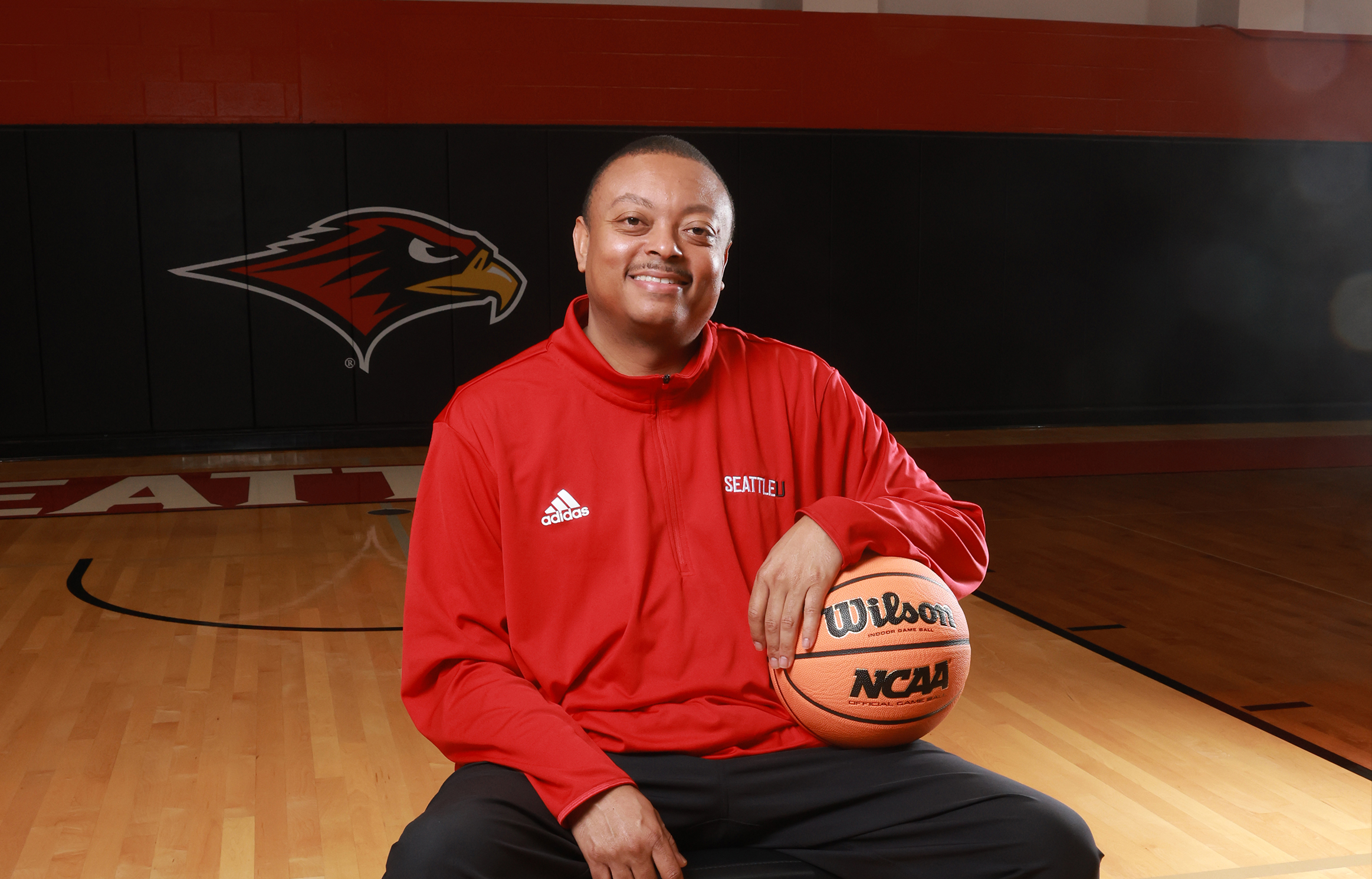
For Bonner, that starts with having great people—if you surround yourself with great students, great staff, you get good results. He wants his players to know they are there to compete but also to grow as students and people prepared for whatever comes post-graduation.
On the court, Bonner’s teams play a physical, fast, entertaining style. Fullerton led the conference in scoring (71.8 points a game), rebounding, offensive rebounding and steals and held teams to 66 points a game.
“We press and we play a full-court game the entire game,” he says. “We play a style that is entertaining to fans and we’re going to be fun to watch. Defense and rebounding are key factors and we’ll bring in players who are willing to adapt and players who play with a chip. But I also want players who are smart, good people who meet the ideals of the culture we’re establishing.”
The culture includes ensuring that student-athletes know they’re cared for beyond just what they can do on the basketball court. Bonner’s education in psychology means relationship-building is vital to his program’s success. He meets with every player regularly to talk about anything not related to basketball—he says he’s seen far too much reality TV in an effort to bond and connect with his team.
“Knowing that you care about them as people helps increase their ability to buy into what you’re trying to do,” he says. “They know I want to connect with them and they know I care about where they’re trying to go in their lives and what they’re trying to work through. Having an impact on young people, being able to help them on and off the court is a big focus for me. Coaching is not a job for me—it’s a passion.”
Similar News & Stories
-
/0x42:2400x1558/prod01/channel_34/media/seattle-university/news--stories/images/Pete-Fewing.jpeg)
-
/0x11:2326x1480/prod01/channel_34/media/seattle-university/news--stories/magazine/winter-2026/Junseok_newstory2.jpg)
From Seoul to Seattle
Seattle University MagazineSouth Korean hoops star Junseok Yeo, ’26, leads men's basketball in first season back in the West Coast Conference. -
/0x37:2240x1452/prod01/channel_34/media/seattle-university/news--stories/magazine/winter-2026/Newsroom-Story_andre.jpg)
An Inspiring Basketball and Legal Career
Seattle University MagazineOne the greats learning from the greats.
Contact Listing
/0x28:576x693/prod01/channel_34/media/seattle-university/directory/faculty--staff-directory/images/placeholders/ProfileDefaultPics-SpiritMark.png)