An On-Ramp for Small Businesses
Written by Tina Potterf
Tuesday, October 20, 2026

Seattle University programs give small business owners practical support and students a dose of entrepreneurial experiential learning.
When Natalie Eltahir was looking to grow her Seattle-based company Popcorn Concierge, she was in need of practical business advice and a support network to take the gourmet popcorn treat from a product to a sustainable business.
“I needed help learning to see Popcorn Concierge as a complete business system,” says Eltahir.
Enter Seattle University’s ON-RAMP program, of which Eltahir learned of through a LinkedIn post. ON-RAMP (Onboarding New-Resource Amplification Management Program) is an offshoot of RAMP-UP (Resource Amplification and Management Program RAMP-Urban Prosperity), which pairs students with area small business owners to provide technical assistance in a consultant-like capacity. Operating out of the Innovation and Entrepreneurship Center at the Albers School of Business and Economics, ON-RAMP offers business fundamentals, such as business plan assistance, marketing, financial literacy advice and practical tools for growth.
Working with the students, mentors and faculty through ON-RAMP has changed how she sees entrepreneurship and the experience has been one built on long-term support rather than transactional.
“One of the biggest things I’ve learned is how to use a support system well. A faculty connection can lead to another resource. A training can lead to a customer. A community relationship can strengthen a business service. A challenge can show you what skill you need to build next,” she says. “I understand now that small businesses grow within an ecosystem of mentors, universities, customers, community organizations, fellow entrepreneurs and business support programs.”
Supporting small businesses—the mom-and-pop’s that are the lifeblood of neighborhoods and communities—in the Seattle area is at the core of the mission of RAMP-UP and ON-RAMP. And this mission is embodied through the entrepreneurs and SU students who work with them to achieve successful outcomes.
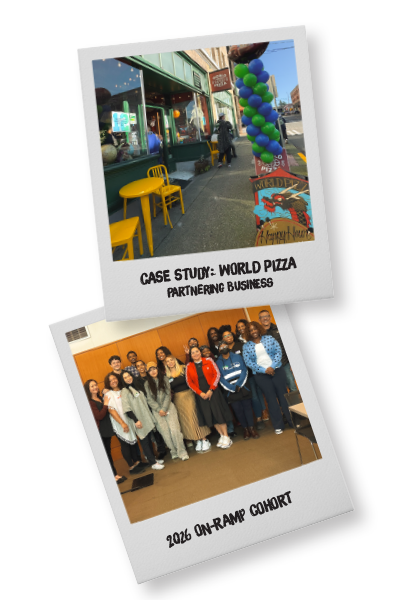
While RAMP-UP employs graduate students ON-RAMP is a five-credit course for undergraduates where they gain the business and interpersonal skills to become business consultants through hands-on experiential learning. Following a four-week onboarding process students spend the remaining six weeks of the term working one-on-one with a small business entrepreneur. Students also learn about the process of lining up a business, often involving literally pounding the pavement and doing on-the-ground outreach research to potential clients for their clients.
The approach is intentionally hands-on, says Janie Ng, director of Strategic Partnerships & Economic Development who oversees the program.
“ON-RAMP’s MGMT 4910 Small Business Consulting course bridges classroom learning and real-world experience,” says Ng. “Students build practical skills while entrepreneurs gain trusted support, creating value for both and strengthening the local economy.”
SU computer science student Hong-Anh Ly got to serve as a consultant through ON-RAMP’s Small Business Consulting class and found inspiration meeting and working with entrepreneurs, witnessing their creativity, passion and drive for their business. This real-life experience will also carry over into Ly’s future career aspirations.
“Beyond just technical consulting skills, the experience increased my confidence in my core strengths, improved my resource leverage, and taught me the true value of what it means to be a trusted advisor. Above all, the foundational skills I developed in this experience—relationship building, resilience and strong communication—are universally adaptable traits that will serve me across any industry.”
ON-RAMP was an idea that had been on Ng’s mind for years. When a professor at the University of Notre Dame presented to her the idea of launching a similar program in cities hosting the FIFA World Cup, the opportunity aligned with what she had already envisioned for an extension of RAMP-UP.
The first cohort of ON-RAMP paired 15 undergraduate students—mostly juniors and seniors from a range of majors—with entrepreneurs. ON-RAMP was deliberatively designed to be small and personal: one student to one entrepreneur. RAMP-UP takes a different approach with similar goals—the program hires graduate students as consultants for placed-based work within underserved neighborhood business communities.
For businesses who work with ON-RAMP/RAMP-UP, the process typically begins with a discovery client meeting and marketing then often expands into other areas depending on the needs of the business owner. For example, some may need help implementing a marketing plan, others may need technical assistance with finance or operations.
More recently RAMP-UP focused on small businesses—many of which are restaurants—in the Chinatown/International District, named one of America’s Most Endangered Historic Places in 2023 by the Nation Trust for Historic Preservations. Through RAMP-Up CID, sponsored by a JP Morgan Chase grant and launched earlier this year, SU students across disciplines provide culturally responsive, business support in both the CID and Little Saigon.
“These neighborhoods have faced significant economic challenges and their future depends on bringing new energy and customers alongside support for longtime businesses to support the community,” says Ng. “RAMP-UP CID helps businesses adapt, but revitalization also requires all of us to show up—have a meal, shop locally, discover a business you haven’t visited before.”
That philosophy is also behind a new initiative launching this fall called Lunch for Good. The idea is simple: Once a quarter, people choose one or two restaurants in the CID or Little Saigon and make a point of eating there.
She sees increased business as part of a broader response to the challenges facing Seattle neighborhoods such as in the CID. While acknowledging concerns about safety and other problems, she worries that constant negative attention can overshadow the businesses and people who have remained in the community for years. And the efforts go beyond foot traffic—it’s about community supporting community, showing up and out for the small businesses that make Seattle distinctive.
“Seattle needs to show up for Seattle,” Ng says.
Similar News & Stories
-
Bless the Animals
SU NewsEvent celebrates the Feast of St. Francis of Assisi and anniversary of the Chapel of St. Ignatius. -
Supporting Community Mental Health and Whole-Person Care: Graduate Opportunities at Seattle University
Campus NewsSeattle University’s College of Humanities, Education and Social Sciences offers several graduate pathways to prepare students to work in community mental health. -
The Impact of Public Service Careers in Communities
Campus NewsPublic service careers help communities respond to real needs. Learn how Seattle University prepares leaders through mission-driven programs.