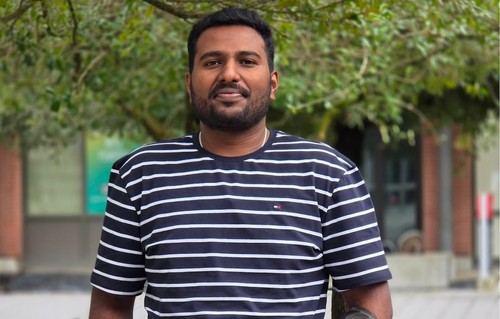
International student Rupeshwar Rao found success and opportunities in SU’s computer science master’s program.
When Rupeshwar Rao reflects on his professional goals, he plans to work in Silicon Valley and leverage his skills in the tech industry. He moved one step closer to reaching his aspirations when he graduated from Seattle University’s College of Science and Engineering in June 2026 with a Master of Science in Computer Science.
As an international student, Rao wouldn’t have pursued his graduate degree in the United States without the influence of his late grandmother Shri Vijayalaxmi. Although he worked in his field for several years after earning his bachelor’s degree, his grandmother encouraged him to study abroad for his master’s. It wasn’t until her death in October 2023 that he began to consider his options in the U.S. for graduate school.
When Rao arrived on the Seattle University campus in 2024, he was prepared to build upon his knowledge from his three years working as an application engineer. Despite finding success in his previous roles, he was eager to keep learning and expand his expertise.
Rao explains why he pursued a graduate degree in computer science. “I was ready for something new after working as an application engineer,” he says. “After a long period of three years dealing with the tech industry, having the same mindset of solving issues, nothing was much more oriented towards solving new issues.”
When Rao began to consider graduate programs in the U.S., he sought a university on the West Coast with strong industry connections. Seattle University rose to the top of the list, especially after he connected with a current student who emphasized the job-relevant curriculum.
At Seattle University, Rao found opportunities to expand both his technical expertise and his approach to solving problems.
The computer science coursework immediately expanded Rao’s perspective on the field. Challenging classes and learning opportunities gave him the insights to understand the bigger picture. In his first semester, he enrolled in a course called “Distributed Systems” with Professor Kevin Lundeen. For Rao, this class redefined his career goals. Over the course of the quarter, Rao shifted his focus from application development to architecting scalable backend infrastructure.
Throughout the program, Professor Lundeen’s teaching methods continued to shape how Rao thought about his learning.
“Professor Lundeen has a very unique way of explaining the concepts of distributed systems, which is the most critical aspect of technical background in a very unique way.”
Although the class was a technical course, Rao found that Professor Lundeen’s use of practical analogies made complex concepts easier to understand.
“He doesn't follow any theoretical aspect of it. He makes you stand, he makes you play with the playing cards so that you realize how important it is in the real world when you are talking about servers and all the technical background.”
Expanding Soft Skills Through Collaboration
Beyond technical skill development, Rao also appreciated that the program provided opportunities to expand his professional capacities more broadly. Alongside the technical expertise he built through his course assignments, Rao and his classmates also developed communication, leadership and collaboration skills.
The program’s extracurriculars and coursework requirements enabled students to practice leadership and public speaking skills. Outside of the classroom, Rao served as the Graduate Outreach Representative for the Association for Computing Machinery Club and worked with his peers to organize events such as hackathons.
Over the course of the master’s program Rao completed six collaborative projects and approached each one as a challenge to step outside of his comfort zone. When given the chance to form groups for collaborative projects, he selected different peers each time. This approach allowed Rao to work with different types of colleagues and gain experience that will be valuable as he continues to grow his career.
Learn more about graduate education options at the Seattle University’s College of Science and Engineering.
Similar News & Stories
-
MPA vs. Nonprofit Leadership: Which Path Is Right for You?
Campus NewsCompare Seattle University's Master of Public Administration and Master of Nonprofit Leadership to find the graduate program that fits your career goals. -
Redhawk Pride is Alive!
Campus NewsJoin exciting events and traditions new and old at Homecoming & Family Weekend. -
Building a Research Enterprise
SU NewsNational Institutes of Health awards three College of Science and Engineering faculty prestigious research grants.