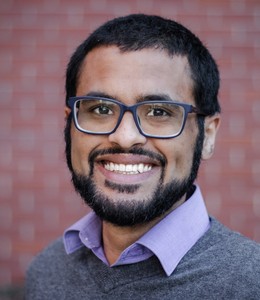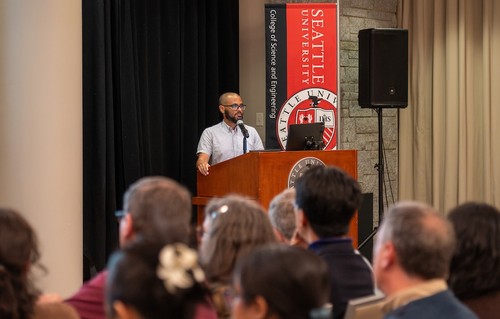
Associate Professor Christopher Whidbey, PhD, ’10, and team of undergraduate students present their research.
Evelyn Smith, '27, discovered a new career path in the lab.
“The opportunity to engage in this research has illuminated my passion for using the tools of biology and chemistry to study the health of marginalized communities,” Smith says.
“This experience helped me develop a clearer picture of my future career, one that blends science, medicine and social justice.”
A senior cellular and molecular biology major, Smith is one of nine undergraduate research assistants working with 2010 SU alum Christopher Whidbey, PhD, associate professor of chemistry, on ongoing research into how bacteria affect health and well-being, specifically in the vaginal microbiome.
In October, Dr. Whidbey presented findings of this research at the Lynwood W. Swanson Scientific Research Award public lecture held at the Leroux Conference Center at SU, the culmination of the Whidbey's Swanson Promise Award he earned in 2025. The prestigious award, presented by the M.J. Murdock Charitable Trust, is given annually to a junior professor who shows exceptional potential in establishing a productive and sustainable research program at a private undergraduate institution in the Pacific Northwest.
“The central question for my research program is how do those very small organisms impact us? What chemistry do they do? How do they facilitate immune and brain development? And how can we use that information to improve public health?" Whidbey says. "These are tough questions and I was able to share some of the ways our team tries to tackle them. I’m very thankful to the Murdock Trust and the team at SU who helped put the event together.”
Smith’s project, which she presented a recent College of Science and Engineering STEM Research Showcase on campus, is focused on bacterial vaginosis (BV), which affects about a third of adult women, with a disproportionate impact on women of color. BV can increase the risk of sexually transmitted infections and preterm birth.
“I have been working on a project studying the activity and identity of enzymes in cervicovaginal fluid (CVF) samples with the goal of comparing bacterial vaginosis-positive and negative samples,” Smith says. “We use activity-based protein profiling, fluorometric assays, and proteomics techniques to characterize active enzymes in CVF samples. This research aims to identify enzymes associated with BV that could later be used as therapeutic targets for treatment.”
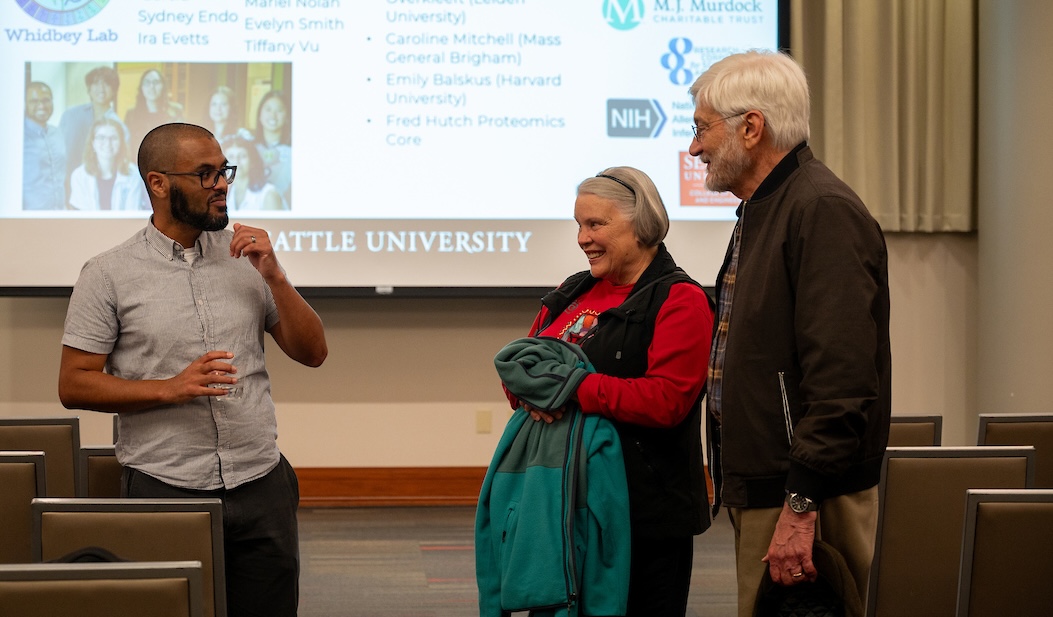 Chris Whidbey, PhD, chats with guests following his talk and presentation of research.
Along with developing students' confidence in the research lab, Dr. Whidbey recognizes the importance of presenting research.
“One of the most important parts of science is being able to communicate your work in a meaningful way to your audience. That’s also one of the hardest parts to teach, because the best way to learn it is just to do it over and over again,” he says. “I think seeing different styles of presentation, like the public lecture, can be helpful, but ultimately it’s events like the showcase where students have a chance to gain that experience.”
Dr. Whidbey and his team will continue their research on identifying proteins that contribute to health in the vaginal microbiome supported by an R15 grant from the National Institute of Health (NIH).
“This microbiome has really been under-studied, but I think this is probably the microbiome where new therapies could have a big impact,” Dr. Whidbey says. “It's an opportunity to help treat and prevent negative health outcomes like bacterial vaginosis and pre-term birth, which are significant public health burdens.”
Similar News & Stories
-
Investing in the Future of Mental Health
SU NewsSupport from the Robert and Jean Reid Family Foundation increases clinical placement opportunities for nurse practitioner students. -
A Legacy of Service
SU NewsNew endowed scholarship empowers future community leaders in honor of late Seattle police officer. -
Presidential Inauguration
SU NewsCampus and greater community come together to celebrate Maura B. Mast, PhD, and her official inauguration as Seattle’s University’s 23rd President.
Contact Listing