/0x18:2400x1583/prod01/channel_34/media/seattle-university/images/campus/Spring23WarmWeather_yk_015.jpg)
Opioid Overdose Prevention
Seattle University is committed to giving every student, faculty and staff the knowledge and tools to recognize and respond to an overdose.
Opioid Overdose Education
Seattle University is committed to giving every student, faculty and staff the knowledge and tools to recognize and respond to an overdose. This page will overview what opioids are, how to use naloxone (Narcan), where to find naloxone on campus for free, and what legal protections exist if you call for help.
Opioids, including fentanyl, heroin, oxycodone, and oxycontin, are responsible for more overdose deaths in the United States than any other drug. Notably, while the United States saw a 24% decrease in fatal overdoses from March, 2024 to March, 2025, Washington state only saw an 8% decrease – making this an accentuated public health concern at the state level.
This Information Could Save a Life
Whether you use drugs or substances, or not, this information is important. Knowing how to help a friend, loved one or stranger could save their life.
Naloxone Info Sheet
Learn more about how to spot an overdose and administer Naloxone.
What You Need to Know About Naloxone
Key Facts about Opioid Overdose
An overdose is when the body becomes overwhelmed, and therefore unable to properly function, when there is too much of a substance within that person’s body. This can occur with a variety of substances, such as alcohol, opioids or a mixture of substances or drugs.
Opioids are a class of drug that work by binding to receptors in the brain and body to reduce pain. These include prescription medications like oxycodone and hydrocodone which are often prescribed by healthcare providers for acute or chronic pain management, as well as unregulated (illicit) drugs like heroin. Opioids dull pain, can inhibit (or reduce) breathing, and produce euphoric feelings. Someone may begin using opioids for legitimate medical purposes and later develop an unhealthy dependence upon them. Research suggests that it only takes weeks for the brain and body to adapt to the pain relief sensations opioids provide, which can lead to a dependence that makes it difficult to function without them.
An opioid overdose occurs when there are too many opioids, or a mixture of opioids and other drugs, in someone’s body which cause the individual’s body to stop functioning properly – they may become unresponsive to stimulation or stop breathing properly.
Opioids work by binding to receptors in the brain called opioid receptors. Once bound, opioids “block” the cell from sending pain signals to the body and help reduce pain levels. However, opioids can also bind to receptors in the brain that oversee our ability to breathe, and this can depress or inhibit our ability to breathe.
If someone is unable to breathe (enough or at all) this can lead to their lips and fingers turning blue (cyanosis) as the oxygen levels in their blood are decreasing. Similarly, without oxygen someone’s heart and brain can stop functioning which can be fatal. A key factor in someone surviving an opioid overdose relies on their ability to begin effectively breathing and begin delivering oxygen to their vital organs.
Fortunately, someone who has used opioids does not immediately stop breathing after consumption, rather, it often takes minutes to hours for breathing to slowly stop after use allowing for time to intervene, administer naloxone, and save a life.
Fentanyl is an incredibly fast-acting and powerful opioid. Fentanyl is 50 times stronger than heroin and 100 times stronger than morphine. While a medically prescribed form of fentanyl exists for treating severe pain, the majority of fentanyl contributing to opioid overdoses are made illegally.
Fentanyl can be purchased on the streets or even social media. It is usually sold as a pill or a powder, and the powder can be pressed into pills that intentionally mimic the look of prescription medication (oxycontin, Adderall, Xanax, Percocet, and more) or other illicit drugs like MDMA and cocaine. People taking these pills are often unaware they are laced with fentanyl. Fentanyl is a dangerous because it is incredibly powerful - a tiny amount has the ability to cause an overdose and it is so fast-acting that these overdoses tend to occur very quickly after consumption. As little as 2 mg of fentanyl (akin to a few grains of salt) can be fatal. Because fentanyl is often undetected by sight, testing the drug/pill is the only reliable way to know whether it contains fentanyl.
Fentanyl testing strip kits available at the Seattle University Student Health Center (Bellarmine 108) and Wellness and Health Promotion (Student Center 380).
Identifying and Responding to an Opioid Overdose
Signs of an Opioid Overdose Include:
- Pupils are very small
- Body is limp
- Cannot wake the person up
- Fingernails or lips are blue, purple, or grey (for individuals with darker skin blue or pale skin changes may not be as apparent)
- Skin feels cold and clammy to the touch
- Deep snoring or gurgling sounds
- Breathing is slow, erratic, or has stopped
If you notice someone exhibiting the above symptoms, first check for responsiveness.
- If you know them, call their name or loudly say/yell “hey are you okay?”
- If unresponsive, ask louder and shake/tap their shoulder (often, people who are overdosing will not wake up when you shake them or shout loudly at them.)
If they continue to be unresponsive, unable to breathe, or turning blue/grey:
- Call 911 right away
- Say: “There is someone who is not breathing and won’t wake up.” Tip: Put your phone on speaker phone so you can follow along with the instructions of the 911 operator.
What if I have drugs on me when I call 911, will I get arrested?
- Probably not - The Good Samaritan Laws protect callers and anyone providing aid from being prosecuted in the state of Washington. With the Overdose Immunity law (RCW 69.50.315), even if you are under the age of 21, you cannot be charged with possession of alcohol/drugs as a minor if you call 911. The person overdosing is also protected.
- There are limits to this – the law does not protect you from outstanding warrants, probation or parole violations, drug manufacture or delivery, controlled substances homicide, or crimes other than drug offenses.
Naloxone is an FDA-approved medication that temporarily reverses an opioid overdose. It is sometimes referred to by the brand name “Narcan” and typically comes in the form of a nasal spray or injection into the muscle. Naloxone works by blocking opioids from binding to the opioid receptors in our brains. If someone is overdosing on opioids, naloxone will help reverse the effects of overdose and help them wake up and start breathing again.
- Naloxone is the most effective tool to reverse opioid overdoses. It only works for opioids like fentanyl, it does not treat or reverse the effects of other drugs or alcohol.
- Naloxone will not hurt someone who doesn’t need it! It can be given to anyone, including children and pregnant people.
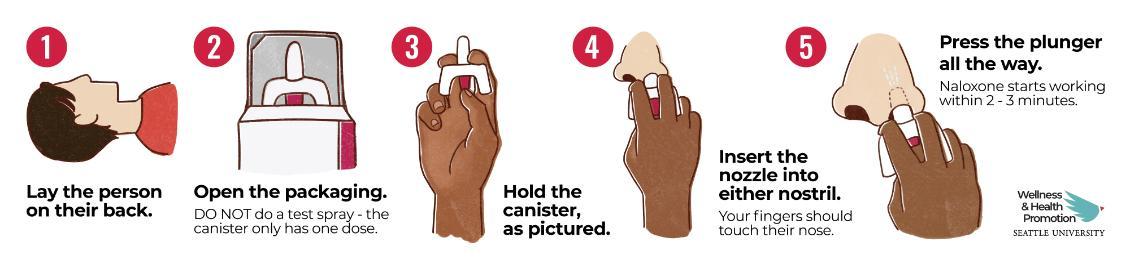
- Lay the person on their back if you’re able
- Remove the naloxone from the box and take one out of the packaging. Each new box will contain two doses of naloxone.
- Hold the canister between your pointer and middle finger, with your thumb lightly on the plunger. Do NOT do a test spray, the canister only has one dose (spray).
- Insert the nozzle into either nostril of the person experiencing a suspected overdose. Your fingers should touch their nose.
- Press the plunger all the way. Naloxone starts working within 2 – 3 minutes.
- If the person does not begin breathing again within 3 – 4 minutes, repeat these steps using your second dose of naloxone. Most people need to go to the hospital after an overdose and may need more naloxone than you have with you.
If the person starts breathing again but is still sedated, they do not need another dose.
For more information on how to administer naloxone please watch this video. As a note, while this video shows two different options for naloxone, Seattle University only offers the nasal form.
Want to practice these steps?
Wellness and Health Promotion’s team of Peer Health Educators provides in-person training and free naloxone and fentanyl testing strip kits in Student Center 380 during office hours. Their team will guide you through the steps, help you practice using a tester naloxone canister and medical dummy, answer your questions, and provide printed resources including instructional materials created by their team.
If you're an SU Graduate, Law or Undergraduate Student:
- Student Health Center (Bellarmine 108) - Naloxone and fentanyl testing strip kits available 24/7 in the Student Health Center hallway
- Wellness and Health Promotion (Student Center 380) - Naloxone and fentanyl testing strip kits available during office hours
- All Automated External Defibrillator (AED) kits on campus contain an opioid overdose kit including two doses of naloxone
- All public safety officers have opioid overdose kits
They are available free in Wellness and Health Promotion (STCN 380), Student Health Center Lobby Kits (Bellarmine 107), and are also free at Seattle public libraries.
In 2024, the Washington State Legislature passed House Bill 2112 to promote education and access to naloxone and fentanyl test strips at institutions of higher education, strengthening the state’s response to the growing opioid public health crisis. Wellness and Health Promotion provides educational training opportunities for Seattle University. Naloxone and fentanyl test strips are available in Wellness and Health Promotion (Student Center 380) and the Student Health Center (Bellarmine Hall 108).