MA in Psychology Newsletter, Fall 2026
Written by Claire LeBeau, PhD, Assistant Editor: Diane Tomhave
Wednesday, September 2, 2026
Learn more about what's going on with the MAP program this Fall
Table of Contents
- Intro
- MAP News
- Alumni News and Spotlights
- Trending to What Stays: Four Interviews with MAP Alumni and Students
- Psychotherapy Cooperative
- Joint MAP Program and Psychotherapy Cooperative CEU and Networking Events for 26/27
- MAP 45th Anniversary Weekend of Celebration
- Centering Collective Healing: Indigenous Epistemologies in Post-Atrocity Societies
- In Memory Of
- Mark Your Calendars
Intro: Dr. Claire LeBeau (MAP class of 1997) and New MAP Program Director
Dear Beloved MAP Community,
Over this last year, I have had the great benefit of learning from Dr. Randy Horton about the complexities and nuances of this Program Director position. I am in awe of the task as well as humbled by the depth of care and devotion that permeate all aspects of our truly extraordinary community of scholars, teachers, healers, and friends. Our lives have been tethered together in the forges of this human philosophy and the joy of our collective meaning making and fellowship. It is an honor to get to keep gathering with you as we help train, mentor, and scaffold the next generation of healers who need us more than ever. As we enter this year of celebration for our 45th Anniversary, I want to invite you all to come back to share your experiences and wisdom as well as enjoy some of the CEU trainings we are holding with the Psychotherapy Cooperative this year. Also, please save the dates for that magical weekend of 45th Anniversary Celebration events from May 14th through the 16th. Additionally, this next year, I am honored be one of the Center for Ecumenical and Interreligious Engagement (CEIE) Fellows. I will let you know about our work this year as we go along.
Last year, we started this newsletter to be an annual outreach to let you know about MAP Program news, alumni and current student news, alumni networking opportunities, and continuing education offerings. Let’s keep in touch and keep encouraging each other! Help us to stay connected by first making sure that Diane Tomhave, our Program Coordinator, has your contact information.
When I think about our MAP founders, I am filled with gratitude for the long reach of the care and devotion from Jan, George, and Lane as well as each of you. I am grateful beyond measure to all you who continue to “loiter” like me around this extraordinary place and purpose.
Hope to see you soon,
Claire
MAP News
Semester Transition
On the near horizon is yet another shift as we move from a 90-credit Quarter based program to a 60-credit Semester Program. We expect that shift to be completed by the beginning of the 2027-2028 academic year. More details to come.
MAP Faculty News and Transitions
“New” Hire – Welcome Dr. Dawn Meyer
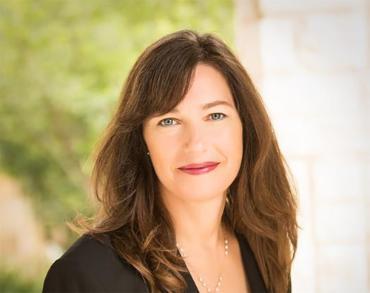 We are thrilled that our own Dawn Meyer, PsyD. is moving into a full-time position beginning this fall quarter. Dawn has been working with Seattle University since 2020. She offers skilled supervision and brings over 30 years of experience in the field as a therapist and a teacher. Dawn has extensive experience working with adolescents, families and couples. She maintains a private practice currently doing a great deal of work with couples. Her approach is transtheoretical, working to match the therapy to the client and their needs. She has a particular connection with Attachment Theory and specifically Emotionally Focused Therapy (EFT) as her therapeutic “dance partner”. Dr. Meyer will continue to teach couples and family therapy, group therapy and legal ethics for the MAP program.
We are looking forward to exciting new additions this year. This fall and winter Dawn will be leading a research project focused on perceived support for trans students on campus. The aim is to gather anonymous and qualitative data through interviews to assess what support is available and what is lacking with the aim of helping to create a more inclusive and supportive environment at Seattle U. This is a great chance to get involved for anyone interested in supporting trans students as well as an opportunity to gain valuable academic research experience. Reach out to Dawn if you are interested in contributing.
For Couples and Family therapy the next section will be taught as a Three-day intensive on January 22, 23, & 24 from 9:00AM - 5:30PM. Dawn enjoys these opportunities to really dig into the material that she is so passionate about. Another passion of Dawn’s is working to increase therapeutic literacy for practitioners working with religious clients. Many therapists are unsure about how to work with clients who hold strong religious beliefs, this can lead to mishaps and missed opportunities in therapy. Dawn will be leading a CEU workshop this spring focused on this topic in April (see events calendar in this newsletter).
Beyond her busy schedule as a therapist and teacher Dawn is a proud partner, mother and grandmother. She enjoys quilting and spinning wool and is very happy to call Whidbey Island home, enjoying the access to nature and the water that island life provides. Dawn is currently excited to be learning about ways to incorporate crafting and flow states into therapy and is always learning how to further hone her craft.
Written by Rodney Schafar - MAP Graduate Student Assistant (MAP class of 2027)
Farewell Dr. Meghan Blattner
While we are so happy that Dawn will be joining us this year on a more permanent basis, we are also sad to say goodbye to our most recent hire, Dr. Meghan Blattner, who has made the difficult and entirely admirable decision to focus on her family right now and step away from her tenure track position. We will miss her and completely understand that life has an important way of letting us know our limits if we will listen. Meg shared this note with us as she let us know:
Dear MAP students and community,
I hope you have all had restful summers.
After reflecting this summer, I have made the difficult decision to resign from my position at Seattle University. While I adore teaching and have genuinely enjoyed getting to know our amazing MAP students, I need to prioritize balance in my life. I am sad to move on, but I am confident this is the right decision.
Thankfully, many wonderful faculty will continue to mentor you. I will, of course, always be delighted to hear from you and welcome you to stay in touch.
Warmly,
Meg
Welcome Dr. Leo Kiralla
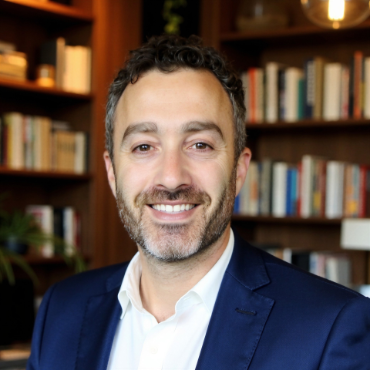 We are thrilled that our own Dr. Leo Kiralla, (MAP class of 2015) will be joining us to teach Research Methods after shadowing emeritus faculty member, Dr. Steen Halling, for this class last year. Leo was born and raised in Los Angeles, California and holds master’s degrees in both history and psychology (MAP) and he recently completed his Ph.D. in clinical psychology. Leo is a tenured Psychology professor at Bellevue College who has been teaching for over 20 years and is a licensed therapist in the state of Washington. Leo has worked in various clinical settings, including the VA, community mental health, neuropsychological and personality testing, and in private practice. His research focuses on monozygotic twins, hermeneutics, intersubjectivity, narrative psychology, psychological assessment, mindfulness practice and dharma, and pedagogy. We are so grateful to keep our qualitative research traditions alive with Leo’s help. In fact, keep an eye out for the SQIP (Society for Qualitative Inquiry in Psychology) conference to be held at Bellevue College next July 2027. Leo is organizing the conference this year!
Welcome Kelvin Peprah
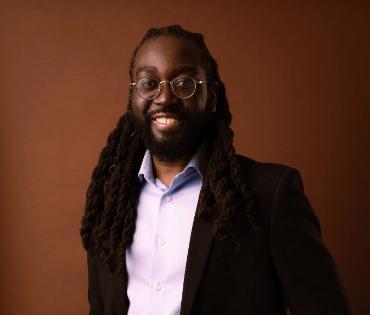 We are also thrilled to welcome Kelvin Peprah (MAP class of 2017) who will be joining us as a clinical supervisor for MAP students this year. Kelvin was born in Ghana and moved with his family to the United States at the age of 11. He earned his Bachelor of Arts degree in Psychology at Hope College in 2014 and completed his Master of Psychology at Seattle University in 2017. While at Seattle University, he completed his practicum with me as supervisor at Matumaini Counseling where he facilitated a course in emotional wellbeing, and provided individual counseling to high school students, primarily students of color. Kelvin has experience working in mental health care field which includes work in an acute psychiatric hospital, working with children diagnosed with autism, providing family and individual therapy to families involved with CPS, as well as facilitating Black men’s groups. Check out Liz Silvestrini’s (MAP class ’18) Alumni Spotlight interview with Kelvin below. Kelvin has been serving on the Board for the Psychotherapy Cooperative for the last three years and will be offering one of the joint MAP and Co-op workshops this year on Impostor Syndrome. Please see the events below for more information.
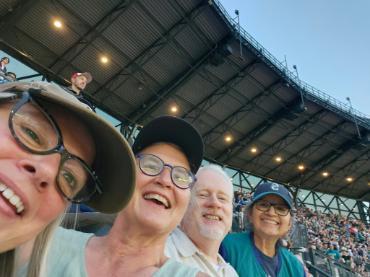
Claire, Erica, Randy, and Diane – Mariner’s Game versus the Phillies in August - Remembering Lane Gerber’s devotion to his favorite team as well as our Mariner’s.
Congratulations and Publications
MAP Faculty, Kathleen Pape, PsyD (MAP class of 1992) and Jerome Veith, PhD (MAP class of 2017) published this important article last Spring. Congratulations!
Pape, K. M., Rodriguez, J., & Veith, J. (2026). Can psychology improve lives and solve the world’s challenges without grounding in the humanities? Jesuit Educational Quarterly, 2(1), 49–65.
MAP Faculty, Dr. Jerome Veith, appeared on a podcast this last spring called Chasing Leviathan. The episode is titled "Gadamer and the Transmission of History: Translating Theory into Clinical Practice." Here is the link.
Jerome also has a chapter in an edited book, Educating Anxiety: Psychological, Philosophical, and Theological Perspectives on Teaching and Learning. His chapter is titled "Being (In) Ambiguity: On the Clinical Relevance on our Ontological Plurivocity." There is more info about the book here.
And last but certainly not least, this spring, we were able to secure Diane Tomhave, as our essential full-time MAP Program Coordinator. Needless to say, we would be lost without her for so many reasons but as we have expanded to a three-year program and now with the semester transition, she has kept us all steady and thriving. So grateful!
Alumni News and Spotlights
Counseling Compact Update
As mentioned in last year’s newsletter, as of the academic year 2024-2025, to align with Interstate Counseling Compact (an interstate reciprocal practice agreement for counseling standards across 39 and counting states in the US), the MAP program has shifted from a 72-credit program to a 90-credit expansion. For more information, please see the compact website here.
Washington State is still in the process of ironing out the specifics of the agreement. Details and updates, including legacy status for LMHC, for our WA State can be found here.
But to get some clarity about how this transition affected his cohort (MAP class of 2023) as well as the MAP cohorts between 2021-2023, Matt Sorg has been doing some research. He reached out to share his experience and how he made his discoveries!
Hey folks,
If you are like me, you graduated from SU's MAP program before it moved to the 90-credit curriculum, which most states and the Counseling Compact require for portability. Graduates from the 2021–2023 cohorts are in a particular bind because you likely couldn't have been fully licensed by the time the Counseling Compact was signed into WA law, so that path isn't available to you without curing your education to 90 quarter credits.
I do ketamine-assisted therapy, and I'm also starting CIIS's Psychedelic-Assisted Therapy and Research 8-month certificate program this fall. I'm really interested in working with psilocybin and wanted to answer the question: how can I get licensed in Colorado and Oregon where this work is legal? Another question I had was how can I get licensed in California where I have always wanted to live?
I created themapguide.com to map out how to get interstate licensure for SU MAP graduates from the 2012–2024 72 quarter credit era. I used Claude AI to systematically gather licensure-by-endorsement, universal recognition, and other requirements from every state, DC, and BC — minus the associate/intern/candidate route. I then had it email each state's boards with our open questions, monitor the email inbox for responses and now it is updating the website as answers come in. Every change is reviewed, logged, and the sources are cited. A state tagged with Hypothesis means that the board hasn't written back yet, or the answer from them is still unclear, and Corroborated means that the board's response either validated or adjusted the original hypothesis for that state. This website is a living document and is updated as new information comes in.
Please email me at matt@matthewsorg.com if you've gotten licensure by endorsement from another state to help validate this website. I'd love to hear from you if you have different information so I can make this resource even more accurate.
I hope you find it helpful. It helped me get licensed in CO!
-Matt Sorg, LMHC (WA), LPC (CO) - MAP class of 2023
Tending to What Stays: Four Interviews with MAP Alumni & Students
Written by Liz Silvestrini (MAP class of 2018)
Liz Silvestrini (MAP 2018) is a licensed mental health counselor with an online private practice based in Seattle and Salt Lake City. She will begin supervising graduates in the Seattle Psychotherapy Cooperative this year and participates in ongoing consultation with the International OCD Foundation (IOCDF). Liz left a career in law to connect more deeply with human experience and explore the intersection of work habits and mental health conditions.
What stays with MAP students after graduating from the program?
Eight years after my own graduation in 2018, I found myself wondering what I had learned in the MAP program that still felt relevant to my current work as a therapist. It turns out, a whole lot - but I had growing awareness that what I learned needed tending in order for it to stay.
So, I sat down with three MAP graduates and one current MAP student to ask them the same question. Of course, these conversations evolved and wandered, as enjoyable conversations do. Rather than finding an answer - a lecture, a theory - I found more of a feeling, a sense of pace.
My sense is that what stays emerges slowly—through conversations with clients, moments of uncertainty, unexpected turns in life, learning something new, and relationships that continue long after graduation.
Thanks to Elaine Webster (1990), Jen Hamann (2016), Kelvin Peprah (2017) and Kiana Fletcher (2027) for their time, conversations, and contribution to this article.
Kelvin Peprah (MAP Class of 2017)
Within minutes of sitting down to talk with Kelvin Peprah, he’s joking about finally buying a portable air conditioner after ten Seattle summers and describing his recent discovery of Excel with the enthusiasm of someone who has uncovered a hidden superpower.
"I see why all the geeks be talking about Excel now," he laughs. "This is incredible."
Humor and conversation seem to come naturally to him.
Long before he became a therapist, Kelvin noticed that listening to people felt surprisingly effortless.
"I really enjoy hearing stories," he says. "To be able to help someone just by listening to their story is something that I thought was really cool."
At first, he didn’t think much of it.
Then, during an undergraduate course, students recorded mock therapy sessions for a final assignment. His professor later told him his recording was the strongest in the class and encouraged him to consider therapy as a profession.
"I was like, 'Oh... really?'" he remembers. "I didn't think I was doing anything."
As a teenager, he and one close friend would spend hours talking about questions that most of their classmates weren't asking.
"What's the meaning of life? Why are we here?"
Looking back, he smiles.
"I didn't really know anybody else in high school having those kinds of conversations."
Graduate school changed that.
When Kelvin arrived in Seattle, he wasn't only looking for clinical training.
He was looking for people.
"People in the MAP program are the only people you can gather around and suddenly we're talking about Heidegger and Dasein. I'm like... could we just be normal people? Oh wait... nah. This is the stuff these weirdos like to talk about."
His affection for the community is unmistakable.
Years after graduating, he continues working alongside faculty, serving on the MAP Cooperative board, mentoring students, and returning to classes simply because he enjoys being in those conversations again.
"It's a nice refresher," he says, "and I can also tell students, 'This is what this actually looks like in practice.'"
He facilitates a Black men's process group that has met every other Saturday for several years. He organizes mixers for BIPOC therapists throughout the Seattle area. This fall, he'll begin supervising graduate students, helping them make the same transition from classroom to practice that he once made himself.
Asked what has stayed with him most from graduate school, Kelvin doesn't mention a particular theory.
He talks about everyday encounters.
Courses in ethics and hermeneutics helped him recognize something he now notices everywhere.
"We take these interactions for granted."
Making eye contact. Smiling at someone on the street. Listening without interruption. Giving another person your full attention.
"What does it mean," he asks, "to pivot your whole attention to this person?"
He lets the question linger before answering it himself.
"When someone feels like another person is really paying attention to them... they're cared for. They're seen. They're understood."
He smiles.
"This is what they mean when they say showing up is doing half the work."
Listening to him, it becomes clear that this has been the thread running through his work from the beginning—not techniques or theories, but ordinary human encounters given the time and attention they deserve, building enough trust to tell one another the truth.
Jen Hamann (MAP Class of 2016)
As an undergraduate philosophy major at Seattle University, raised by a father who taught philosophy, Jen Hamann grew up around conversations that asked large questions: What makes a good life? How should we live? What do we owe one another? Philosophy was not simply an academic subject in her family—it was dinner table conversation.
"I wanted... an applied philosophy," she recalls. "Not just armchair philosophy... I wanted to use philosophy to help people."
That search led her back to Seattle University and the Master's in Psychology program.
The fit seemed obvious on paper.
Living it was another matter.
Like many students, Hamann arrived expecting graduate school to mean mastering theories and techniques. She anticipated long hours memorizing interventions and learning how to become a competent clinician. Instead, the early months left her deeply unsettled.
"I internally panicked a little bit," she says. "I'm like, what am I getting into?"
The program felt unfamiliar—less interested in immediately teaching therapeutic methods than in asking students to examine themselves, their assumptions, and what it means to encounter another person. Looking back, she laughs that the program described itself accurately all along. She simply wasn't prepared for what that description actually meant.
While in the program, Hamann was diagnosed with brain cancer.
The philosophical questions that had first drawn her to existential psychology were no longer abstract. They became immediate.
Rather than pulling her away from psychology, the experience deepened her commitment to it.
She also encountered emotional states she had previously understood mostly from the outside. Before graduate school, she says, she had experienced relatively little anxiety or depression herself. Cancer changed that.
"This is what anxiety feels like," she remembers thinking. "This is what depression feels like."
She would never have chosen those experiences. Yet they gave her something she believes has made her a more compassionate clinician: lived recognition.
"I'm glad I know what it feels like," she says. "Then I can relate to other people."
For Hamann, philosophy has never been about escaping life through ideas. It has become a way of entering life more honestly.
That orientation continues to shape her work today, where conversations about meaning remain central. She still enjoys discussing what she calls "the big questions," but those questions now arise less from intellectual curiosity alone than from accompanying people through uncertainty, suffering, and ordinary existence.
Just as enduring has been the community she found.
She compares the MAP community to the close-knit alumni cultures she had admired elsewhere—places where graduates remained connected not simply because they attended the same institution, but because they had shared an experience that permanently altered how they saw the world.
"I was like, okay," she says. "This is that community for me."
Years later, that sense of belonging still matters.
Kiana Fletcher (Current student and MAP class of 2028)
As an undergraduate psychology major, Kiana found herself continually drawn back to questions about people. During the years between college and graduate school, she read widely—not because anyone assigned the books, but because she couldn't stop returning to them.
"I just love the material. I love this stuff. I think people are so interesting. I think how humans interact is so interesting."
The MAP program didn't introduce those interests so much as give them shape.
"I already felt like I was building these ideas. But now I have more language for them. I'm like, oh... this is where they originated. This is where they spread. It's pulling it all together."
She pauses before adding something that sounds both exhausting and hopeful.
"I feel myself... changing, though. And expanding."
Friends have noticed it too.
"My sister and friends from Austin are like, 'Yeah... you're changing. We can tell.'"
+++++++++++++++++++++++++
Choosing Seattle required trusting something that could not quite be explained.
She applied to multiple programs, interviewed at several schools, and considered staying in Texas. Nothing felt quite settled until her interview with Dr. Randy Horton.
"I was still on the fence about everything," she remembers. "But the way that he connected and how we talked... I was like, Oh. I think I need to go there."
She laughs.
"It just kept feeling right. I don't know how else to explain it."
++++++++++++++++++++++
Graduate school has brought its own challenges.
Moving from Austin to Seattle meant starting over socially while also navigating an intense first year of coursework.
"I don't have a support system already built in here like a lot of people do."
At first, she imagined school could become her entire world.
"It just hasn't. That can't be it."
Instead, she's found herself learning something unexpected about community.
"In Austin... it was just so easy to meet people."
Seattle has asked something different.
"I've had to lean into this side of myself that's like, okay... if I want it, I have to create it."
She describes initiating conversations, showing up to events alone, and trusting that relationships will slowly grow.
"It's building," she says. "I have found people."
++++++++++++++++++++++++++
Throughout the interview, Kiana resists the pressure to have everything figured out.
When asked what kind of therapist she hopes to become, she smiles.
"I don't exactly know."
There is no embarrassment in the answer.
Only curiosity.
She imagines group practice. Community mental health. Maybe private practice someday. She wants mentors. She wants to learn from alumni. She wants to keep discovering what this work can become.
For now, that feels like enough.
The certainty she does have isn't about a destination.
It's about paying attention to what keeps calling her back.
Again and again, those threads lead toward people, conversation, and a way of being in the world that feels, in her words, "really right."
Elaine Webster (MAP class of 1990)
When Elaine Webster began looking at graduate programs in 1989, she didn't know much about existential phenomenological psychology. "I was like, Gee, that looks interesting. What's that?"
The more she explored it, the more something settled into place.
"It was like you put on a shoe that fits," she says. "This is me. This is how I see the world."
Looking back now, after thirty-six years of clinical work, she sees that what has sustained her was less a particular therapeutic technique than an ethical orientation - a way of meeting people.
"I could really honor individual experiences of my clients," she reflects, allowing experience itself to remain at the center rather than forcing it into predetermined explanations.
For a young therapist, that was no small task.
"There’s a lot of pressure as a therapist to be the expert," she says. "You have to be able to sit with the not knowing."
Over time, she discovered that this willingness to remain with uncertainty became one of the greatest gifts she could offer clients.
She recalls one meeting with colleagues in which a struggling mother was described using language that felt, to Elaine, too narrow and too condemning.
"I just didn't like that language," she says simply.
For Elaine, the issue wasn't whether difficult behaviors existed. It was whether the language clinicians used allowed room for the person's humanity.
"I'm much more comfortable with the language of trauma," she explains, because it invites therapists to ask what experiences shaped a person rather than reducing them to a label. "It just felt like it was dehumanizing."
The conversation was uncomfortable. Not everyone agreed.
But she traces her willingness to speak up directly back to the foundation she received as a graduate student.
Existential phenomenology, she says, gave her permission to resist explanations that felt "too reductionistic... too small."
Much of Elaine's early career unfolded in community mental health, crisis intervention, and programs serving survivors of sexual assault. She describes those years as intellectually rich but often professionally difficult. Alongside meaningful clinical work there were healthcare systems that could be fragmented or dysfunctional, environments that sometimes pulled therapists away from the very people they hoped to serve.
Rather than rushing toward explanation, she learned to trust that understanding often emerges from careful attention to lived experience.
That orientation also gave her the confidence to question theories when they no longer seemed to serve the person in front of her.
That same spirit shaped the professional communities she built throughout her career.
After graduation, Elaine moved to eastern Washington, far from Seattle University. Rather than trying to recreate the program exactly, she found ways to find thoughtful consultation wherever she worked. If an agency lacked meaningful supervision, she started informal consultation groups. If she could not find the conversations she needed, she helped create them.
"I brought that sense of home... to these other places," she says. "It was home bringing instead of homecoming."
Now, as Elaine gradually retires from clinical practice, that same orientation continues to unfold in new ways. She has found herself returning to qualitative research and rediscovering the pleasures of collaborative inquiry with MAP colleagues.
"Coming back at it after all these years of experience," Elaine says, "I can match it so much against my own lived experience... it's so insightful."
Listening, my sense is that this has always been a thread running through Elaine's life—not mastering psychology but remaining teachable by human experience.
-Liz Silvestrini MAP class of 2018
Psychotherapy Cooperative
We at the Psychotherapy Cooperative are grateful to have the support and involvement of volunteer therapists, supervisors and board members. The Psychotherapy Co-op endeavors to provide alumni of the MAP program a space to connect with the community and one another to further serve, learn and grow together. The board of directors is currently composed of Nathan Feuerborn (President), Professor Emeritus Dr. Steen Halling (Secretary), Karen Sanders (Treasurer) (MAP 2000), and members at large, Kelvin Peprah (MAP 2017) and Rachel Patrick (MAP 2017). We welcome you to connect and join us in any capacity, be it therapist, supervisor or board member. We also are interested in assisting alumni to set up and run CEU workshops which will financially support the co-op. Please connect with us at contact@psychotherapycooperative.org or go to our website.
Our Origins
The Psychotherapy Cooperative is a Seattle-based non-profit organization with roots in Seattle University’s Master of Psychology (MAP) Program. Faculty and graduates of the MAP Program established the Cooperative as a 501(c)(3) in 1998 during the advent of managed care. Psychotherapy was becoming less affordable, and a growing bureaucracy and emphasis on prescribed treatments was threatening the understanding of psychotherapy as a healing relationship rather than one where the therapist is primarily a diagnostician or technician. From this context, the Cooperative’s mission was born.
Our Mission
Service
Our mission is to provide affordable counseling and therapy services to those who are not otherwise able to afford these services from therapists in private practice or from community mental health agencies. The goal is to provide quality counseling services where the duration and style of therapy is determined by the needs of the client rather than by limits imposed by insurance companies, managed health care, or limited income.
Community
The Cooperative also strives to support community amongst practitioners. Our therapists, clinical supervisors, board of directors, and other participating members provide their services to the organization on a pro bono basis. These members are graduates of the Seattle University Master of Psychology (MAP) Program, whose instruction is grounded in the existential phenomenological tradition of psychology. From this training foundation, graduates tend to challenge approaches in psychology that view human beings in a reductionistic manner. They also seek to develop an in-depth, embodied understanding of human existence and emphasize an understanding of people within the context of their lives. They work individually with adults who experience depression or discouragement, problems with self-esteem or anxiety, difficulty with life transitions, and other issues influencing the quality of life.
A 2006 article on the Cooperative (In the Trenches) captured our long-standing goal of fostering community thusly: “The Existential Phenomenological therapist must try to explain his or her model to a society holding an increasingly formulaic way of seeing and addressing psychological distress. [...] But at least one of the missions of the Cooperative is to attempt to support its members as they do this work.”
Supporting Our Work
Become a member
If you are interested in becoming a therapist, supervisor, or other supporting member of the Psychotherapy Cooperative, please read more here about that opportunity.
Financial support
As a 501(c)(3) nonprofit organization, we are grateful for donations from the community. All monies received go toward the cost of operating the Cooperative. The therapists, supervisors, and board of directors all work on a volunteer basis. If you would like to support our work, please click the link to use PayPal or your credit card to contribute. You may also send contributions to the Psychotherapy Cooperative at 2711 East Madison Street, Suite 209, Seattle, WA 98112.
Joint MAP Program and Psychotherapy Cooperative CEU and Networking Events for 26/27
Book Club
Psychotherapy Cooperative Members and MAP Alumni Nathan Feuerborn (MAP 2009) and Paul Johnson (MAP 2014).
Book One
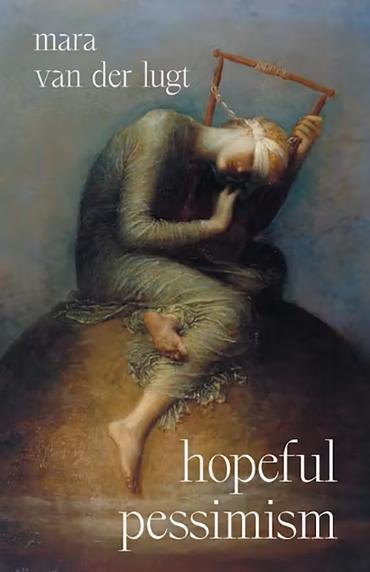
The first of three books in the Book Club this year will be Hopeful Pessimism by Mara van der Lugt.
This will be a 2-hour Book Discussion offering 2 CEUs held on Zoom on Thursday Nov 12th from 7pm to 9pm. This will be a 2-hour book discussion offering 2 CEUs.
Book Two
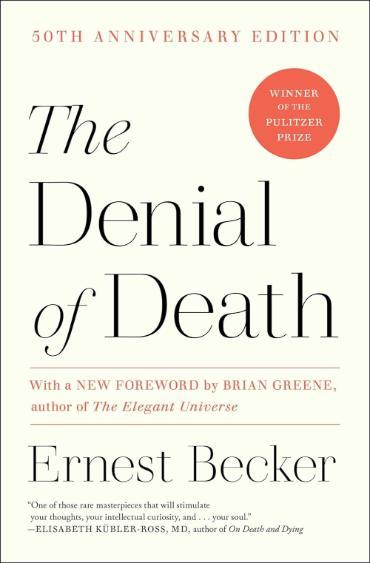
The Denial of Death by Ernest Becker. Thursday February 25th.
Book Three
Spring - TBD
Please email Paul if you would like to join this Book Club to get the Zoom link and the learning objectives.
Workshop - Improving Trauma Treatment Using a Cross-cultural Perspective
Seattle University MAP Program and Psychotherapy Cooperative
Oct. 24, 2026- 10:00 am to 1:00 pm 3 CEU’s offered online on Zoom. RSVP.
Workshop Description
Treatment for interpersonal trauma and the effects of violence is most often framed from a biomedical perspective in the individualistic cultural context of mainstream US society. This approach has left most psychotherapists, treatment professionals and other helpers with a major blind spot. We are also psychosocial cultural beings. One of the central injuries from interpersonal violence is harm to our interpersonal skills and capacity to trust. Healing well from trauma requires special attention to rebuilding our interpersonal and relationship skills and capacity to trust. Informed by cross-cultural research in relational cultures, we can enhance our understanding of both the harm done and the healing approaches required to more effectively treat interpersonal trauma and the aftermath of violence. This workshop outlines a way of viewing trauma effects and healing through a relational lens and introduces a set of principles to inform effective, cross-cultural collaboration and supportive group consultation.
Learning Objectives
Participants will be able to:
- Identify and compare the way that individualistic and relational cultural contexts shape our understanding of trauma effects and trauma healing, with special attention to the way that relational cultural schemas enhance trauma healing.
- Explain the way that cycles of trauma harm and healing framed with a relational emphasis enhance wellbeing through supporting interpersonal skills and rebuilding trust.
- Describe the way that cross-cultural collaboration can strengthen learning and resilience through a process that combines complexity, challenge, and support within well-defined limits.
- Become more alert to the way that power differences affect interpersonal relationships and require special attention to cross-cultural respect.
- Identify a set of 6 Principles for effective cross-cultural working and how they inform the process of supportive consultation and collaboration across significant differences of point of view.
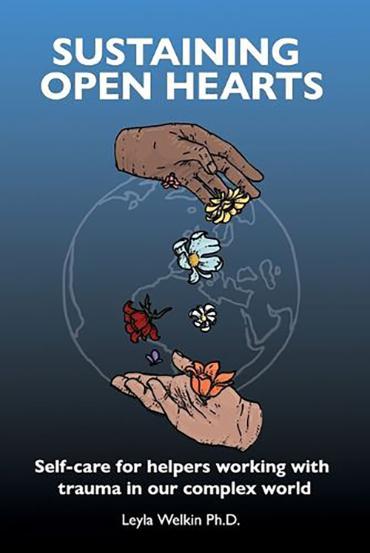
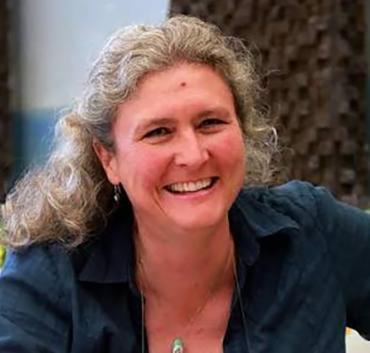
Leyla Welkin, PhD, LMHC is a psychotherapist in private practice and a teacher, consultant and supervisor with an international non-governmental organization, Pomegranate Connection. She taught at Seattle University between 2003 and 2008. Since 2009 Pomegranate Connection has conducted research, provided training, and supported cross-cultural approaches to trauma healing and sustainable helping for people working with the aftermath of violence, forced migration and disasters in the Middle East, Europe, and the United States. She is the author of Sustaining Open Hearts: Self-care for helpers working with trauma in our complex world published in 2025 and True Friend, a guide for women who have experienced sexual abuse and for people who want to support them, first published in English in 2014. She is based in the Salish Sea region of Washington State.
Training - Working with BIPOC clients and Impostor Syndrome
Saturday December 12th from 11 am -1pm for 2 CEU credits - Hybrid
Kelvin Peprah, MA, LMHC, Peprah Counseling. RSVP.
Impostor syndrome, known as the "silent killer" of confidence, often shows up differently for professionals of color, shaped not only by internal self-doubt but also by workplace cultures where lack of representation and microaggressions can lead to questions of belonging, and difficulty accepting or recognizing their own achievements. In these environments, high performance becomes a survival strategy, fueling overwork, emotional exhaustion, and burnout.
Participants will learn:
- The history of Impostor Syndrome.
- Identify racial and cultural factors that play a role in Impostor Syndrome for people of color.
- List ways to reduce and address the feelings of impostorism.
Training - Honoring Beliefs: Effective Therapy Working with Religious Clients
Dawn Meyer – Saturday April 3rd 9:00 am to noon, 3 CEU credits - Hybrid. RSVP.
- Explore the research on religious coping
- Examine the ethical issues working with clients who have different beliefs
- Learn effective tools for working with religious clients
MAP 45th Anniversary Weekend of Celebration–May 14th to 16th
These events are sponsored in part by the John Schwab (MAP Class of 1992) – (1952 – 2024) Memorial Fund. John got his master’s from the MAP program at Seattle University and earned a doctorate in Clinical Psychology at Seattle Pacific University. He created and ran a private practice in clinical psychology for more than 20 years. His family and friends developed the John Schwab Memorial Fund in his honor to help support the continuing training and education of the MAP community. John’s memory is indeed a blessing for us as we celebrate this weekend together.
Friday May 14th - 5:00 pm to 8:30 pm - ADAL 116 - Stuart T. Rolfe Community Room - Panel Discussion - The Movement of Gelassenheit
Our panelists will explore their own lived experiences with the phenomena of Gelassenheit, the Meister Eckhard and Heideggerian term for "releasement" or letting be, or the experience of something moving through us rather than from us, in their scholarship, therapeutic work, and in life overall.
Dr. Steen Halling, Dr. James Risser, Dr. Kevin Krycka, Dr. Heather Macdonald
Saturday, May 15th
MAP student and alumni day conference
Sunday, May 16th
45th MAP Anniversary Reception and Keynote Address by Anne Kubai - 3:00 pm to 7:00 pm - Student Center 160
Centering Collective Healing: Indigenous Epistemologies in Post-Atrocity Societies
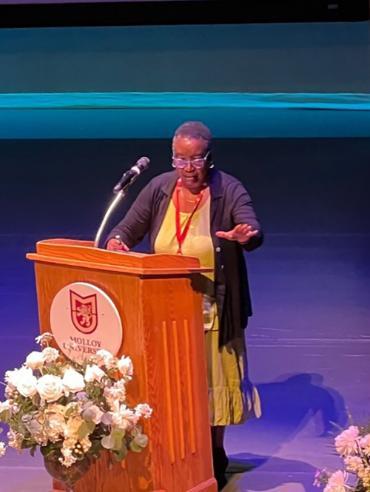 This presentation interrogates how centering indigenous philosophies and ideas—particularly through testimonies of elders and survivors—offers epistemologically distinct frameworks for addressing collective trauma in post-atrocity societies. Contrasting with approaches privileging individualistic rationality, African knowledge systems operate as fundamentally communal systems, establishing knowledge validity through collective rationality and intersubjective verification rather than isolated individual reasoning. African epistemologies institutionalize oral tradition and testimony as legitimate epistemic sources, wherein elders' authority derives from accumulated communal knowledge rather than individualized expertise. This epistemological orientation proves particularly generative for research in post-atrocity contexts, where survivor testimony functions simultaneously as historical evidence and therapeutic mechanism. The relational ontology—grounded in concepts of human interconnectedness—provides philosophical scaffolding for reconceptualizing trauma as constitutively collective rather than reductively individualistic phenomena. Drawing on ethnographic engagement with post-genocide communities, this presentation argues that integrating indigenous epistemological frameworks into trauma recovery processes creates epistemically legitimate spaces for survivor testimonies to validate collective experience and catalyze communal healing. By centering survivor and elder testimonies, these approaches situate recovery within the restoration of social bonds and collective reconciliation processes.
In Memory Of
Karen Stonehocker Lutz (1939 - 2026) - MAP Administrative Cornerstone
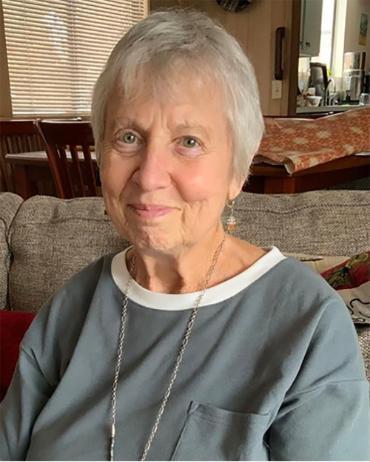 This year, we gathered to celebrate one of the beloved cornerstones of our MAP program, Karen Stonehocker Lutz. Karen was a beloved presence in the Psychology Department during the many years she worked here as our Administrative Assistant. She was appreciated by faculty, staff and students for her gracious manner and kindness as well as her effectiveness. Karen was a force for good in this world and she helped to make the department a place where everyone felt welcomed and recognized.
Words by Desmond Tutu (whom she met in 2000 when he received an Honorary Doctorate at Seattle University) that Karen carried with her and exemplified in her life:
“Do your little bit of good where you are; it’s those little bits of good put together that overwhelm the world.”
“We are made for goodness. We are made for love. We are made for friendliness. We are made for togetherness.”
Nancy Rae (nee Cloud) Schroder (1947-2026) – MAP Class of 1998
Nancy Schroder brought a light into the life of everyone who knew her. That light will live in their hearts for as long as she is remembered.
Nancy died peacefully at home after a challenging battle with metastatic colon cancer.
Nancy was beautiful, brainy and brave. She loved her family, her life, her pets and her land. She was born in Tacoma and grew up in North Seattle, attending Roosevelt High School where she met her long-time love and future husband Ray Serebrin. In 1982 Nancy and Ray left Seattle and purchased a timber frame cottage on 5 acres in the woods in North Kitsap County. Also making the move were daughter Siri and Huckleberry the cat. So began a 44-year adventure in rural living for the family, as they inherited a dog, some rabbits and a bunch of raw land and wooded acreage.
Nancy had an insatiable curiosity and drive to learn about everything and so, in her forties, she made a decision that reflected that worldview, returning to school to finish her bachelor's degree at the University of Washington. She then went on to complete a master's degree in Existential Phenomenology at Seattle University and began a career as a psychotherapist.
At the same time Nancy was highly creative. She was a trained classical pianist, and she took up drawing late in her life. Her artistry and imagination were most visible in the vast decorative and vegetable gardens that she designed and created at their rural home.
Nicholas Stephen Sciarrone (1979 to 2026) – MAP class of 2013
Nicholas lived in Seattle for over 20 years. He attended Seattle University where he received both a bachelor's degree and a master's degree in psychology. Nicholas worked as a therapist for many years with the past five years being in private practice where his dedication to his patients was unmatched. His approach to therapy rooted in empathy, understanding, and patience, which transformed lives and brought solace to those in crisis.
Mark Your Calendars for Next Year
To mark the 100th anniversary of the publication of Being and Time, the SU philosophy department is organizing a one-day symposium to be held in November of 2027 (exact date TBD). This will be a gathering of people from multiple fields and practices whose work has been in some way influenced by this book. Presentation formats will vary, from talks to panels and salons. We suspect local therapists could have a lot to share, and you do not need to be a Heidegger expert to do so. If you are interested in participating, please contact Dr. Jerome Veith. Please also share this announcement with anyone in any field who may fit the bill.
Similar News & Stories
-
/0x89:5090x3304/prod01/channel_34/media/seattle-university/college-of-arts-and-sciences/images/ChrisPerry_yck_017.JPG)
Supporting Community Mental Health and Whole-Person Care: Graduate Opportunities at Seattle University
Campus NewsSeattle University’s College of Humanities, Education and Social Sciences offers several graduate pathways to prepare students to work in community mental health. -
South Seattle Emerald: Computer Science Chair Burkhard Englert on Data Centers
Campus News, In the NewsComputer Science Chair Burkhard Englert is interviewed about the impact of data centers on local power and water supplies. -
/0x123:1195x878/prod01/channel_34/media/seattle-university/college-of-arts-and-sciences/departments-and-programs/couples-and-family-therapy-program/images/Jed-Walsh-at-Computer.jpg)
How Jed Walsh Supports Community: Couples and Family Therapy at Seattle University
Campus NewsAs a master’s student in Seattle University’s Couples and Family Therapy program, Jed Walsh learned a social justice approach to support families.
Contact Listing
/0x173:1000x1327/prod01/channel_34/media/seattle-university/directory/faculty--staff-directory/images/artsci/Claire-LeBeau.jpg)