Seattle University
  • Calendar
  • Site Index
  • Directories
  • Contact
  • Support SU
More Options
  • Report a Problem
  • Give Us Feedback
  • Advanced Search
  • Where do you need to go?
    • Admissions
    • Core Curriculum
    • Diversity Statement
    • Global Education
    • Health and Personal Wellness
    • Mission and Ministry
    • Nondiscrimination Policy
    • The SU Experience
    • Visit Campus
    • Schools and Colleges
    • Albers School of Business and Economics
    • College of Arts and Sciences
    • College of Education
    • College of Nursing
    • College of Science and Engineering
    • Matteo Ricci College
    • School of Law
    • School of Theology and Ministry
    • Departments
    • Alumni Relations
    • Athletics
    • Bookstore
    • Conference and Event Services
    • Housing and Residence Life
    • Human Resources
    • Information Technology
    • Lemieux Library
    • Marketing Communications
    • Public Safety
    • Recreational Sports
    • Registrar
    • Student Financial Services
    • Online Services
    • SUOnline
    • Email
    • Angel
    • MySU

Site Map | Contact | Directory

College of Science and Engineering
  • About the College
  • Areas of Study
  • Students
  • Project Center
  • Outreach
  • Donate Now

Physics

  • Physics Main
  • News
  • Prospective Students
  • PhysFest
  • Courses and Degrees
  • Physics Dept Learning Outcomes
  • Faculty and Staff
  • Physics Dept Research
  • Useful Links

Loading...

Contact Us

For more information about the Seattle University Department of Physics, please contact:

Lisa Berman
Administrative Assistant
bermanl@seattleu.edu 

Dr. David Boness
Chair and Professor 
dboness@seattleu.edu

Seattle University
Department of Physics
901 12th Avenue
Seattle, WA 98122

Phone: 206-296-5930
Fax: 206-296-6266

College of Science and Engineering > Physics
Loading...

Welcome to the Seattle University Department of Physics!

SeattlePikePlaceMarket

Our Physics Department graduates have been having little trouble finding interesting technical jobs or going on for further graduate study in physics, astronomy, geophysics, mechanical engineering, electrical engineering, or biomedical fields. We have graduates flying converted spy planes for NASA, working as engineers and physicists in private companies, government labs, or universities, and programming computers or managing computer networks. In recent years, we have sent SU physics major graduates to PhD programs in physics, mechanical engineering, planetary sciences, electrical engineering, and mathematics at Stanford, UC-San Diego, Ohio State, Michigan, Oregon, Vanderbilt, Penn State, Wisconsin, and Texas A&M.

Physics is the foundation science upon which all other natural sciences and most types of engineering are built. This makes physics the most diverse and applicable technical major you can have. These are just a few of the things physicists study, using experiments, observations, theory, and computer simulations: optical systems, subatomic particles, exploding stars, high-powered lasers, biological cells, magnetic materials, nuclear fusion power, protein folding, planets, tsunamis, materials for computing, teleporting photons, earthquakes, black holes, and endless more topics.

In other words, physicists work to deeply understand the smallest things, the biggest things, the oldest things, the newest things, and everything in between. Physicists either invented, or made possible, such major inventions as electric power; electric motors; radio, TV, and cellular phone communication; superconductors, transistors, microprocessors, lasers, and spacecraft.

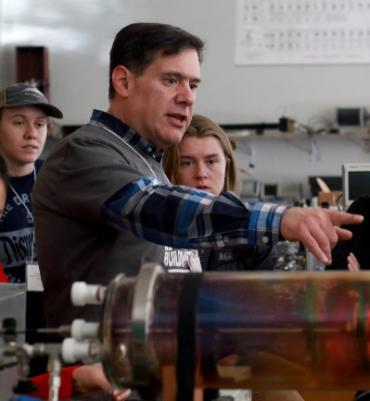
The Seattle University Department of Physics offers small classes and personalized attention to the education of undergraduates in physics. The active research of our faculty contributes to knowledge, keeps classes lively, and provides opportunities for motivated students to participate in on-going research projects. Why go to a huge university with gigantic, impersonal classes taught by graduate students? At Seattle University, you are taught by caring, dedicated, and highly capable professorsSigmaPiSigmaInduction2004.  

Physics is universally recognized as a subject that teaches thoughtful problem-solving skills, and people trained in physics are typically seen as intelligent and adaptable. These traits are essential for a world of rapidly changing computation, communication, and developing technology, from nanotechnology and bioinformatics, to the next-generation internet, quantum cryptography, and quantum computing.

Consider these questions:

  • Why must advances in optical and wireless networking and communications require people who understand optical physics?
  • Is time travel possible?
  • What can experiments and computations involving the physics of fluids tell us about Earth and planetary atmospheres?
  • How is condensed matter physics research leading a revolution in nanotechnology?
  • Why don't recent physics experiments measuring detection of light pulses before they are emitted violate Einstein's relativity principle?
  • Is there a physics-based reason to believe that there exist multiple universes?
  • Why do the dimples on golf balls make them fly farther?
  • How small can the circuitry on a microprocessor get?
  • Why do things have mass and feel the pull of gravity?

SnowLakeInCascadesThere is no end to questions such as these that we and other physicists try to answer. That's why it's fun! If you are a student of intellectual curiosity, consider joining us as a physics major. Physics is also a very practical major for students who want jobs in the computer and high-technology industries; the strong record of our physics major graduates at obtaining such jobs is proof. Also, physics majors are highly sought after by admission committees in graduate programs in engineering and at medical schools, law schools, or business schools.

Upcoming Events


CONTACT | PUBLIC SAFETY | CAREERS | RSS

Copyright 2008 - College of Science and Engineering, Seattle University.

Seattle University

College of
Science and Engineering

901 12th Ave, P.O. Box 222000
Seattle WA 98122
206.296.5500
sedean@seattleu.edu